Thank you! Your submission has been received!
Oops! Something went wrong while submitting the form.
MENU


Awelcome email is essential for any online business, and we’re here to help you with effective welcome email examples.
A welcome email is sent immediately after initial sign-up to thank a new subscriber, make an introduction, provide a call to action, and give the legally required mailing address. Unlike other email marketing communications, a welcome email is unique because the subscriber has chosen to engage with you, and it’s your opportunity to build trust. Think of it like they’ve knocked on the door of your online business; it’s up to you to open the door and make them feel welcomed. You can do this in many ways: special offers, such as a discount code or free trial, social proof or testimonials, etc. As you’ll see in the examples below, it’s also important to include all your contact information, so you can offer a clear channel of communication and high quality customer service.
A welcome email has an 86% higher than normal open rate with a 196% click-through rate (or engagement rate). This increases the chance of conversion rates, once a subscriber lands on your website. In other words, you’re not going to get this level of attention with this much ease ever again. Time spent here now will lead you to boost new sign-ups and grow your email list. To help you cash in on this opportunity, we’re going to show you six examples of our favorite welcome email templates. We’ll break down what the writers do and show you exactly how you can replicate their process to develop an engaging welcome email in your voice.
To start, view our welcome email worksheet below, and follow along.
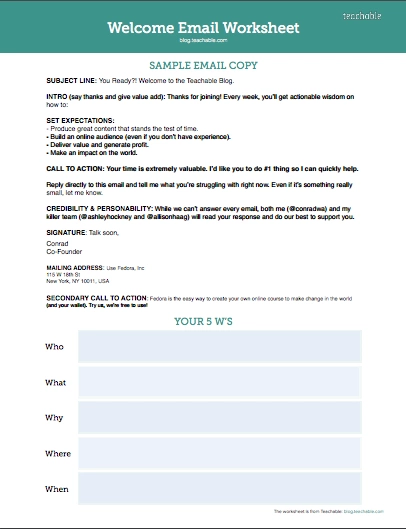
First, start by thinking about how you—or better yet your ideal client—would like to be welcomed or greeted. With this in mind, you’ll want to creatively tailor your email copy to make it personal to your people.
You’ll also want to consider the most important information for them to know about your brand or business, to help orient them to your products or services. You might also consider a special gift to thank them for subscribing to your email list.
Another approach is to work backward. Consider a call to action—what action you’d like your subscriber to take upon reading your email—and build content that leads up to it.
To help inspire you, we’ve rounded up some of our favorite tried-and-true welcome emails. In each example below, we’ll analyze the sender’s strategies using the five Ws: who, what, where, when, why.
Additionally, you can also get ideas and inspiration for email design by comparing their different approaches. Now, let’s dig into new insights and what exactly you should do when writing your own email, with these top welcome email examples.
Marie’s personality is one of her major strengths. It’s a competitive advantage that keeps me opening her emails over other newsletters and has grown her audience to millions. Marie’s writing style is bubbly, feminine, and rah-rah. She proves that you can be entertaining while being informative.

Who: This is Marie Forleo, a self-titled “part business strategist, part marketing maven and part spiritual ass-kicker with a side of hip-hop swagger.” Right off the bat, Marie grabs your attention with her personality. From the subject line “You’re Awesome” to the name of her site “marieforleolovesyou.com,” readers get a sense of what makes Marie, Marie.
What: In the second paragraph, Marie explicitly says what she does: give actionable wisdom. But wait, there’s more: She also implicitly shows you more of her personality.
Why: Why should readers listen to Marie? She clearly states that she gives “actionable advice” and “entertaining videos,” two big claims that she backs up with strong linked content.
Where: The very first thing Marie does is remind you that YOU signed up for her blog. From there, she seamlessly goes into already-created assets. Not only is she repurposing strong content, but she’s driving people to her other online properties, boosting UVPM (unique visitors per month) and building a relationship. She also includes a call-to-action to follow her on social.
When: Marie quickly sets audience expectations by giving the day of her weekly newsletter and describing the content involved. She’s direct, efficient, and articulate.
After digging into the best articles with welcome email examples, we were surprised that none of them mentioned the email signature.
Your signature adds credibility to your business. Give your title, your Twitter handle, and website. Including your Twitter handle has the dual purpose of helping people reach you while spurring organic, no-cost promotion.
Want to know why so many people take and selfies? Because as people, we like and connect with faces. According to Buffer and face-tracking studies by Mashable, the profile picture or avatar is the first place the eye is drawn to on Facebook and other social media profiles. Use that and include a photo of yourself.
Alex’s is one of the few welcome email examples where his Google photo came through, which adds to the overall strength of this email by making him more personable.

Who: Alex is the CEO of Groove, a customer service software for teams. Alex comes off as sincere and friendly in his email, using words like “appreciate,” “help,” and “I’ll do my best.”
He even includes his email address, something most founders aren’t willing to make obvious, and offers to meet with anyone who asks. That’s a huge way to be remembered and show off his competitive advantage: providing great support.
What: Alex wins by including branding and his logo at the top of his email. I’ll remember that. However, Alex tells me he’s going to send me his best content, but I forgot what he writes about. Awkward. Make sure you remind people what you specifically do in your welcome email.
Why: Alex drives empathy for his brand by writing as a CEO. It makes people feel special. His willingness to give feedback furthers this notion.
Where: Alex lets you know that YOU signed up for Groove, but he doesn’t link to his website. I’d like to see that. However, he drives visitors to his site through a strong call-to-action: Try Groove for free for 30 days.
When: Alex sets expectations by saying he’ll send content over “the next few days.” He also nurtures new sign-ups who are curious about getting similarly great content.
This email kills through its clear call-to-action: Do one thing and tell me what you’re struggling with right now. They make a strong first impression with an engaging call-to-action.
We know that of the last 3,000 of emails sent, GrowHack has gotten a 10% response rate on this simple email. This has allowed GrowHack to respond and let relationships blossom.
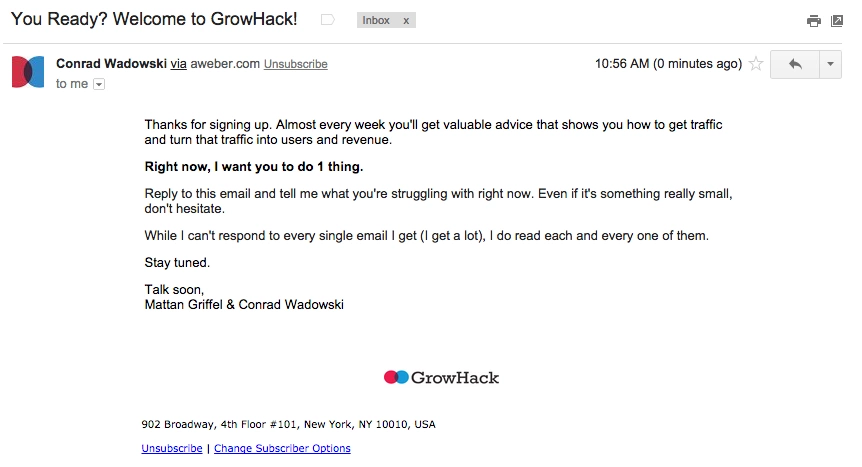
Who: GrowHack tells you who they are better than most. There’s an eye-catching logo at the top left and bottom of the email, and the sender is a real human being. Tip: The image pulled because it’s the profile picture for GrowHack on Google+.
What: We love that GrowHack doesn’t make us work to figure out what they do. They give “valuable advice that show you how to get traffic…and revenue.”
Why: GrowHack makes you care by using carefully chosen words: “valuable,” “revenue,” “traffic,” and “show you how.” These words add value to the email and entice an audience. They also express the competitive advantage: GrowHack will help you make money.
Where: GrowHack doesn’t link to their website anywhere. However, it keeps us focused on the call-to-action and gets us to engage and respond.
When: GrowHack is very upfront about their email coming “about once a week.” This sets expectations that we’re not going to get too many emails from them in an already crowded inbox. Adopting this strategy can help motivate you if you’re not sure you can meet a once-a-week deadline.
We know this isn’t example a welcome email example as Neil doesn’t have a welcome email. Instead, he sends you the last post he created. We don’t suggest this. But in this case, it works because Neil is well known and gives away so much content in his regular newsletter.
To that point, the email includes a ton of free content without using the word “free” in the subject line. This is important because according to email studies from Mailchimp:
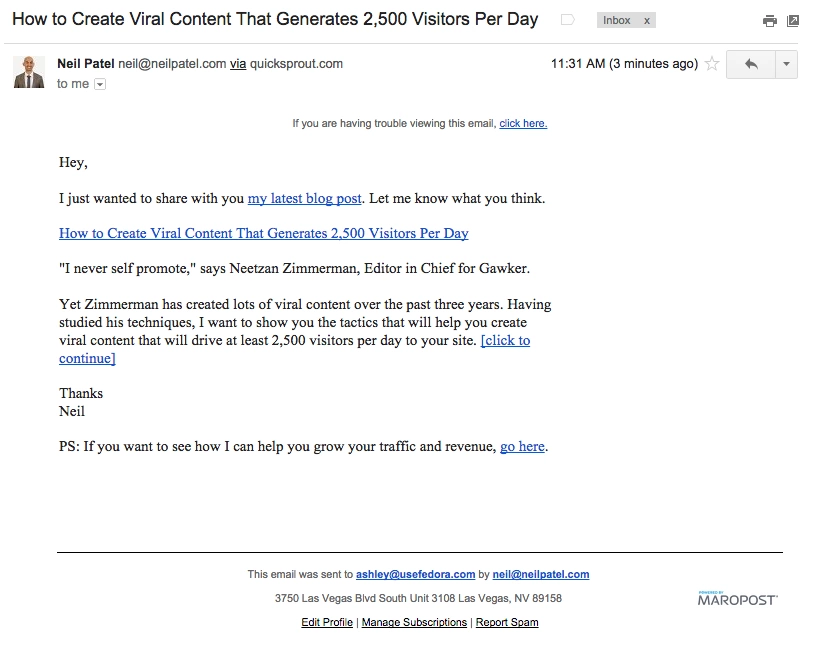
Who: We may know Neil Patel as the co founder of KISSmetrics and QuickSprout, but notice that his sender line feeds back to QuickSprout. This is a quick technique you can use to drive traffic to one of your many online properties if you have multiple.
Neil is also unpretentious about his big titles. He’s straightforward, brief, and down-to-earth. However, this only works if you’ve already established credibility. We signed up for his emails by going to NeilPatel.com making those titles unnecessary.
What: Neil is going to help us increase visitors. It’s in the subject line, the text, and the title of the posts he includes. Even in a short email, it’s good to repeat information in new forms as a way to drive home your point without being redundant.
Why: Neil is giving us one huge reason why we should care about his content, and it’s because he’s giving away actionable content for free. There’s a saying in marketing, you’ve got to give, give, give, and then ask. Neil is the master at this.
In his beautifully brief email, Neil gives away content in four links and promises to “show us how.” Use this phrase: It’s one thing to give advice, it’s another to give concrete steps as to how.
Neil also includes a strong call-to-action in the very first line of his email: Let me know what you think. This is an effective strategy for engaging your audience.
Where: Neil gives numerous places to find his other work. Like Marie Forleo, he makes existing content continue to work for him, saving time and increasing page views on existing content.
Fair warning, unless you’re established like Neil, don’t use “go here” as the text for a link. It’s not an effective cliffhanger. If people don’t know you, they don’t trust you and they don’t want to follow links to find out what your content is. Tell people what they’re getting before they navigate away from your email.
When: Neil doesn’t tell us how often he’ll be sending content. To be fair, he’s “sharing a journey to 100K monthly visitors” and might not know when he’ll push new content and doesn’t want to overpromise.
We can’t get over this subject line. It’s four words, introduces Noah, and drives to strong online property. Noah makes those four words do work. Added bonus: Because they’re the subject line, they have a much larger audience than any other text.
Think about it: Your subject line is seen by every new subscriber, even those who quickly unsubscribe, and read by your entire email list, even if some of those people don’t open your email.
Not to mention, the average person gets 121 emails a day according to a study by Radicati. This is on top of texts, Instagram tags, tweets, and pings on Slack. Avoid becoming grey mail (unwanted newsletters or notifications) by making your text and subject lines entertaining.
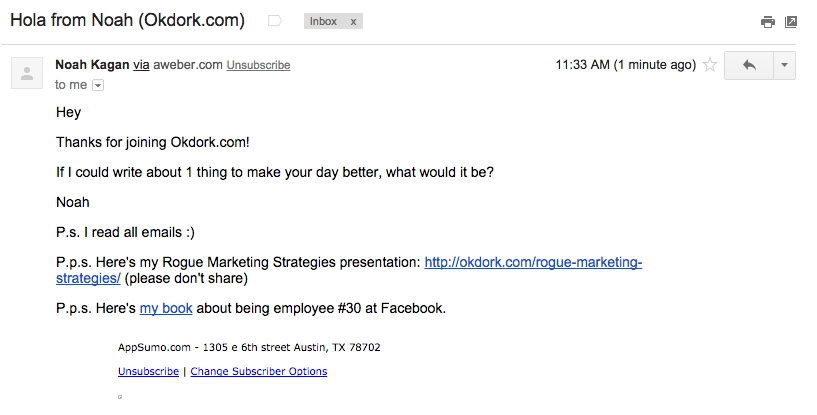
Who: Noah Kagan. Who is he? He’s a self deprecating goofy dude with great content at OkDork.com—and all of this is said in the subject line. Impressive.
We’re also learning about who Noah is from the style and brevity of his content. In case you thought about not taking him seriously, he reminds people he was employee #30 at Facebook in the P.S.
What: Noah is telling us two things that he does: 1. rogue marketing and 2. help you. He could be a bit clearer in my opinion, but in true Noah style, whatever.
Why: Noah gives a crystal clear call-to-action is the most prominent part of his email, and it’s clearly meant to help him help you.
He also notes that he “reads all emails.” Like Alex at Groove, this is a super memorable tactic. Noah adds in another element: personality. His brevity and smilies are part of that, and reading his email feels like a quick high-five.
Where: Noah includes the email address for his site in the subject line. He’s clearly driving people there and promising to include content you care about with the call-to-action—not so dorky after all.
When: Noah doesn’t mention when he’ll send the next email, but as discussed before, that’s OK.
It might seem out of place to talk about Thrillist after discussing so many content marketers, but we wanted to emphasize what you can do with visuals—if you have a visually appealing product.
“In an online store, customers think that the quality of a product’s image is more important than product-specific information (63%), a long description (54%), and ratings and reviews (53%),” according to Jeff Bullas.
While you need to be careful that Google spam filter won’t catch your VIP welcome email, visuals can convey your brand, purpose, content, and personality without a single word.

Who: Thrillist. From the subject line, to the massive logo, to the use of “Thrillist” nine times in one email, we’re not going to forget. Notice how they did this without being redundant. Include branding in sender lines, boiler plages, website URLs, and social handles.
Careful with including too many calls-to-actions, especially with social. You don’t want to drive your audience to too many online properties at once.
Thrillist has also done a fantastic job of branding itself as the one stop shop for food, drink, and travel. Which pretty much slams you in the face with their images and headings.
What: The photos show us that Thrillist does food, drink, and travel. (Plus, we want that burger.)
Why: What’s the best burger in America? What don’t we know about drinks? We want to know! When you caption a photo, you’re giving yourself another opportunity to tell you audience why they should care and including clickbait messaging.
Also consider the size of your image. Nothing is worse than a photo that isn’t visible on mobile or takes ages to load, or an email being so heavy it clogs an inbox.
Where: Mentioning “Thrillist” nine times makes me remember where we signed up. It also leads me back to all of their properties. They’re all included. It’s the carpet bomb of linking.
When: Thrillist sets their expectations in the banner. This works well with a visual-focused email.
It’s one thing to know, and another to actually create your own. Did you notice that every one of these example emails put their value add in the second sentence? Did you learn anything from these welcome email examples? How much time have you spent optimizing this important first contact with your new subscribers?
How you write your welcome email is up to you. But these top welcome email examples contain some of the most tried and true tactics we’ve seen. Implement them and see the results.

Iwant to take 3 seconds of your time to ask one thing: what defines you?
Is it your career, your family, your hobbies or passions? And if you have an answer that comes to your head immediately, are you sharing it?
This is a question Carrie-Anne Moss would undoubtedly have an answer to.
You may know Carrie-Anne as Jeri from Jessica Jones or Trinity from The Matrix Trilogy, but as a mother of three, wife and woman she felt a burning passion to share what she has learned. She since started a blog – Annapurna Living – and has built not only one, but multiple online courses.
Sitting down in one of the most heartwarming and authentic interviews of my life, Carrie-Anne tells how she shares her passion and knowledge through her online courses and how and why you can too.
It’s a Teachable motto that we all have a course inside of us. We all have unique experiences, skills and passions that we not only can – but should – share with the world.
For Angela Fehr, a talented artist, she’s brought together a community to learn how to watercolor paint. For Nat Eliason and Justin Mares, it’s their skills with technical marketing that help people advance their careers. For Jon Haws, it’s alleviating the pain of nursing school and making it easy for student to pass their licensing exam.
By launching their course and sharing their knowledge all of these people were, yes, able to make money to support their families BUT ALSO help help a huge number of students in a way that isn’t possible with traditional teaching.
Courses allow you to “scale yourself”, to share your knowledge with more people than ever before. This is inspiring.
“I had this yearning…in my heart that I wanted to create this platform, where I could share some of the things that I was learning around motherhood, around well-being, around consciousness, around meditation, yoga, in the ground. Simple ideas of thinking that I wanted to share,” says Carrie-Anne about why she started to blog and create.

If you’re struggling with creativity, check out this post for 10 Steps to Bring Creativity Into Your Life by Carrie-Anne.
“Well, I think the trickiest thing for someone like me and there’s a lot of people like me that has something that they’re offering. It’s like; how do you offer it? I couldn’t find the platform. Originally, these courses that I do, I was doing them in 10-day email courses. I enjoyed that, it was great. But I really couldn’t figure out like how can I create a container. What container can hold this for me?” Carrie-Anne said.
It’s a problem. When we want to share something, we all want to find the best way to put our voice into the world and be heard, but with an overload of “content” and streams of social media this can be incredibly hard, not to mention, you want a platform that matches your vision.
That’s the beauty behind courses – they’re a content medium that people both value and engage with. The average instructor on Teachable make $5K on their online course.
By contrast, 81% of “bloggers” never make even $100. An author makes only 8-15 cents on every dollar made on their book. The “average” YouTuber with 5K views per month makes just $15/month.
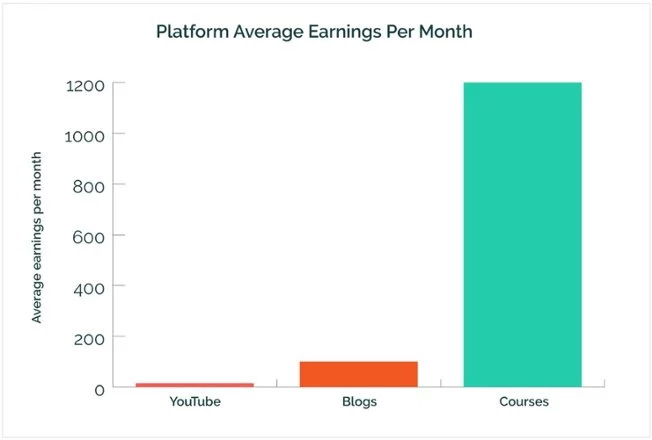
And while money is a big incentivator for some creators, others simply want to share their voice and find a a platform that helps them bring their vision to life.
As Carrie-Anne says, “[Mariah Coz] recommended Teachable and I’m just thrilled. It’s exactly what I imagined when I would think about how I wanted to [share my idea].”
Our dev team is delighted 🙂
However, one of the best things about an online course is how often you interact with your audience. This isn’t like a blog where you write a post, put it into the world and hope to get a few comments. You’re sharing videos, getting and giving feedback and your audience will start to help each other. It’s much more of a two-way interactive street between you and your students.
In our interview, Carrie-Anne talked about how she wanted to create and cultivate a community – but she was having a hard time doing that with an email course. She was able to do it with her Teachable school.
Maybe this makes me a nerd, but the first time I got into the Teachable platform, it was fun. Yes, fun. Like someone handed me a new box of digital crayons with which I could create anything – everything.
I’ve always been a sucker for new projects, exploring and seeing what I could create. Challenging myself to write, design and customize to make new projects more beautiful than the last. I’m pretty sure this is how some people feel when they solve a sudoku, but for a creative, a new creation platform has the same feeling.
Which is why it was thrilling to hear Carrie-Anne say the same, “It’s just been so fulfilling for me to actually have a place that I get to bring myself to in a way that isn’t controlled by say a movie or a television show, or a PR world. Like it’s all me. I found that to be pretty exciting that we live in a time right now, where we can create what we want to share.”
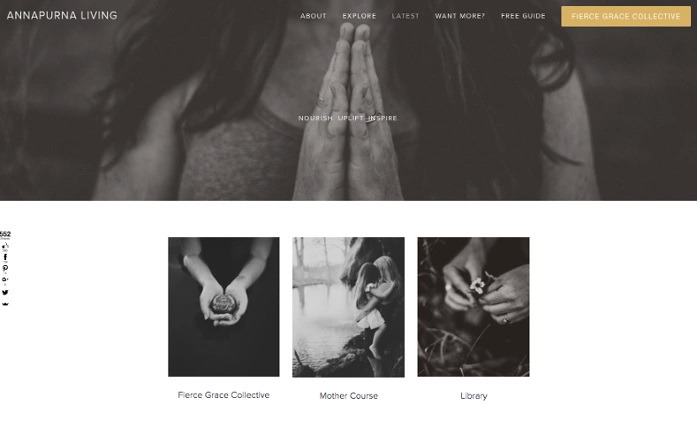
Annapurna Living: Carrie-Anne’s Blog
And that’s true. Creating online gives us a creative outlet not always found at our day jobs. Your persona can be anyone and the more personalized the better. You’re teach as an individual to individuals. You’re not a company or a brand and our best course creators are the ones who let their voices shine through.
So when you’re thinking of starting to turn your passion into a course, you’ve got to pinpoint your course topic.
You’re a foodie, but a course on food is too broad – you’ve got to hone in on the specifics. The best way to find your course idea is
But then we’ve got to take it one step farther. Even if we’re passionate about dance and have taught it before, what aspect of dance are people struggling with that they would PAY to learn about?
Rather than just guessing, you can look online and research your potential topics to help you find your idea and make sure people are interested in it.
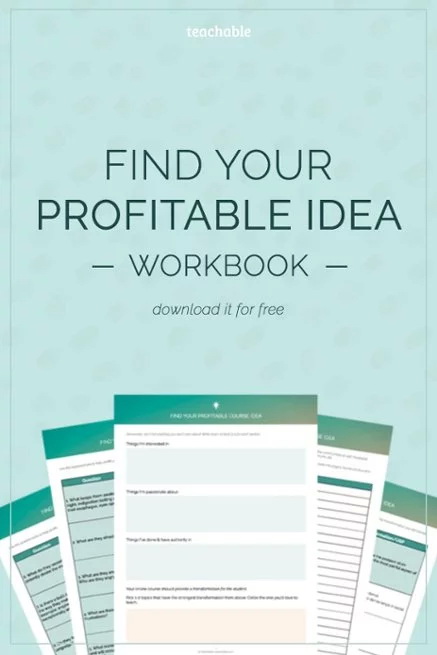
We’ve actually created a small workbook just for this process. Download our Profitable Course Idea Worksheets to
Carrie-Anne knew exactly what she wanted to teach – she had a passion and has bravely shared it.
“I want to share that with women…a simple three-minute meditation, that has the power to transform their entire lives. Because when you get out of the thinking mind and the manic craziness of your mind, you make good choices.
You know what to do. You know what relationships to have. What jobs to take, what to eat….you become more prosperous, because you understand what’s important in your life. As you can tell I’m pretty passionate about what I’m doing.”
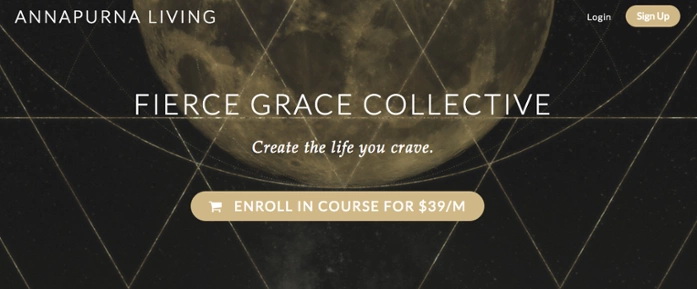
Click here to enroll in the Fierce Grace Collective course.
What I loved about speaking with Carrie-Anne is that she was confident that she stumbled on something could change people’s lives and felt passionate and a sense of obligation to share it.
And she has. Through both her courses and blog posts, like this one which is a simple and sincere meditation practice.
I’ve personally spoken with hundreds of people who have a course idea they’re passionate about, they spend hundreds of hours a week learning more about the topic and yet, when I suggest they make a course they say 3 things: 1. I’m not an expert. 2. I don’t know how to create a course 3. I don’t have the time.
I understand these fears, but you won’t get sympathy from me for hiding your light from the world. As we said at the start of this post, we all have something we’re able to teach and if our knowledge can help people’s lives we have an obligation to share it.
Hearing Carrie-Anne speak about her idea she said, “But it’s really giving women the tools to uplift and inspire their lives without having to buy anything. Without buying into this cultural advertising of that, you need to buy XYZ in order to be beautiful, valuable. All of these things. It’s like women have been so distracted from their true grace and their true beauty by cosmetic companies, by dieting, by tabloids, by reality television.
All of those things have distorted what it means to be a woman in such a major way. For me I’m at this place where I’m like enough is enough. I’m not buying into any of that. I don’t want my daughter to have to buy into it. I don’t want anyone to have to buy into it. We are enough. We are so creative and so beautiful and graceful and amazing. When we stand in our center and we aren’t looking outside of ourselves to give ourselves value.”
There’s passion in those words and a desire to change something, which is exactly what you can do teaching online.
So the first thing we hear when someone wants to teach online and the biggest mental hurdle is the Expert Myth – or the idea that you have to be an “expert” to teach online.
“I want to empower other women. Listen, I need it to. It’s not like I’m super confident all the time. I’m teaching what I need. It’s like in Kundalini Yoga, it’s like if you want to master something. Teach it. I’m only teaching what I need. I’m not an expert. I don’t know it all. We have these circles where I talk, where we have this conversation, people ride in,” says Carrie-Anne.
And that’s exactly it.
The dictionary definition of an expert is:
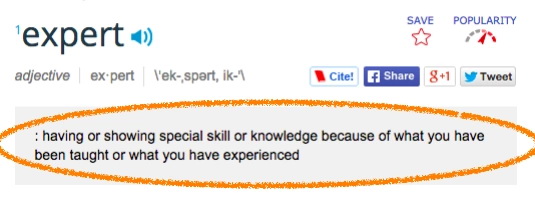
A person just one step ahead of you. In fact, at Teachable, we think the best instructors are sometimes the people who have just learned a topic – not the masters.
Think about it, when you needed help in Calculus 123 in college, who was better to learn from? Your friend who got in A in it last semester or the professor. More often than not experts forget the issues beginners struggle with and alienate them with theory and advanced concepts.
This is often reflected in how people price their course where they constantly undervalue and underprice it. Don’t do that!
Carrie-Anne talked about this, “There’s energy in money, there is an energy. I think it’s very important to have that exchange happen and I think you’re totally right.
You have to know your value and put it out there in a way that you’re content with, and that feels good to you. So yeah, I totally agree and I have a generous inclination. I really would love to give it away to everybody, but I know that’s not the right thing. Whenever I’ve given it away, people don’t do it.”
I know it’s hard to do, but think about owning your worth and what happens to your course if you don’t price based on it’s value.
You don’t have to know everything on your topic to teach it.
“I’m not answering questions. I’m having a conversation. I don’t have the answers, but you have the answers for you. I have the answers for me,” Carrie-Anne says.
There’s also a technical obstacle to sharing your passion online and that’s the fear that you don’t know what you’re doing or how to do it.
A course does NOT need to be fancy. It doesn’t need professional videographers, microphones, a script writer or designer.
“I’m literally creating this content at my kitchen’s table, on my bedroom floor making videos. I don’t have a production office. I don’t have staff… it’s a labor of love, it’s a lot of work and I love it. But I wasn’t ready until I got to Teachable,” Carrie- Anne says.
The biggest thing to remember is that done is better than perfect. Between the Teachable blog, our community of creators in The Teachable Tribe and our live workshops – all the resources you need are free at at your fingertips.
{{coursecurriculum-component="/blog-shortcodes/blog-popup"}}
When I’m working with our potential course creators, they are saying, “I just can’t that first step. I have been pushing that off. I like signed up and here I am many days later and haven’t done it.” So I asked Carrie-Anne, what would you tell those people who are passionate about something, but haven’t taken that first step?
There is a way through every block. There is another saying that says, “Start and the pressure will come off of you.” When you feel the pressure start and it will come off. I think a lot of us get stuck in that feeling of like it’s too much, it’s too much. But yet if you just do that first step, you end up feeling like this release of the pressure. It’s in the resistance that all the pressure comes.
So I say start, have a very manageable kind of steps that you can actually take to make what you want happen. Because sitting around and talking about it is valuable, because you’re cultivating the idea. You’re finding it. But you have to do it. You have to put it into action. It has to be important to you. If there is fear that’s getting in the way, this is the thing I’m kind of exploring right now in my courses. Because I created my courses every month, has a different theme. It’s like that fear that gets us.
One of the best ways to take the first step is to set deadlines. Maybe it’s 1 module per week. Maybe is an outline one week and all the video content in two weekends. Whatever it is, don’t let fear hold you back.
“…ultimately the biggest fear lies within us. You’ve got to confront that. Just got to come, move through it. You got to do it. You just have to do it. If what you’re doing is truly something that it’s been so true to you, you got to express it. You have to do it. It’s like your gift and not doing it is actually just not okay. It’s so simple,” Carrie-Anne said.
While we are all afraid to put ourselves out there, or as Pat Flynn of Smart Passive Income says,“ A lot of people have ideas, but they don’t want to execute because they’re not sure whether or not that thing that they are going to be working on is actually worth that time and effort.
And those what-ifs, which are initially ‘What if this works’, ‘What if this is the one’, those end up turning into ‘What if I fail’, ‘What if I let my family down’ and ‘What if it was all for nothing.’ And they don’t do anything – they are much more comfortable being complacent with where they are than potentially failing.”
Everyone feels like they’re putting their reputation on the line, but for an actress like Carrie-Anne the stakes are undoubtedly higher, but that didn’t for a second stop her.
“I’m an actress. People see me in a certain way. I’m very private. It was like, literally, that moment when you publish your website or whatever…I was like, “I don’t think I can do it. I can’t do it. I’m too afraid.” [My friend] was like, “Well, what are you afraid of?” I said, “What people will think of me. People will judge me and think, ‘Who does she think she is?’ All of the voices.”
She said to me, “Where are you right now?” I said, “I’m in my kitchen.” She goes, “Imagine the people you imagine would make fun of you sitting at your kitchen table. See them.” I said, “Okay. I saw a couple of people that I thought making fun of me.” And she goes, “Do you really care what they think of you?” I was like, “No.” Who cares? Who cares?
People are rooting for you, people are rooting after you. And that’s what you have to believe.”
And it’s true. When I interviewed Jon Haws of NRSNG he described this same fear – a fear so lingering that he compiled a list of compliments from students so when the “bad ones came” he’d have something to lean on, but the complaints never came and Jon has continue to build his course into a school into a business.
“I didn’t know that I would eventually be making videos with my laptop, no lighting, no hair and makeup, no editing, just like display, just me,” Carrie-Anne said. “I would have never in a million years would have imagined that it would go down like that. That I could feel that comfortable creating what I’m creating. But at first, the blog felt a little arm’s length. I think the information was still the writing was all there and all of that. But slowly it became, “Okay. Am I really willing to put myself out there and to share authentically and from a truth?”
What do you think? Are you inspired? I know I was. What kind words do you have for future course creators?

In this article, Jessica Sprague tells us why a gorgeous homepage is important and how she designed hers to earn credibility from 80K online students. One of the most frequently asked questions in our community is, “How do I get Jessica Sprague’s homepage?”
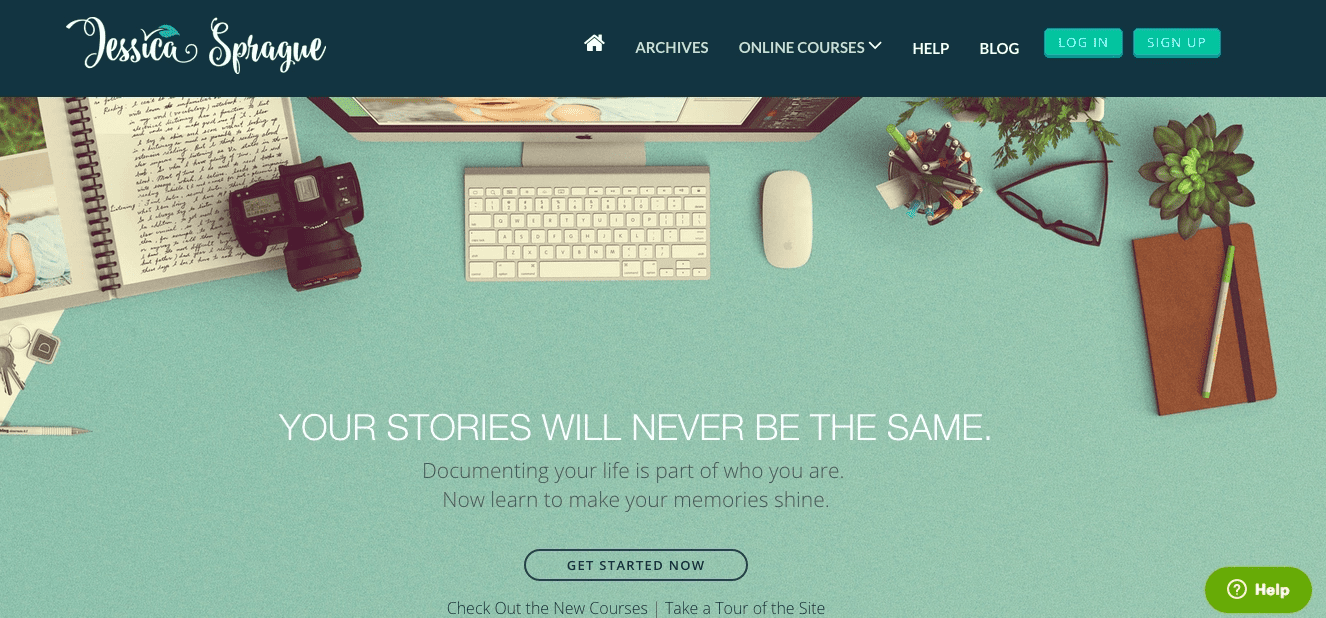
To be fair, Jessica is a master of her trade. For someone who fell into scrapbooking, she’s seen considerable success teaching digital tricks to crafters. In 2007, she launched a course called “Up & Running with Photoshop” that crashed her server. She now teaches through Teachable with over 80K students enrolled in her online course that quickly made over 20K in 4 months.
We asked Jessica if she’d join us for a joint-webinar and teach people how she set up and customized her online course. Specifically that gorgeous homepage. We’re not sure if Jessica knew what she was getting into, because after she said yes, we had over 600 people register.
Jessica’s designs are way more than just pretty. That sassy succulent does more than look fresh. It adds to the perceived value of Jessica’s information drawing in students and convincing them to buy her course.
“You know how they say image is everything, I hate that, and don’t think it’s true, EXCEPT for web design, in which, image actually is everything. What I mean is that in order to put across that credibility that we’re looking for, in order to invite people to trust you as their teacher, you have to be able to show them beautiful things. That is the toughest part, but I’m going to help you along the way.” – Jessica Sprague
Put simply, good design increases site credibility (and we all know that affects profits!).
The Stanford Credibility Project ran a study with more than 2,500 participants, “Nearly half of all consumers (or 46.1%) in the study assessed the credibility of sites based in part on the appeal of the overall visual design of a site, including layout, typography, font size and color schemes. (…) Beautiful graphic design will not salvage a poorly functioning Web site. Yet, the study shows a clear link between solid design and site credibility.”
Yoast nicely summarizes a technical study proving that people perceive a visually appealing website as usable due to the halo effect (you know, that one you learned in Psych 101 where beautiful people are presumed to be nicer, smarter, better whether or not they actually are). As in people, so in websites.
Conversionxl.com makes two gut-wrenching points. First, it only takes .05 seconds for someone to judge your website. Secondly, if they disapprove, they’ll leave immediately and continue to distrust you and your product in the future. It’s like meeting your dream date while wearing crocs. Yikes!
Hard Fact: You’ve done a lot of work to get people to your website, but if it’s poorly designed, it’s wasted effort.
In summary, good website design is pretty freaking high-leverage and important, and unlike my sprinkle doughnut, I’m more than happy to share.

{{homepageguide-component="/blog-shortcodes/blog-popup"}}
You’ve probably noticed that Jessica works in a field that values appearance, but web design is equally important if you’re selling music, medical care or another type of online course.
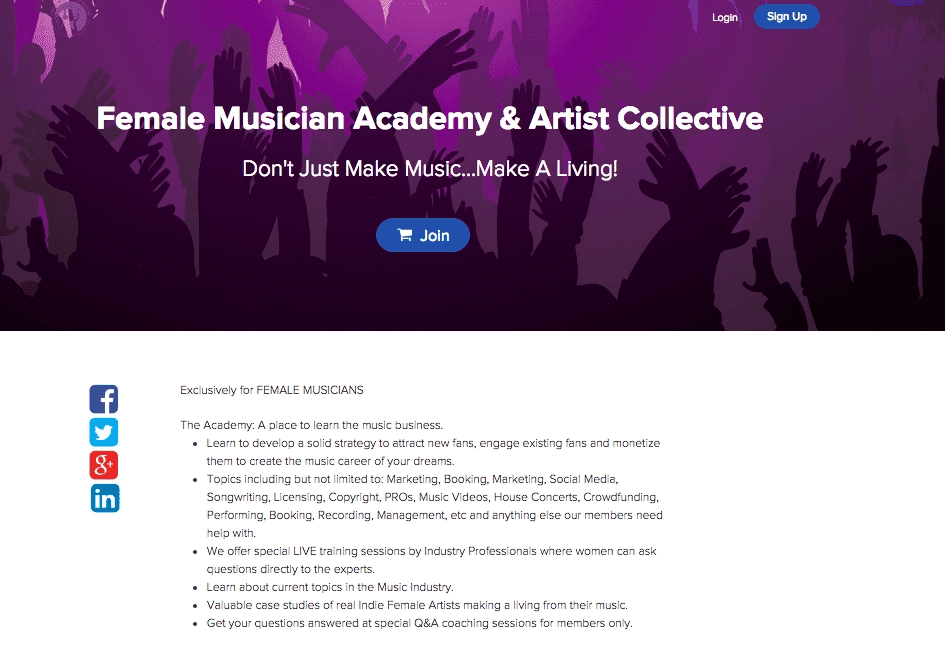
Looking at our own original data, Bree Noble, a Teachable instructor who sold her course Female Musician Academy at $290, was able to presell her course because of its stunning design.
“I was able to pre-sell my online course (Female Musician Academy) to 15 people at $290 ($4,350) without having any content in the school yet. In fact, my new students told me that my Teachable school was so beautiful that they could tell the course was going to be amazing.”
Another instructor, Jon Haws, who made $16,000 launching his course NURSING.com discusses why he values design:
“I’m trying to get everything as clean and crisp as possible and the logos and designs are still changing. With nursing specifically and with YouTube and the way that it is these days. You see that anyone can throw content out. Watching people make videos, well, it’s frustrating because they’re not always giving accurate content. But they’re getting out there and getting in front of people. My goal is to make the audio clean, video clean, logos clean, everything clean, and of course have accurate content, to be more trustworthy.”
You know email and you know online courses. But do you know email courses? The concept seems simple enough—a shorter version of your course that is delivered via email—but the impact of an email course when done correctly is far greater than you may think.
We’ll walk you through what an email course is, why it’s important, and share how you can create your own to build an email list full of people who are primed to buy your course.
Brennan Dunn of Double Your Freelancing says, “An email course is just an autoresponder, which is a series of emails that are sent out over a period of time.” And that’s true. But an email course is more than that. It also teaches your audience something real, something necessary, and something related to your course by delivering lessons over a series of automatically generated emails.
See it in action from creators Nat Eliason and Justin Mares of Programming for Marketers, who sent emails daily over the course of a week to deliver their content.
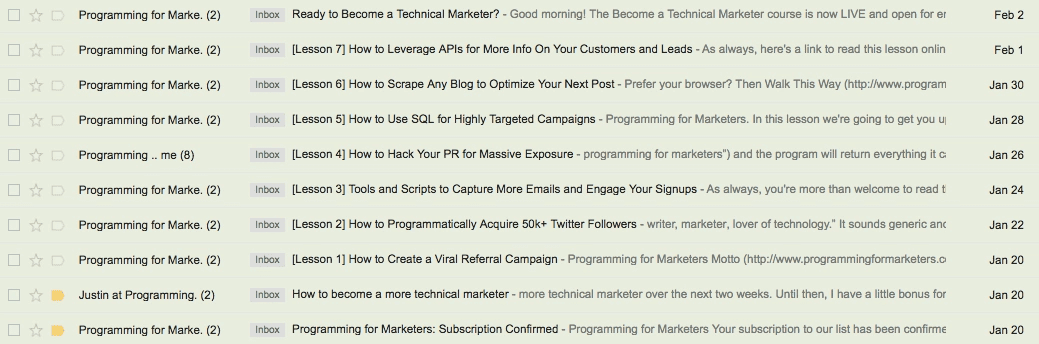
Each one of those emails contains a mini lesson and at the end of the series, subscribers were given an invitation to join the full course Programming for Marketers.
So, what exactly can email courses do for your business. Well, quite a lot actually.
Email courses can:
You’ve heard us say it before, but your email list is the backbone of your business. You launch your course and make money by emailing your list about your course. The larger your list, the larger the number of potential buyers.
Giving away a free email course is exactly the kind of lead magnet (aka an opt in or freebie) that attracts new subscribers, who are also the right subscribers.
But, why are these the right people? In short, the audience is qualified. They’re people who want a course, want to learn, and want to learn what you’re teaching. Naturally, you’ll want to base your email course on a topic related to your full course, but more on that later.
Because you’re growing your list of the right kind of people quickly, we often refer to an email course as the perfect lead magnet.
Take a peek at our checklist for the perfect lead magnet.
If you’ve listened to one of our webinars, you’ll know that Teachable often compares selling your course online to buying veggies from a farmers market. Except that you’re not at a farmers market. So you’ve got to give people a way to see people at your stand, taste test, and trust you before they buy your product.
And, an email course does all of these things. Your email course is a hearty taste test. It’s not enough to be a full meal, but enough to excite. When you create your course, you need to give away valuable content—some of your best—so people know exactly what they’re getting from you.
Your email course also should introduces you as an authority students want to learn from. Your email course exemplifies your teaching style and showcases why people may want to choose you over another teacher. It also highlights your authority on the topic, your wealth of knowledge, and what you have to offer.
Remember: You don’t have to be an expert on every aspect of your topic, as long as you can prove you know and can teach the subject at hand.
As students work through your email course, they’ll become more and more aware of your course subject matter and what they don’t know yet—but want to. This will generate more demand for your full course.
Course creation gurus like Melyssa Griffin use the same techniques in their webinars before pitching someone to buy a full course.
This will all take time to create. But, for the number of subscribers you have the potential to gain and the rate at which they convert, it’s a good margin.
There are a couple ways to mine existing content you have to turn it into a stellar email course. For example, maybe you’ll have a meaty blog post you can repurpose, or you can take the first section of your full course and turn it into this powerful lead magnet.
Delivering smaller chunks of valuable content will give you back time to focus on further developing your course content while still nurturing your business.
Creating and launching a successful email course doesn’t have to be lofty. With these five steps, we’ll show you how to narrow down your topic, strategize your emails, and get to the sales period.
Before you create anything, figure out what to teach first. Naturally, you want to pick a topic that is valuable, shows off your teaching abilities, and also generates demand for your full course.
Let’s say your full course is entitled, “Planning a Trip to Italy.” You may take the first section of the course “How to Pack for Europe” or “The Top Places to Travel to in Italy” to repurpose as your email course.
Both of theses ideas are valuable on their own, but they also generate demand for a larger course on a full trip to Italy. You’ve attracted your target audience, solved pain points, and generated demand for how to plan a trip to Italy.
Most email courses are sent over a period of one to two weeks. But the key is to send content quickly and consistently enough to warm up new leads. This will let leads know who you are and what you do quickly enough so that they stay intrigued.
Just remember the ideal ratio: Keep emails spaced out enough and containing enough value. This only leads to desire for your full course even more.
Brennan Dunn gives truly powerful advice when he talks about email digestion time. When you space out your course, consider how long it may take someone to complete the tasks. If it isn’t a one day thing, opt for a longer course over a shorter one.
Don’t forget to look at the course as an extended sales pitch. But a word to the wise: Don’t spend the whole time selling. Simply remember this process is an opportunity to turn top funnel leads into nurtured subscribers ready to buy your course.
You can accomplish this by first selling readers on your idea. Move them through valuable content that builds trust in you and demand, and then use the last few emails to provide the solution.
Your outlines may look like this:
Email course structure example #1
Email course structure example #2
Brennan is a fan of selling a course within this free course, but not all email courses do this. Some follow up the day after the email course closes with a hard sell to join their online course. There’s plenty of wiggle room to customize this experience to your crowd.
Above all, if you build trust with your audience and provide real value from the start, they’re more likely to make a monetary investment down the road.
You know the saying “reduce and reuse.” But it applies to more than just your disposal habits. Reducing your work and reusing your content is strategic for email courses.
If you have content…
Reuse your blog posts to help create your email course. If there are specific blog posts that have performed well, focus on this information in your email course. For example, take your five most popular blog posts and turn them into your email course. Then, go in depth during your full course.
If you don’t have content…
Create it using the above advice on what builds trust by giving value and generates demands.
Petovera suggests five emails with 1,000 words of content. But, tailoring this experience to your audience is what really matters. Write as much as it takes to get your audience to the end goal.
Remember: Know how much hand-holding your audience will need and give them exactly what they want.
An email course hinges on automation. When a new reader stumbles on your content, they can opt-in and ask for your course and get it, automatically.
This kind of instant gratification makes a difference. When people get something they want instantly, they get a hit of dopamine. For potential customers, this helps create an immediate sense of value.
To make a positive experience for your new leads, set up your autoresponders. You can do this with programs like Aweber, ConvertKit , Mailchimp, or Drip. Or, you can run your email course through Teachable using our drip feature, which is perfect if you’re already using the platform. (If you’re not, you’ll be impressed by our beautiful plug-and-play sales pages.)
As much as an email course is value focused, you eventually want to make the sale. That means thinking about leading people from interested to very interested throughout your email series.
Remember how we said you need to sell people on the idea of your course first? You can do that in your very first email.
After sending the automated confirmation for enrollment, send a welcome email that starts to introduce your topic and why you can help.
You’ll also want to seed your full course within your email course. You can do this by mentioning it toward the end of the flow or sending an email the day after your email course closes.
Pro-tip: If you’re mentioning it in the email course, tie it in naturally in the second-to-last email and add a fast-action bonus—something someone can only get now if they buy here—to create a sense of urgency.
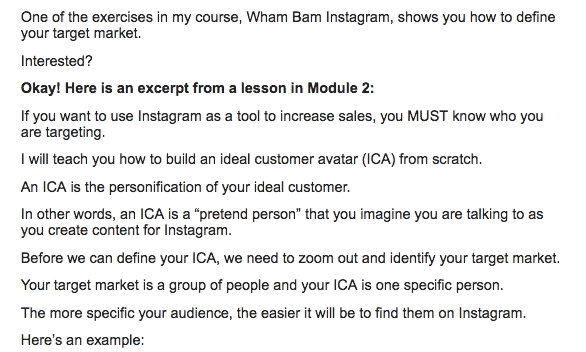
Remember: Email courses tend to convert very well, so a higher than normal percentage of your list will buy than if you had only run a giveaway or discount.
Once you’ve followed the above five steps to setting up your email course, market, spread, and promote your free course. You can start by linking to it on the homepage of your blog, as this is a quick way to collect email addresses from any new lead visiting your blog.
You can also do a social media push through Instagram Live, TikTok, Clubhouse rooms, and Facebook
Regina Anejinou of Publish Your Thing has great advice, saying:
“Plan out multiple, ideal paths that your audience members can take to get to your free email challenge landing page. Will they hear about it during your online workshop? Will they see a Facebook ad? Will they get a link to it in an email? Will you write multiple blog posts on the topic and tell your audience to “click here for an email challenge the goes in depth on this” or something along those lines?”
At the end of the day, developing several funnel options to attract students and potential customers to your course is the ideal way to grow your list and prime your audience.