Thank you! Your submission has been received!
Oops! Something went wrong while submitting the form.
MENU

.png)
Checkout is where a sale is won or lost. For anyone selling courses, coaching, or memberships, the moment between wanting a product and paying for it decides how much you keep, how much of your week goes to admin, and how many students around the world can buy from you at all.
Most creators end up assembling that moment themselves. One tool runs the checkout page, another handles taxes, a spreadsheet reconciles the numbers, and a separate processor covers anyone paying from abroad. Every extra piece adds a fee, a login, and one more thing to fix late at night.
Teachable rebuilt its checkout on Stripe so you start with all of that handled. You keep more of every sale, you spend less time on payments and taxes, and you can sell to students across most of the world from your first launch. Your students see a clean, familiar checkout. Underneath, it runs on the same Stripe technology behind a large share of online commerce, and it does the operational work for you.
The timing works in your favor. Goldman Sachs Research projects that the creator economy could roughly double to $480 billion by 2027, up from $250 billion. More of that money will move across borders, on phones, and in local currencies. Teachable Payments was built for that.
Your checkout should earn you more, hand back your weekends, and let you sell anywhere. That is Teachable Payments.
Your checkout should make you more money, give you your weekends back, and let you sell anywhere in the world. That is the new Teachable Payments.
Here is what comes built in from your first sale, next to what selling with a separate payment tool usually looks like.
The first thing you feel is how much you keep. Your rates start below standard processing, and creators selling internationally see the biggest reduction. Talk with our team to see your exact rate, then read the full breakdown on our pricing page.
Selling more from the same traffic matters just as much as the rate. Built-in order bumps add around 20% in revenue on the transactions that use them, Buy Now, Pay Later lifts sales by about 25%, and tax-inclusive pricing can raise checkout conversion by up to 22%. These tools come with your checkout, with nothing extra to install.
“When you are just starting, giving up a small percentage may not seem significant. But as your business grows, every percentage point starts to matter.” — Stefan Kunz, founder of Stefan Kunz Studio
Rates start as low as 2.5% + $0.30 based on where you are and how much you process. Talk with our team to see your exact number, then read the details in our Teachable Payments help guide.
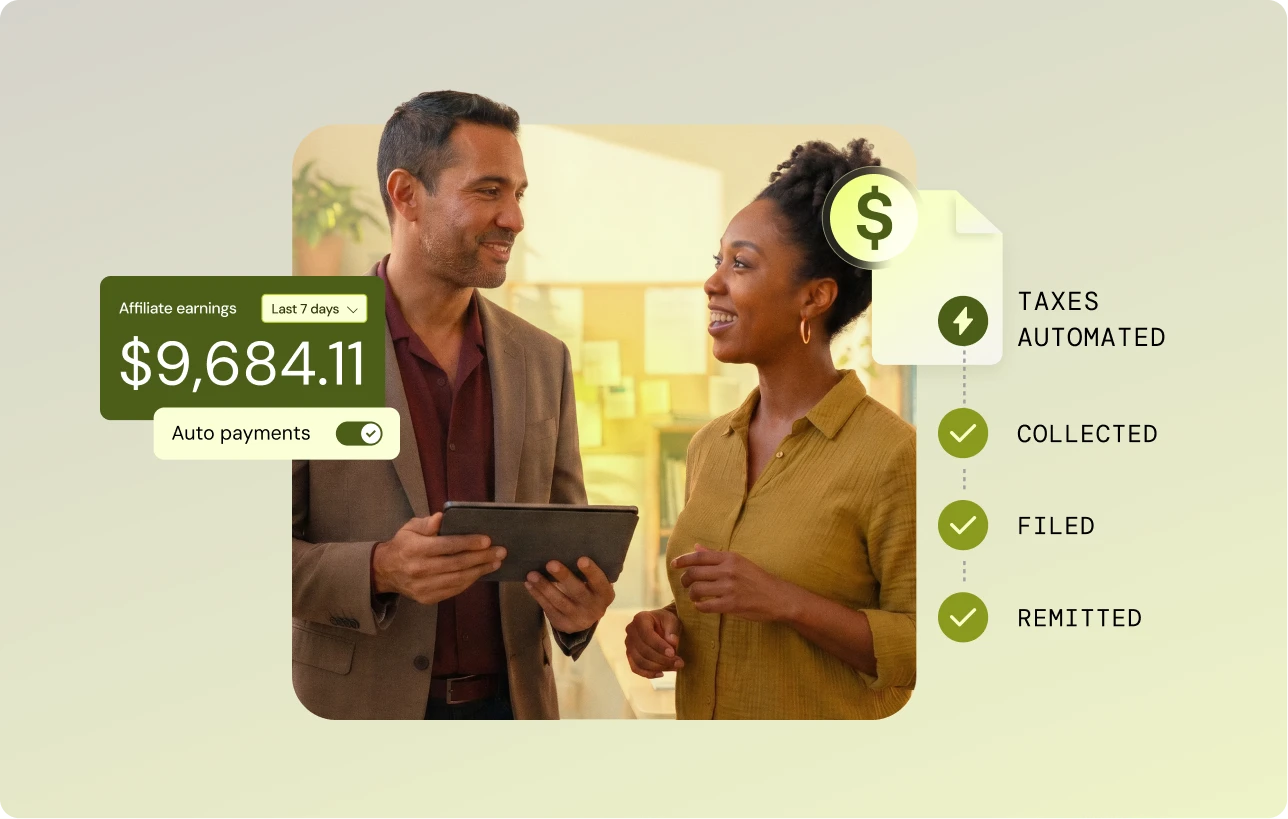
Next, you stop being your own accountant. On every sale, sales tax, VAT, and GST are calculated, collected, and remitted for you across 45+ countries.
There are no forms to chase, no spreadsheets to reconcile, and no separate tax app to connect. Tax handling runs on Stripe Tax, so it keeps getting stronger over time.

Your students should pay the way they already do. Teachable Payments gives them more than 35 ways to check out. On a phone, that means one tap with Apple Pay or Google Pay and no card entry. With local currency display, buyers see prices in their own currency automatically, so a student in Sao Paulo or Warsaw feels at home at checkout.
When a buyer sees their own currency and their usual payment method, more of them finish the sale.
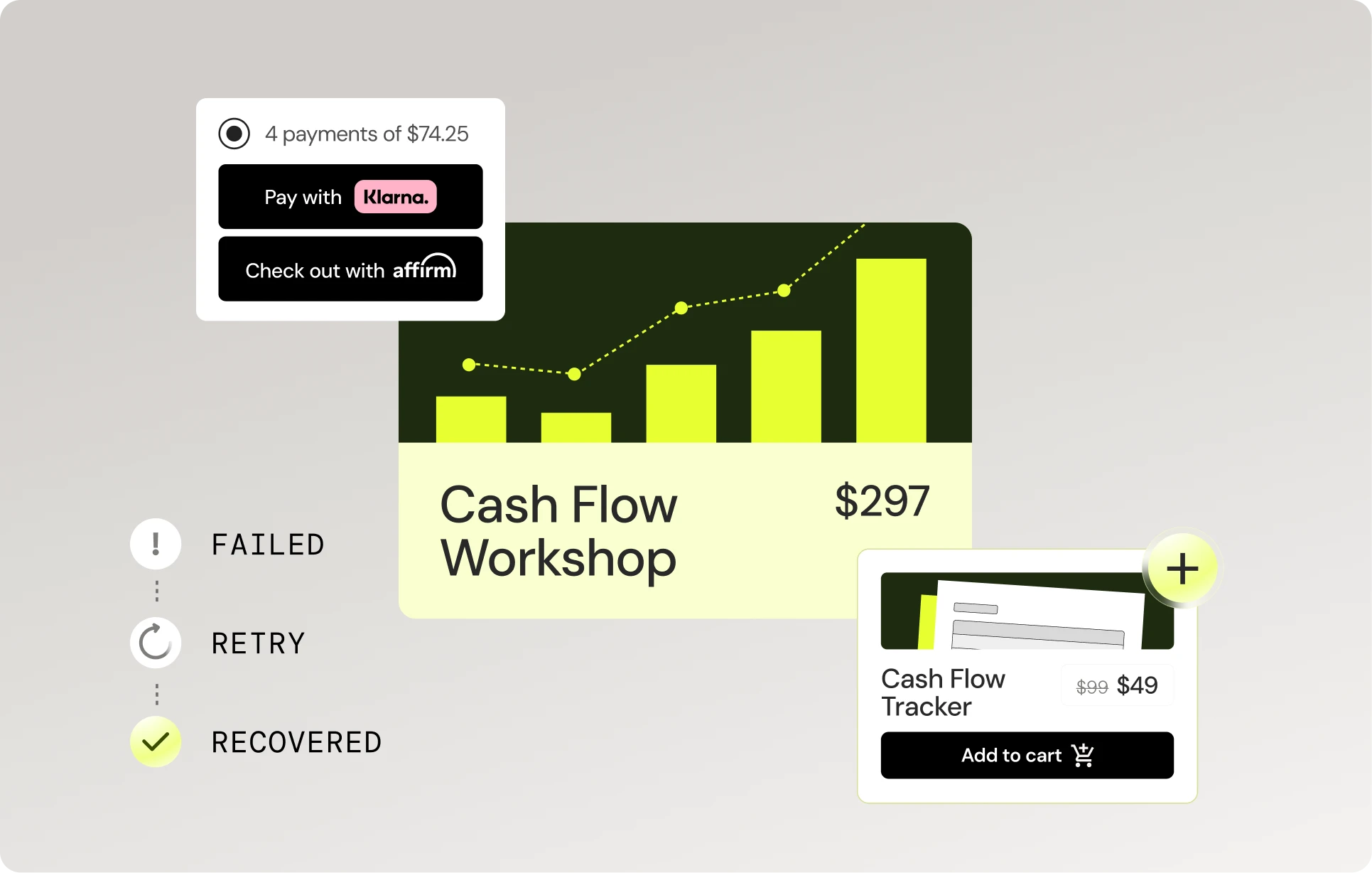
Recurring revenue runs on Stripe Billing. Failed payments get retried automatically, and many are recovered before you would notice. You get smart dunning, proration, and tax-aware invoicing from day one. For anyone selling memberships, coaching, payment plans, or drip courses, recurring payments can raise lifetime student value by around 43%.
Your money should reach you quickly. Eligible creators get instant payouts, with funds arriving in minutes through eligible debit cards or bank rails. Every transaction runs through Stripe fraud protection, so risky charges get caught early, before they turn into a costly chargeback.
There is no migration and no separate processor to connect. Teachable Payments is part of the platform, so it is on from your first product, and setup takes minutes. It is powered by Stripe for reliability and security.
You also get a named Customer Success Consultant who knows your setup and answers you directly, plus warm intros to other creators and invitations to Teachable events around the world.
Creators are already growing across borders on Teachable, and these payment features fit exactly how they sell. For Stefan Kunz, having payments built into the platform mattered from day one. He could open enrollment without wiring up a separate processor, which kept his attention on his students.
“It felt like a platform that would let me focus on creating and teaching rather than managing technology.” — Stefan Kunz, founder of Stefan Kunz Studio
Stefan has taught more than 8,000 students across 25-plus launches, reaching learners on nearly every continent, with Teachable handling tax and local payment methods for him.
With students from 188 countries, tax compliance could have been a nightmare. Teachable handles it all, so we can focus on helping our members build their data skills. — Leila Gharani, XelPlus Academy
Youness School has supported more than 2,000 engineering-prep students across Morocco and France, plus another 20,000 reached through free lessons, on a platform that travels with the student wherever the signal goes. For more stories like theirs, browse our creator success stories.
The new Teachable Payments gives you better rates, less admin, and more buyers, all inside the platform you already use.
See the new Teachable Payments and talk with our team, then see how creators are already selling worldwide with it.
Teachable DOES NOT provide legal or tax advice to users of Teachable Payments. By using Teachable Payments, You are solely responsible for obtaining any such legal advice and tax advice that You consider appropriate in connection with Your use of Teachable Payments.
.png)
Stefan Kunz can fill a room. Before he recorded a single lesson, he was teaching hand lettering in person to sold-out workshops in New York, Los Angeles, London, and beyond.
Reaching the rest of his audience meant teaching online, and the first online setup he saw up close looked complicated. Stefan taught a guest course for a fellow lettering educator whose school ran on WordPress, Vimeo, and password protection, all wired together by hand. The arrangement delivered the course. Keeping it running took constant attention.
Stefan wanted the opposite of that. He went looking for one place to build, sell, and run his courses, even if a packaged platform meant giving up some custom control. A recommendation from his friend and podcast co-host Lauren Hom pointed him to Teachable, and he has stayed there ever since.
“It felt like a platform that would let me focus on creating and teaching rather than managing technology.” — Stefan Kunz, Founder of Stefan Kunz Studio
Related: How to make money selling courses right now
Stefan never set out to become a teacher. His path ran through filmmaking, then wedding photography, then hand lettering, each craft picked up on his own and turned into a living.
Lettering took off as a trend, and people kept asking him the same question about how he did it.
Answering that question in person became a business of its own.
In 2019 he hired an assistant, cleaned out his studio, and ran his first lettering workshop off a big chalk wall in his own office, with pizza for about fourteen people. Demand kept showing up, so the rooms kept getting bigger.
By the time recording crossed his mind, he had taught hundreds of students face to face. He understood that whatever platform he picked would carry all of that online, which raised the stakes on choosing well.
That first online teaching, the guest course for a fellow lettering educator, ran on a custom mix of WordPress, Vimeo, and password protection stitched together piece by piece.
The setup delivered the lessons, and it also showed Stefan how much upkeep a hand-built system demands.
He wanted one place that handled the whole job, and he was willing to give up some custom control to get it. When Lauren Hom, his friend and Striving Artist podcast co-host, told him she was running her own courses on Teachable and loving it, the platform went straight to the top of his list.
A closer look confirmed the fit. The course builder, student management, comments, and online course tools all sat in one place, with a setup simple enough to learn in an afternoon. What stood out most was speed, since payments and delivery already worked together, so he could put his attention on the course instead of the connections between separate tools.
One detail settled it for him. Stefan could build his entire course before paying anything, which let him confirm everything worked before he committed. He created his first course, an online version of his lettering workshop, in a few days.
The feature he reaches for most today solves a problem that used to eat his evenings. Teaching a global audience, he once uploaded every video to separate services to make transcripts and subtitles by hand. Teachable now generates them for him, which feeds the kind of student experience that keeps international learners moving through a course.
“Being able to upload a video and have transcripts and translations generated automatically saves an incredible amount of time and helps me make my courses accessible to students around the world.” — Stefan Kunz, Founder of Stefan Kunz Studio
Stefan started with Teachable and has stayed. Switching platforms later, he points out, is no small task, which made getting the first choice right worth the care he gave it.
When Stefan started, having payments built into the platform mattered. He could open enrollment without wiring up a separate processor, which kept his attention on the course itself.
His needs changed as the business grew, and the platform gave him room to adjust. Stefan now connects his own Stripe and PayPal accounts through Teachable while keeping the built-in option available for whenever he wants it.
“As my business expanded, I had more flexibility to customize parts of my setup, including connecting my own payment processors like Stripe and PayPal.” — Stefan Kunz, Founder of Stefan Kunz Studio
Those options matter more for someone teaching across borders. Stefan's students reach nearly every continent, and Teachable Payments, powered by Stripe, handles tax and local payment methods across dozens of countries. For a creator selling to that kind of audience, the platform manages each market so the creator does not have to.
Stefan is the first to say there is no single right platform for everyone. Predicting how a business will grow is hard at the start, so he tells new creators to pick a tool that can grow with them.
“I would highly recommend choosing a platform that can grow with you.” — Stefan Kunz, Founder of Stefan Kunz Studio
The economics deserve early attention too. Giving up a small percentage feels minor in the beginning, and it adds up as the numbers get bigger.
“When you are just starting, giving up a small percentage may not seem significant. But as your business grows, every percentage point starts to matter.” — Stefan Kunz, Founder of Stefan Kunz Studio
The last thing he weighs is presentation. How a course looks and feels is part of a creator's brand, so Stefan wants a platform that lets him organize content, shape the student experience, and use tools like drip release to deliver a course the way he pictured it.
Take action
Stefan has launched more than 25 courses since 2019, and along the way he built a way of working that any creator with an audience can follow. The core of it is simple. He proves that people want something before he spends weeks building it.
Stefan learned this the hard way. Early on he poured months into courses he felt sure would land, then watched some of them open to near silence.
“You should sell first and then build it later. If it sells really well, then you build it. If it does not sell, what is the point of building it?” — Stefan Kunz, Founder of Stefan Kunz Studio
His model came from outside the course world. A sportswear brand he follows released a limited shoe by inviting people to enter their payment details for a chance to buy a pair, which told the brand exactly how much demand existed before it produced anything.
Stefan runs his launches on the same logic. For his animation course, he set up a tool that sent a waitlist link to anyone who commented the word animate on his videos. Around 3,000 people signed up within a couple of weeks, and that list became his proof.
“I had to have around 3,000 people on the waitlist to get 250 students. That conversion is still really good.” — Stefan Kunz, Founder of Stefan Kunz Studio
Take action
Stefan began in the smallest way possible, with a chalk wall and a pizza order.
His first workshop ran in his own office, with room for about fourteen people, and he taught it across a weekend before running it again. From there he booked a thirty-seat space, then back-to-back weekends in New York and Los Angeles with 120 seats to fill, followed by London, the Philippines, and India.
By the time recording crossed his mind, he had taught more than 300 students in person. He knew the questions they asked, the parts that confused them, and the moments things clicked.
“Start small, understand how it works, build up, and you can grow it piece by piece.” — Stefan Kunz, Founder of Stefan Kunz Studio
Take action
Stefan rarely changes his order of operations. He runs a live workshop first, turns it into a multi-week bootcamp next, and records the evergreen course last, once the material has proven itself several times.
The bootcamp stage is where Teachable's comment feature earns its place. In his weekly animation bootcamps, students post their homework and Stefan replies with video feedback, something a single-day workshop never had room for. The multi-week format makes space for that exchange, and the work students hand in gets noticeably better.
“Like a band performing the same show at different stadiums, I have refined it with every iteration.” — Stefan Kunz, Founder of Stefan Kunz Studio
By the time he records the evergreen version, real students have pressure-tested every lesson. The final course is the polished result of all those rounds.
Take action
Stefan compares a good course to a football team with one play it runs perfectly. The other side knows exactly what is coming and still fails to stop it.
“They were so good at that one single play that nobody could beat them.” — Stefan Kunz, Founder of Stefan Kunz Studio
He has watched his own launches grow so elaborate that even his team lost track of the plan. The fix was always the same. He stripped the launch back until everyone understood it again.
Simple plans are the repeatable ones. A launch you can run cleanly the second and third time is worth more than a clever one you manage to pull off once.
Take action
Plenty of creators teach students to copy one finished piece, step by step, which produces good imitations and little else. Stefan teaches the thinking underneath instead, the principles he uses to make any piece, and he gets students to a first win as fast as possible because an early result keeps them going.
He has a phrase for the balance.
“People want the quick win. So I try to hide the vegetables in the food.” — Stefan Kunz, Founder of Stefan Kunz Studio
The quick win is the food, and the principles are the vegetables. Students arrive for the result they saw on Instagram and leave able to make work of their own.
Take action
A common worry among creators is that teaching will pull them away from their craft. Stefan found the reverse to be true.
“You try to figure things out yourself, and then there comes the next level. Now you have to teach it to someone else, and that is when you learn whether you really understood it.” — Stefan Kunz, Founder of Stefan Kunz Studio
Explaining a technique forces him to understand why it works, which sharpens his own work. When he shares a method and watches other artists run with it, the pressure to find the next idea pushes him forward.
That loop is why he keeps taking client projects alongside teaching. His wife, a primary school teacher, pointed out that he learns the most when he solves real problems for paying clients. One recent brand project asked for a painterly texture effect he had never made before. He spent hours working it out, and now it is one more thing he can teach.
His path has run from lettering to Procreate to animation, and each new area started as a client challenge or a personal experiment. The teaching always follows the making.
Stefan prefers to let his reach tell the story rather than share revenue figures.
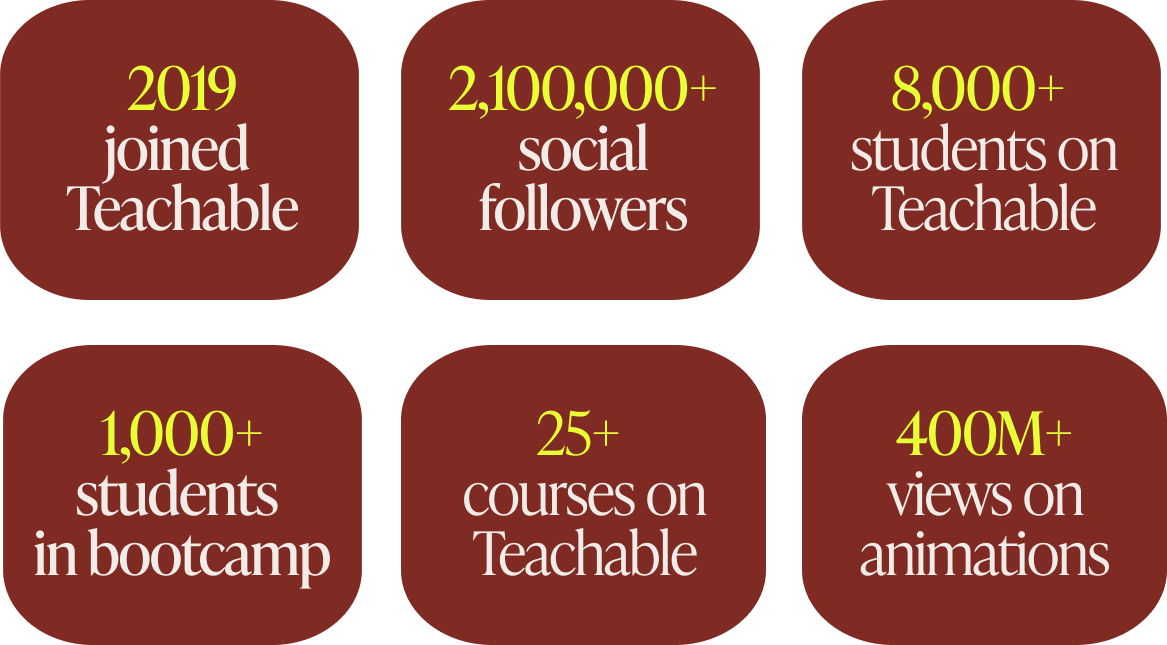
His brand animations have passed 400 million views, and his audience across social platforms sits above 2.1 million people. More than 8,000 students have come through his courses and workshops, with over 1,000 in his animation bootcamp alone. He has worked with brands including Coca-Cola, Apple, and Adobe, and he has taught students on nearly every continent.
For an artist who started by adding words to his Instagram photos, the pattern holds steady. He keeps making the work, and the teaching grows out of it.
Stefan is one of many creators using Teachable to reach students far beyond their home country. Elisa Azoum grew French Mornings to more than 2,850 language students across dozens of countries on the same platform, and Amie Tollefsrud built an eight-figure course business on it. The pattern repeats: real expertise, a clear program, and a platform that travels with the student.
Stefan's focus right now is client work, which has kept him busier this year than ever. He treats every project as research.
The lessons stack up quietly. How to use AI as a real tool in animation rather than a shortcut, how to build a studio camera setup, how to edit a video that travels well. Each one is a future course waiting for the right moment.
When the season turns and he has room to teach again, the material will be ready. The order will stay the same as always. Prove the demand, run it live, then record it.
The wider market is moving in his direction. Goldman Sachs Research projects the creator economy could reach $480 billion by 2027, roughly double its 2023 size. Creators who prove demand before they build, the way Stefan does, are the ones ready to claim a share of it.
See Stefan's work: Follow his animation on Instagram and YouTube, explore his Teachable school, or browse his full portfolio at stefankunz.com. You can also hear him on the Striving Artist podcast.
Read more creator stories: See how Youness School chose Teachable to train more than 2,000 engineering-prep students, and browse the full Success Stories collection.
Learn the sell-first approach: Stefan proves demand before he builds. For more on that, read how to make money selling courses right now.
Try Teachable yourself: Teachable gave Stefan one place to build, sell, and run his courses, with Teachable Payments handling tax and local methods for a global audience. Start your free Teachable trial and build the course your audience keeps asking you for.
A large audience and a thriving business are two different things.
Plenty of creators build the first and assume the second will follow. The ones who grow past a certain point work out something harder: how to turn attention into demand, and demand into a business that holds up across markets, languages, and currencies.
That problem is the reason we brought Europe's top creators to Rome.
Teachable Collective Rome is a three-day, invite-only gathering running June 23 to 25, built for established European creators who want time with peers operating at the same level and direct access to what we see across our top accounts.
It is the European counterpart to the Collective we hosted in Los Angeles earlier this year. Follow along on Instagram as the week unfolds.
Twenty-two Teachable schools and around 30 creators and operators are in the room, and the guest list is regional by design. Seventeen of the schools are based in Europe, with a few more traveling in from the United States, Canada, and Australia. The largest groups come from the UK, Italy, Spain, Austria, France, and Romania.
What these creators teach covers a lot of ground. Languages lead the room, followed by music, exam and interview prep, and tech. Around those sit creators teaching astrology, aviation, dance, marketing, nutrition, philosophy, and photography. One attendee runs a language podcast with more than 400 million downloads.
Teachable Select schools start at $250K in annual sales and Elite starts at $1M, the same tiers we recognize across the Customer Journey program. Rome is what that support looks like at the top of the range in Europe. Like our week at SXSW this spring, it is built as much around the rooms between sessions as the sessions themselves.
The framing we are taking into the day is direct. A big audience is a strong starting point. Turning it into a strong business takes a different set of moves. Early growth rewards reach and repetition. Past a certain point the ceiling changes, and what drives results is product depth, repeat purchases, and how well a creator sells into new markets.
Three things come up again and again across our top European accounts:
The first evening is a welcome dinner on a rooftop terrace in the center of Rome. No agenda, no presentations. The point is to let the group meet, warm up, and set the tone before the working day that follows.
The full content day takes place at Soho House Rome and runs from morning into the evening. Our Managing Director, Giovana Carvalho, opens with Teachable's read on where creator education is heading in Europe. From there the day moves through three creator keynotes:
Between the keynotes, our data and product team breaks down what actually drives repeat purchases across top accounts and how to price for audiences a creator has not sold to before. After lunch, the whole group moves into hot seats, where creators bring a live business problem and the room works through it together. The day closes with a happy hour, and our team films creator content throughout.
The final day moves out of the city. The group heads to Frascati, in the hills outside Rome, for a wine tour and tasting. It is the least structured part of the event, and that is on purpose. Some of the most useful conversations at the LA Collective happened in exactly these moments, away from a stage, when creators compare notes on what is working in their businesses.
Rome is invite-only, and most creators reading this are not in the room this round. The thinking behind it applies at every stage.
The demand for expert-led education is growing, and it is global. Goldman Sachs Research expects the creator economy to roughly double to $480 billion by 2027, up from around $250 billion.
The creators who grow into that are the ones treating their teaching as a real business, with deeper products, stronger repeat purchases, and pricing and payments built for buyers in more than one country.
We run the Customer Journey program because a creator at $50K needs different things than a creator at $500K, and both need different things than one pushing past $1M.
The Collective is what that support looks like at the top tier. Rome is where we bring it to Europe.
Talk to our team to understand how Teachable can support where your business is heading next. If you are ready to start building, you can do that today.
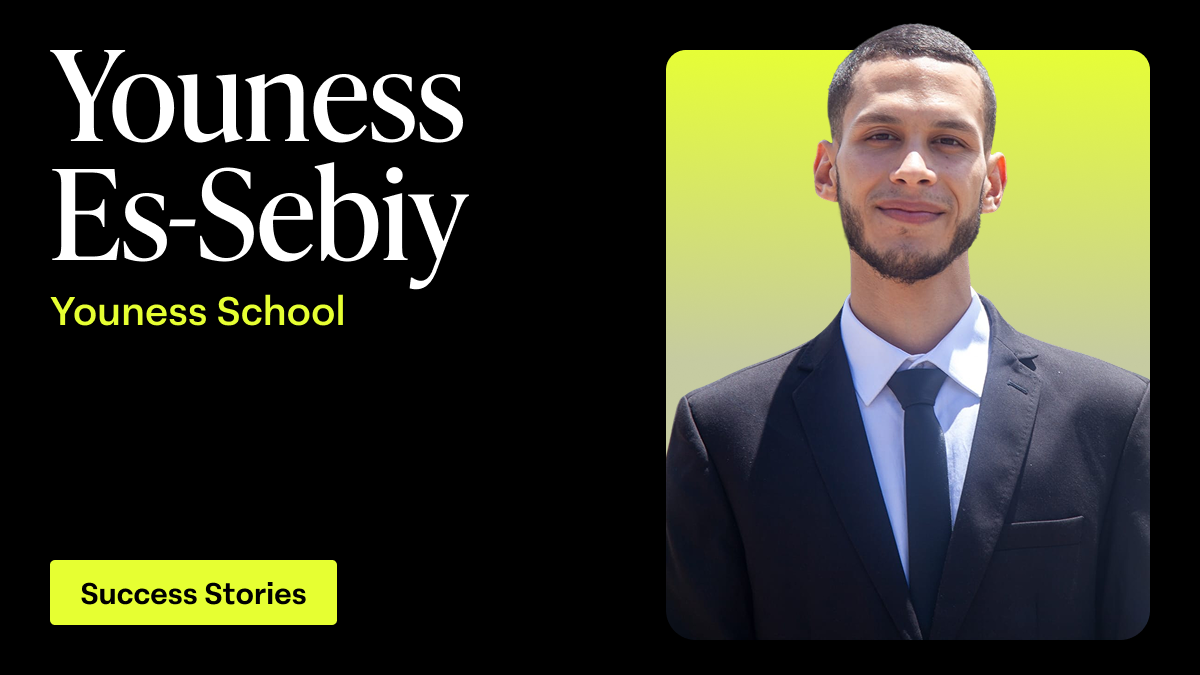
Before Youness Es-Sebiy built Youness School into a course business that has trained more than 2,000 students, he did what most serious creators do first: he tried the other options.
He taught on several platforms and compared what each one actually delivered for his school.
The answer he reached was Teachable, and he is direct about the reasons.
"I have tested other platforms in the past, including Thinkific and Podia. While they are good platforms, I ultimately chose Teachable because of two factors that were very important for my business and my students … The first is security … The second is the mobile learning experience." — Youness Es-Sebiy, Founder of Youness School
That decision came from someone who knows the stakes from the inside. In Morocco, the road to a top engineering school runs through CPGE, the Classes Préparatoires aux Grandes Écoles: two intensive years after high school studying advanced math, physics, chemistry, and engineering sciences, then one national exam that decides which schools will take a student. Youness went through all of it. He reached the other side and graduated from École Hassania des Travaux Publics, one of the leading engineering schools in the country.
Then he started teaching the students coming up behind him. He launched Youness School in 2019 while he was still an engineering student himself, recording lessons for the exact exams he had just survived. By 2023 the school was his full-time work.
Today it has directly supported more than 2,000 students preparing for Morocco's national exam (the CNC) and the French Grandes Écoles exams, with more than 20,000 others reached through free lessons and his YouTube channels across Morocco, France, Tunisia, and Mauritania.
The two reasons he named for choosing Teachable, security and the mobile experience, run through every part of how that school works.
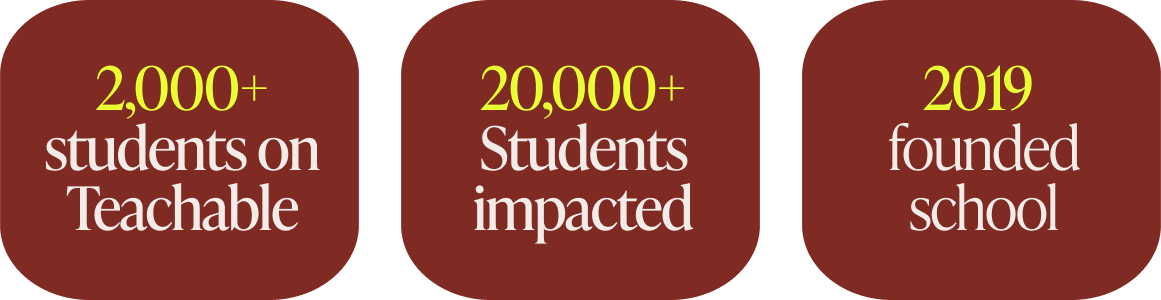
Youness built Youness School around a problem he had felt directly. CPGE students carry an enormous load across many subjects, and a lot of them hit a wall in one or two of those subjects with little structured help to get past it. He wanted to give them that help in a format that fit how they actually live and study.
" I went through the same preparatory classes, and they were very difficult. My goal is to help students who are facing the same problems, to help them grow and reach the best engineering schools." — Youness Es-Sebiy, Founder of Youness School
He made one early decision that shaped everything after it. Youness School would be online only. He had looked at in-person tutoring and found it too limited for what he wanted to build.
"We chose e-learning because we find the platforms very efficient. Physical classes are limited, and for our students online learning is the best solution." — Youness Es-Sebiy, Founder of Youness School
That decision raised the stakes on the platform itself. If an entire school lives online, the platform has to protect the content, reach students on whatever device they own, and keep working when the connection drops. Those three requirements are what pointed Youness toward Teachable over the other tools he had tried.
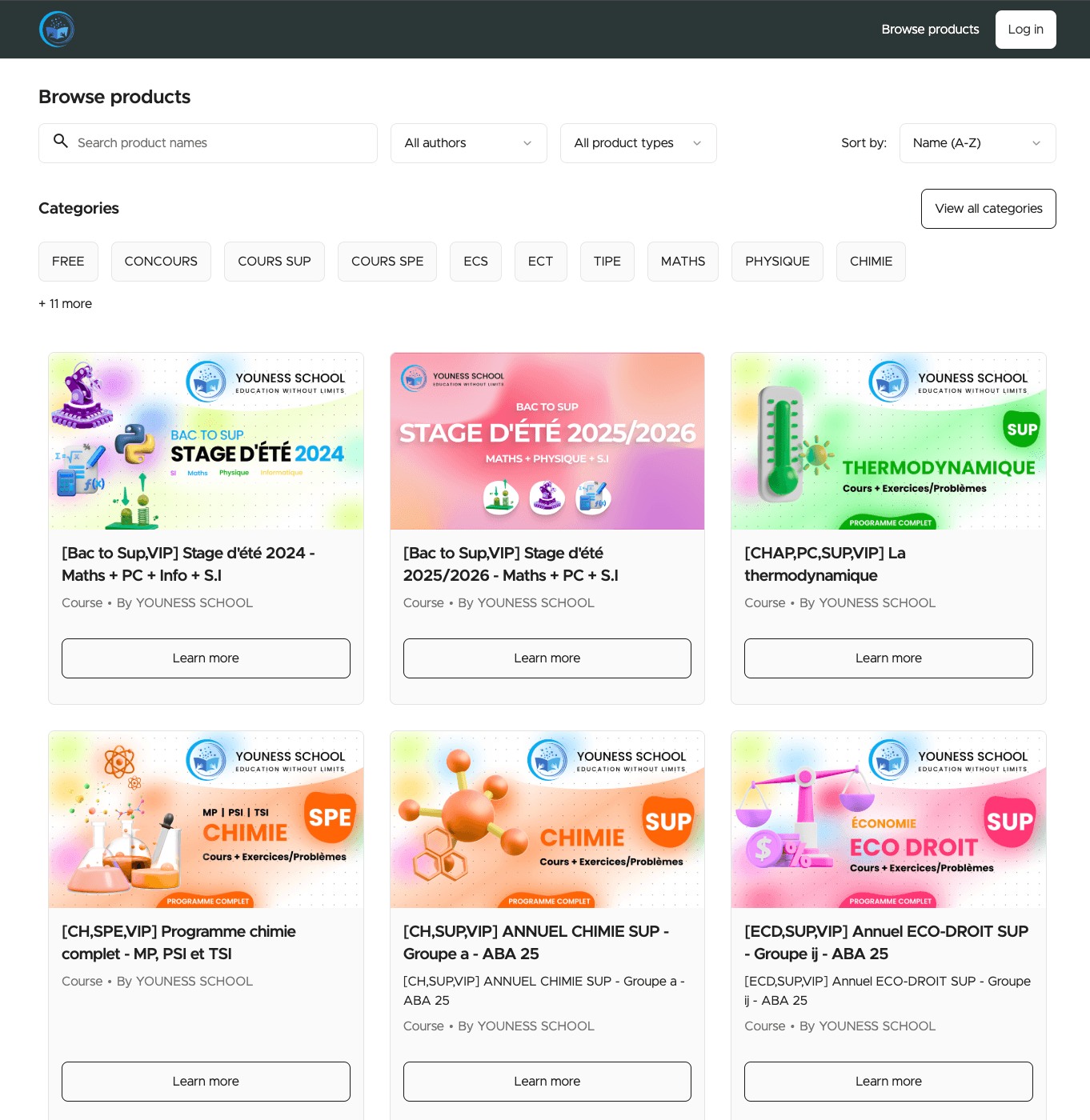
Youness runs the school with the same clarity he asks of his students. Five choices shape how Youness School finds, teaches, and keeps its students.
Most enrollments at Youness School begin with a conversation, usually on WhatsApp, where his sales team finds out where a student is actually struggling before recommending anything.
"In the beginning, we try to understand the needs of the student. If a student has problems across many topics, we offer a bundle with the whole platform. If they only have difficulty in one subject, we give them one or two courses." — Youness Es-Sebiy, Founder of Youness School
The result is a recommendation matched to what the student actually needs. A student weak in one subject buys a single course. Someone starting the full two-year climb buys a bundle, which Teachable lets him package as one grouped program.
Take action
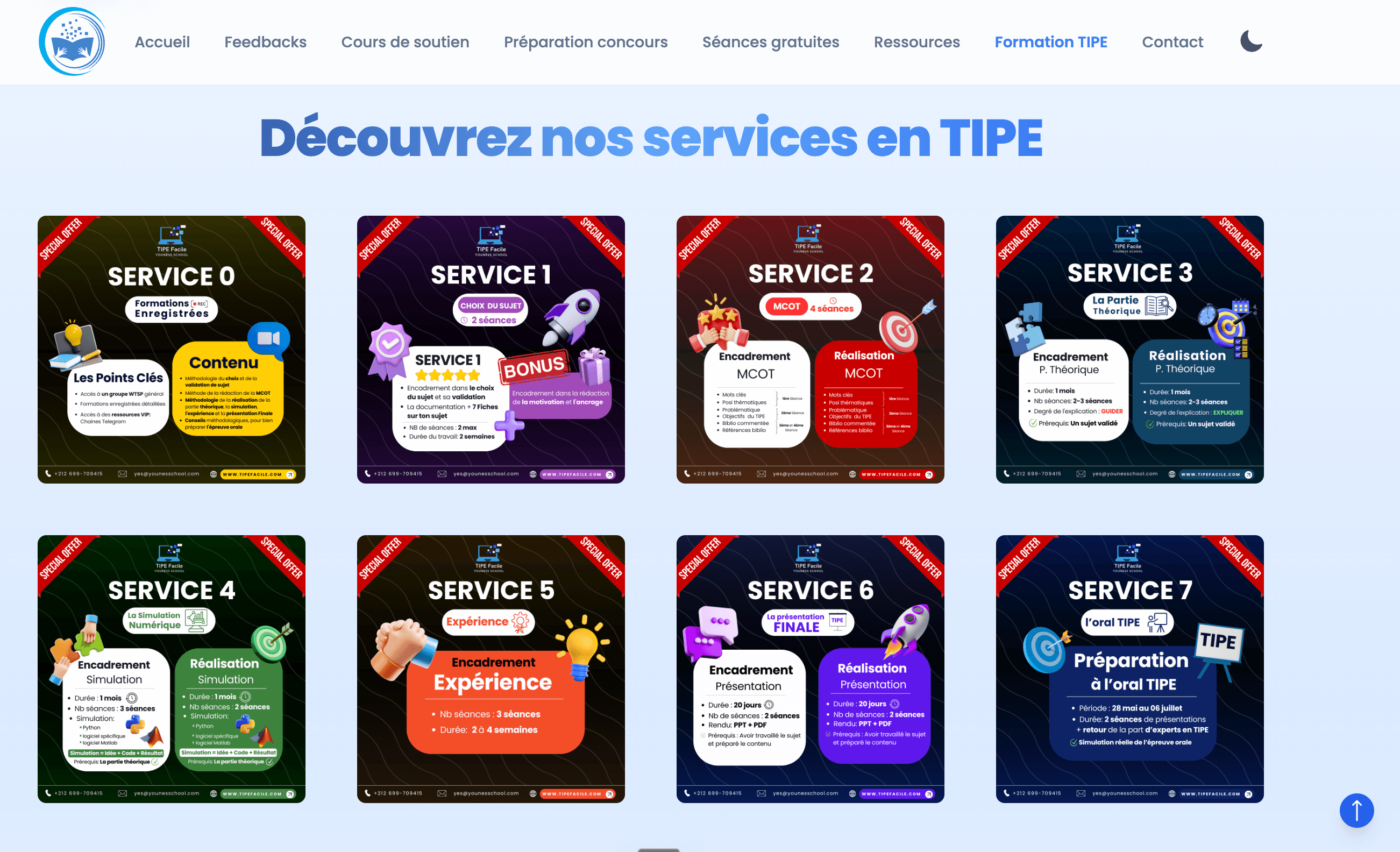
Youness School runs on three formats at once: recorded lessons students watch on their own time, live sessions with collaborating professors, and one-on-one coaching.
"We use both approaches. We have recorded classes on the platform with Teachable, and we have live courses with professors who teach in these preparatory classes. There is also coaching to answer questions and correct their work." — Youness Es-Sebiy, Founder of Youness School
The recorded library carries the core curriculum and reaches every enrolled student. Live sessions and coaching cover the moments where students need a person in the room with them: stuck on a problem set, preparing for a mock exam, or talking through method. Together they create the kind of student experience that keeps learners moving through the material.
Take action
For a school that sells exam-prep video, the content is the product. Youness named content protection as one of the two factors that decided his platform choice.
"As an online school, protecting our educational content is a top priority. I found Teachable's video hosting and content protection to be particularly strong, which gave me more confidence using the platform for premium courses." — Youness Es-Sebiy, Founder of Youness School
Secure video hosting keeps his lessons from leaking out, which matters when the same exam prep sells to a fresh cohort every year. Content that walks out the door loses the value he priced it on.
Take action
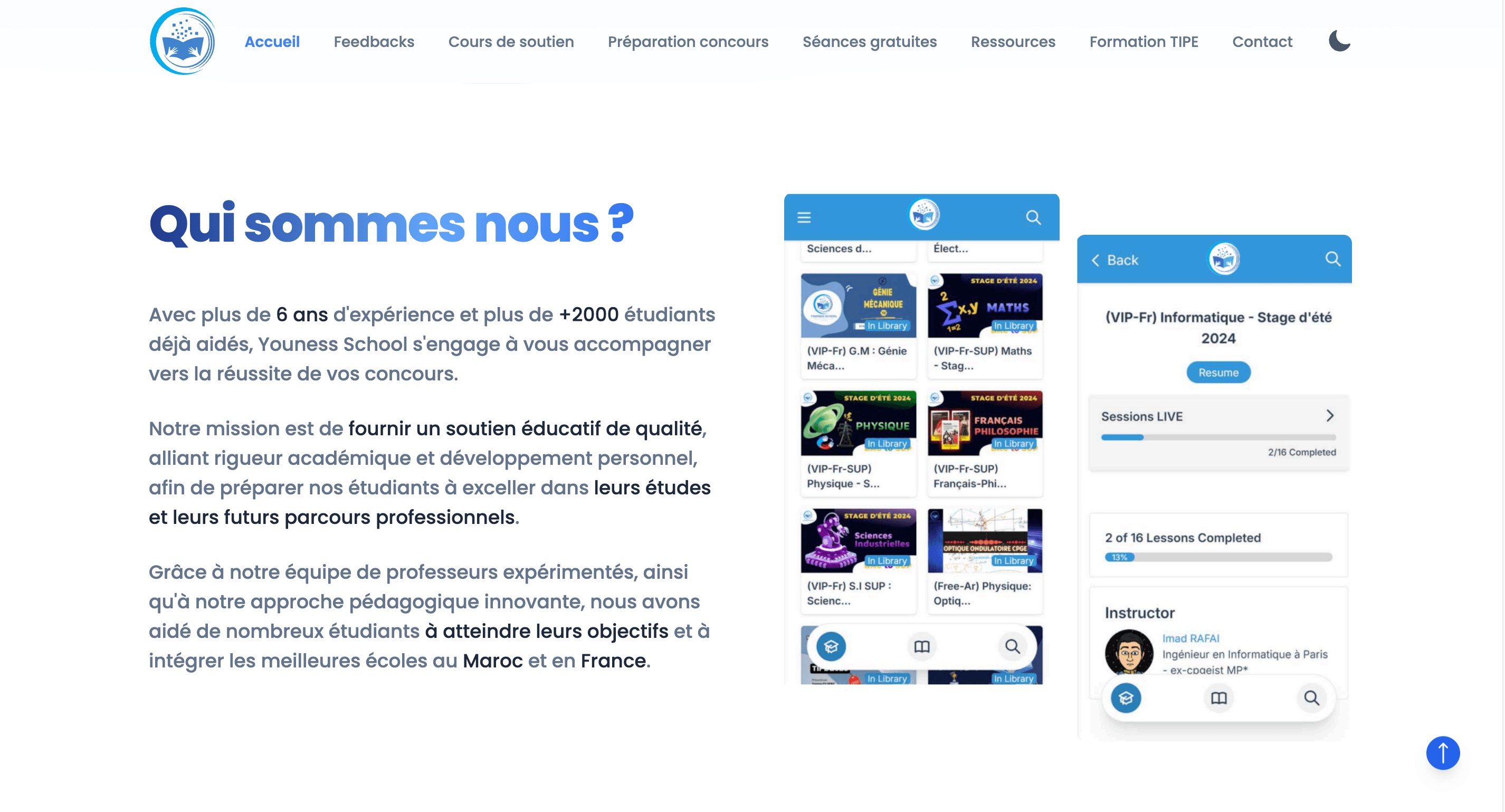
This is the choice most specific to where Youness teaches. His students are spread across Morocco and the wider Francophone world, and the connection they study on is uneven. The Teachable mobile app, and offline downloads in particular, became central to how the school reaches them.
"The mobile app lets students access their courses easily on their phones and tablets. The ability to download videos for offline viewing has been extremely valuable, especially for students who do not always have a stable internet connection." — Youness Es-Sebiy, Founder of Youness School
The context behind that quote is real. In 2025, about 36 percent of people in Africa used the internet, the lowest rate of any world region, according to the International Telecommunication Union. For a student living inside that gap, a course that only streams is a course that stalls every time the signal drops. An offline download turns a commute, a power cut, or a weak connection into study time.
Take action

Youness prices across a wide range, from single courses around $60 to full programs above $1,000, so a student pays only for what they need. He also gives free access to families facing financial hardship, and he has used free trial periods to let students try the school before paying.
"We give some courses for free to families facing financial difficulties. We want talented students to have access regardless of their financial situation." — Youness Es-Sebiy, Founder of Youness School
More than 5,000 students have come through Youness School's free-access and trial campaigns, which widened his reach and let prospective students experience the platform before buying. Payment access shapes the model too. In Morocco, many students and parents pay by bank or cash transfer, and a card is rarely the default, so a real conversation often comes before a sale.
Take action
Youness built the school around one belief, and he states it plainly.
"We believe talented students should have access to elite-level education regardless of their city, country, or financial situation." — Youness Es-Sebiy, Founder of Youness School
That belief is why offline access matters so much to him, and why the price range stays wide. The students he most wants to reach are often the ones with the least reliable connection and the tightest budgets. Building for them first is what makes the school useful to everyone else.
The measure that matters to Youness is straightforward: whether his students get into the schools they are aiming for. Since 2019 he has worked directly with more than 2,000 of them, with another 20,000-plus reached through free lessons, webinars, and his YouTube channels. They sit the same national exam he once sat, and the strongest performers go on to the top engineering schools in Morocco and France.
"My advice would be to focus on the student experience and content protection. If security, accessibility, and mobile learning matter to you, I would recommend Teachable. Students can learn from any device and access content wherever they are, and that makes a real difference." — Youness Es-Sebiy, Founder of Youness School
Youness is one of a growing number of creators using Teachable to teach students far beyond their home country. Elisa Azoum grew French Mornings to more than 2,850 language students across dozens of countries on the same platform. The pattern is consistent: subject expertise, a clear program, and a platform that travels with the student.
Youness has a wider plan for the school. CPGE is a small field by design, with roughly ten thousand students entering each year in Morocco. He wants to take the same model to high school students, a group he puts at around half a million in Morocco alone, and eventually to learners in other countries.
"I have a global strategy to develop Youness School and help more people. In Morocco there are about half a million high school students, and we want to give them similar platforms and solutions." — Youness Es-Sebiy, Founder of Youness School
The plan he describes brings together education, technology, and the careful use of AI, built for students who would otherwise sit outside the reach of this kind of coaching.
Youness's students pay differently than a US or European creator's audience does. Cards aren't the default in Morocco. Many families pay by bank transfer. And selling across Morocco, France, Tunisia, and Mauritania means four different markets, currencies, and different sets of tax rules.
But the best part is that, in the near future, Youness won't ave to manage payments manually.
That's exactly what Teachable Payments is built for. Local payment methods appear automatically at checkout based on where the student is. Tax is calculated, collected, and remitted across 45+ countries without the creator filing anything. Prices display in the student's local currency without manual configuration.
For a school built around the belief that talented students should have access regardless of where they live, the checkout experience should reflect that too, and now it does.
Explore Youness School: Visit younesschool.com to see the courses and programs, and youness.online for more on Youness's work. Follow Youness Es-Sebiy on LinkedIn and YouTube, and follow the Youness School YouTube channel and company page on LinkedIn.
Try Teachable today: Youness built a school that protects its content, reaches students on any device, and keeps teaching when the internet drops. Teachable handles the video hosting, the mobile app, and the payments so creators can spend their time with students. With Teachable Payments, that now includes local payment methods for an international student base like his.
.png)
Most training programs share the same problem. The content gets built, distributed, and largely ignored. Completion rates stay low. Managers ask whether anyone actually learned anything. No one has a clean answer.
This is the challenge Daniela Bianchin, Product Marketing Lead at Teachable, opened with during a recent global training webinar. The session brought together L&D professionals, healthcare trainers, solo course builders, and people managing partner education at companies like Google — joining from Brazil, Canada, Australia, Russia, Georgia, and the United States.
Their top two challenges: measuring impact and getting learners to actually engage.
Below is a summary of what the session covered, including the specific features Daniela demonstrated and the questions attendees raised.
When training lives across PDFs, slide decks, and shared folders with no consistent structure, measuring it becomes nearly impossible. You lose track of who completed what, which concepts landed, and where learners dropped off.
According to the 2023 LinkedIn Workplace Learning Report, 89% of L&D professionals agree that proactively building employee skills is the best way to navigate the future of work — yet most organizations still rely on fragmented content to deliver it.
A platform purpose-built for training addresses this at the delivery level. Teachable for business gives you course structure, compliance tools, and reporting in one place, so you can see exactly what is happening inside your program.
Two examples from the webinar illustrate the difference:
The most requested topic during the session was accountability: how do you confirm someone actually went through the material?
Teachable addresses this through course compliance settings. You can require learners to pass a quiz before advancing to the next lesson. You can require them to watch at least 90% of a video before moving forward. Either way, both requirements generate data you can act on.
When learners consistently miss the same quiz questions, you can see which concepts need reinforcement. When they skip sections, the reporting shows it. This matters both for measuring learning and for improving the material over time.
In a recent Teachable survey of more than 500 students, over 60% said that having a clear structure with a defined path forward was the main reason they came back to finish a course.
That is the practical difference between a course people start and a course people complete. Structured paths with clear next steps give learners a reason to return. Compliance checkpoints give administrators something to report on.
For more on how new hire training programs use these features, that post covers the setup in more depth.
.png)
You can create a course on Teachable using AI to generate a first draft, or upload content manually. The two approaches work together. A common setup is to use AI to generate a section outline, then replace the placeholder content with your own material.
Course content supports: video (MP4, MOV, AVI), PDFs, audio, text and images, embedded video from external platforms like YouTube, and live sessions connected through Zoom. Quizzes sit alongside this content as standard lesson types, not a separate system.
AI can also generate quiz questions from your existing lessons. Select the lessons you want covered, and the tool produces a draft set of questions. From there, you edit to match your specific terminology and objectives.
For teams that need structured sequences, Learning Paths (currently in beta) lets you chain multiple courses together in a defined order. Learners move through them in sequence and cannot skip ahead. Bundles, by comparison, give access to a collection of courses without enforcing any particular order — useful when learners can self-direct their path.
Learners notice when training looks generic. For enterprise training programs in particular, a branded experience signals that the program was built intentionally. It reads as deliberate, not assembled from whatever tool was available.
Teachable supports custom domains, branded color schemes, and white-label configuration so the environment stays consistent with your organization's visual identity. Design templates give you a starting point. Custom code access opens full control for teams with specific requirements.
Multi-language support extends this to global teams. You can set the learner interface to a specific language, and video subtitles can be translated to match. This also covers accessibility: subtitles help learners who process written material more easily than spoken audio.
Certificates at the end of a course can carry your brand. Learners can share them directly to LinkedIn, which creates organic visibility for your program without any additional promotion effort. For more on how certificates work, see the Teachable certificates support article.
For L&D professionals working across business units, or trainers delivering to multiple client organizations, having all learners in a single undifferentiated list creates real management problems.
Teachable's Organizations feature (currently in beta) creates separate containers for each group. Each organization can be assigned specific courses and a defined access window: a seasonal cohort gets 30 days, a specific team sees only the courses built for their function. An organization admin inside the client company can manage enrollment directly, so you are not routing every access request through your own account.
Reports are scoped per organization. You can see who logged in, which lessons were completed, quiz scores, and open-response answers. A leaderboard view shows relative engagement across the group at a glance.
For organizations selling training to other businesses, the B2B online training guide covers how to structure these programs for external clients.
.png)
Plans start at $29 per month. Course compliance features are available on higher-tier plans, so reviewing the full feature comparison at teachable.com/pricing before selecting a plan is the clearest way to match your needs to the right tier.
teachable:pay handles payment processing and tax management for sellers. It supports more than 30 payment methods through a Stripe partnership. Withdrawal schedules run daily, weekly, or monthly depending on your preference.
One-time purchases, installment plans, and limited-enrollment pricing are all available when setting up a product. Enrollment limits can be set by the number of students or by a specific date window.
Teachable gives training teams the tools to build structured courses, track completion, and produce real data on whether learning is happening. See how it works for business training.
.png)
Open any feed right now and you'll find a thousand people explaining AI. Most of them are explaining the same five tips. Very few are showing you what it looks like to actually use these tools to run a business.
That's the gap we built Teachable AI Academy to close.
It's a live workshop series. We bring in creators and experts who use AI every day, and we put them in front of you to teach the exact systems and workflows behind their work. The first sessions kicks off on June 15, 2026, and the full lineup carries into August 2026.
Every session is free to attend. Each one is hosted live, and we record all of them, so the replay is waiting on Teachable whenever you want it.
%20(1).png)
AI Academy is a run of live, online workshops. More than 20 AI creators and experts are on the schedule, and each one picks a topic straight from their own work.
They teach it live, in real time, and they leave room for your questions at the end.
The people teaching have built audiences in the millions and run real businesses with these tools. So the advice you get is grounded in what they actually do day to day.
We host every session, and we keep the replay up afterward. That means the library grows every week as new workshops go live.
Here's how we see this moment. AI made information instant, and that made the hunger for real skill sharper than it has ever been.
People want to build things. They want to change careers and pick up abilities that have nothing to do with what they trained in. We call this the Learning Renaissance, and we think it's the most exciting thing happening in education right now.
The hard part is knowing where to start. When everyone is posting at once, it's tough to know whose advice you can trust.
AI Academy is our answer. We put practitioners you can trust on a set schedule, each teaching one concrete thing you can use.
This is showing up in the data, too. In its 2025 Workplace Learning Report, LinkedIn found that 71% of learning and development professionals are already exploring, experimenting with, or integrating AI into their work.
That number is worth sitting with for a second. The people whose entire job is teaching skills are moving on AI right now, and AI Academy is built for everyone trying to keep pace with them.
Once you learn something in a session, you can put it to work inside Teachable. Our own AI features sit right in the platform, so the courses and content you build benefit from the same tools.
The first wave of workshops runs through June, and each session below is open for registration now.
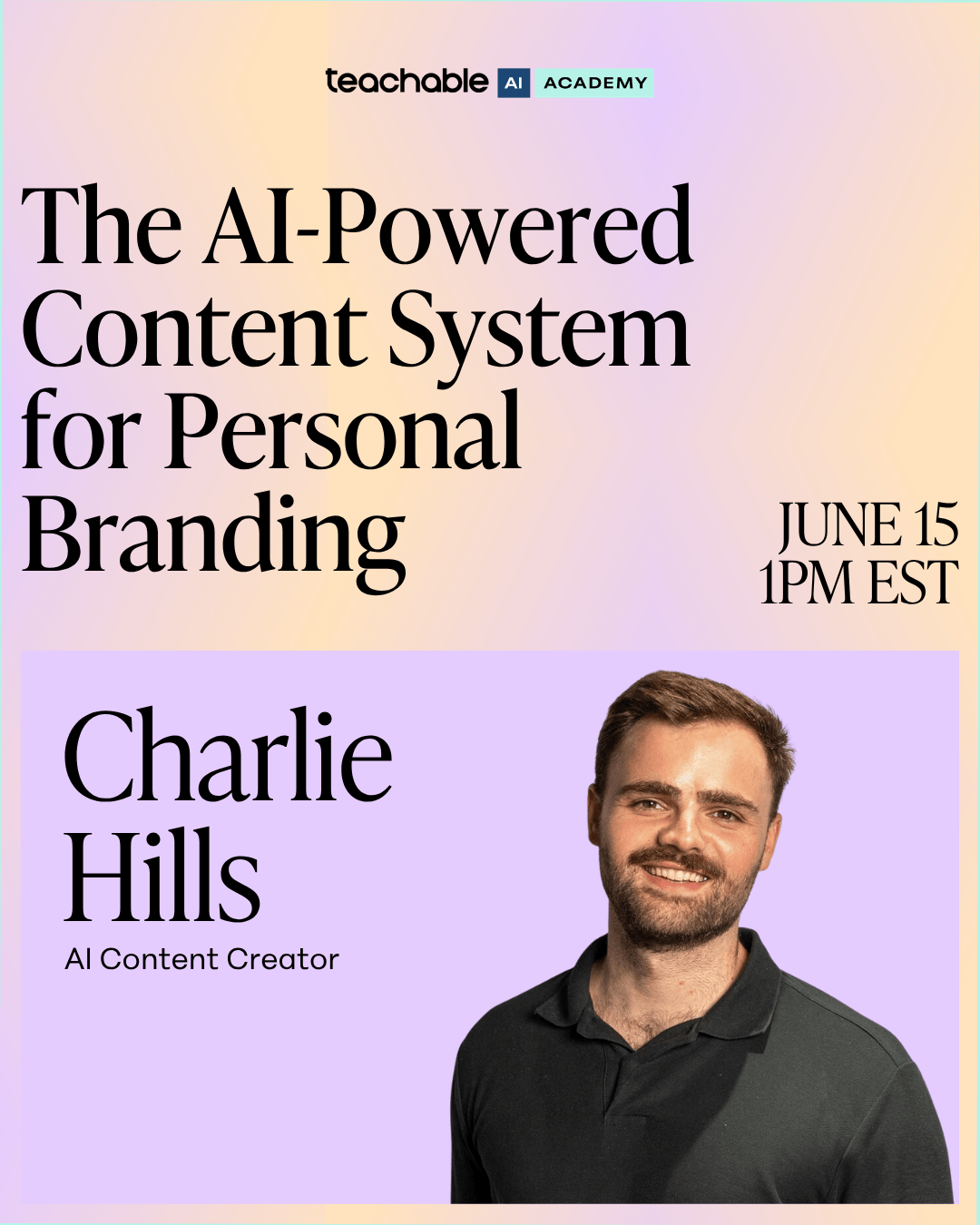
Charlie Hills, June 15 at 1:00pm EST. The AI-powered content system for personal branding. Charlie Hills grew from zero to more than 200,000 LinkedIn followers using a repeatable, AI-assisted content system. He breaks down the tools and workflows he uses to generate ideas, speed up production, and turn attention into business, all while keeping his own voice in the output. If you want background reading first, Teachable has a guide on how to build a personal brand.
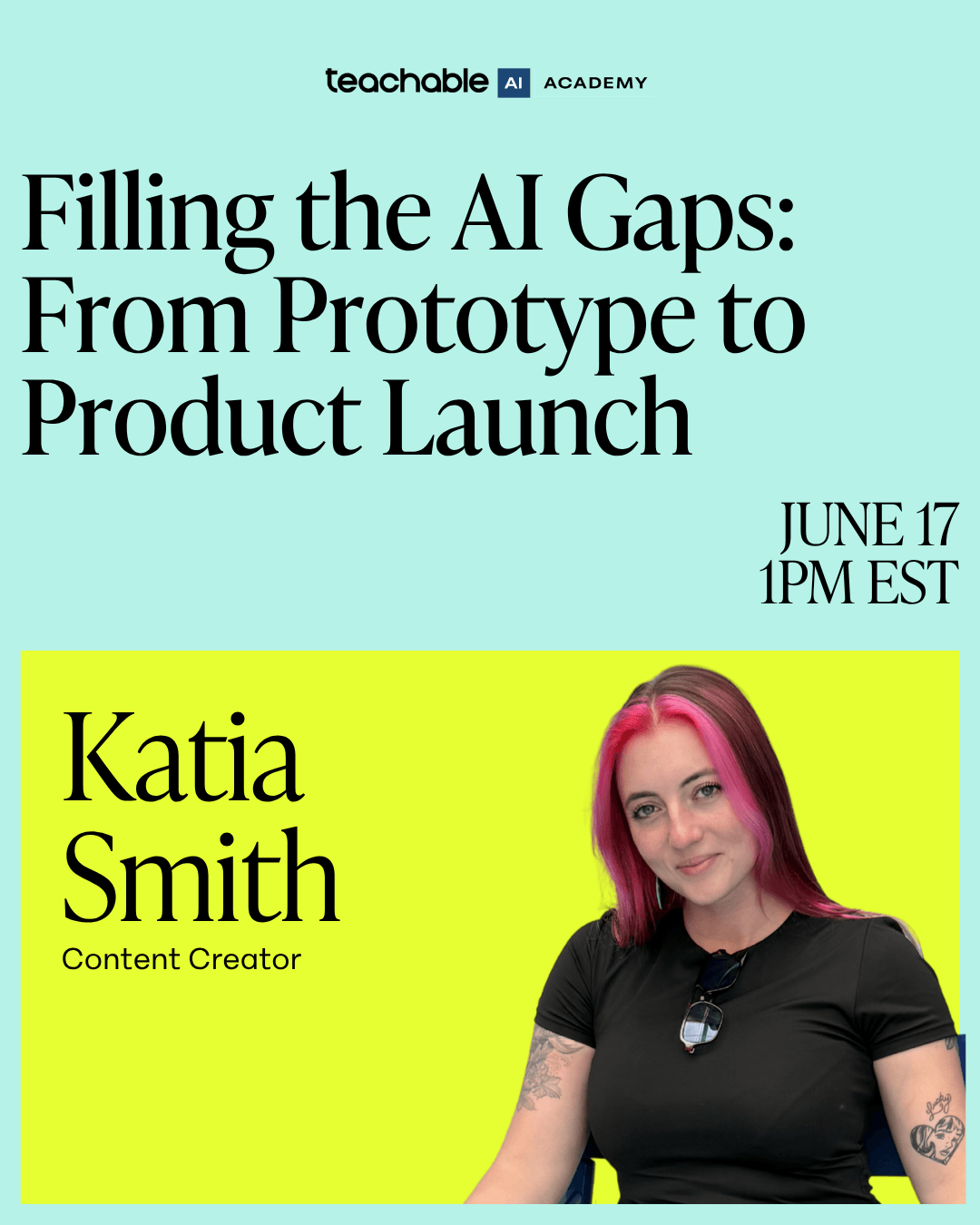
Katia Smith, June 17 at 1:00pm EST. Filling the AI gaps: from prototype to product launch. Katia Smith is a former Microsoft engineer and the founder of Second Life Software, where she turns rough, AI-built prototypes into products ready for real users. She walks through the five gaps AI coding tools tend to leave open, including security, error handling, and what a user sees when something fails, using real before-and-after examples from her agency work.

Sandra, June 22 at 1:00pm EST. Ship AI-built apps without shipping risk. Sandra is a cybersecurity educator with a following of more than 550,000 security and IT professionals. She shares the flaws that ride along with fast, AI-built apps, from exposed API keys to weak authentication, and gives you a seven-point checklist you can run on anything you build before it goes live.
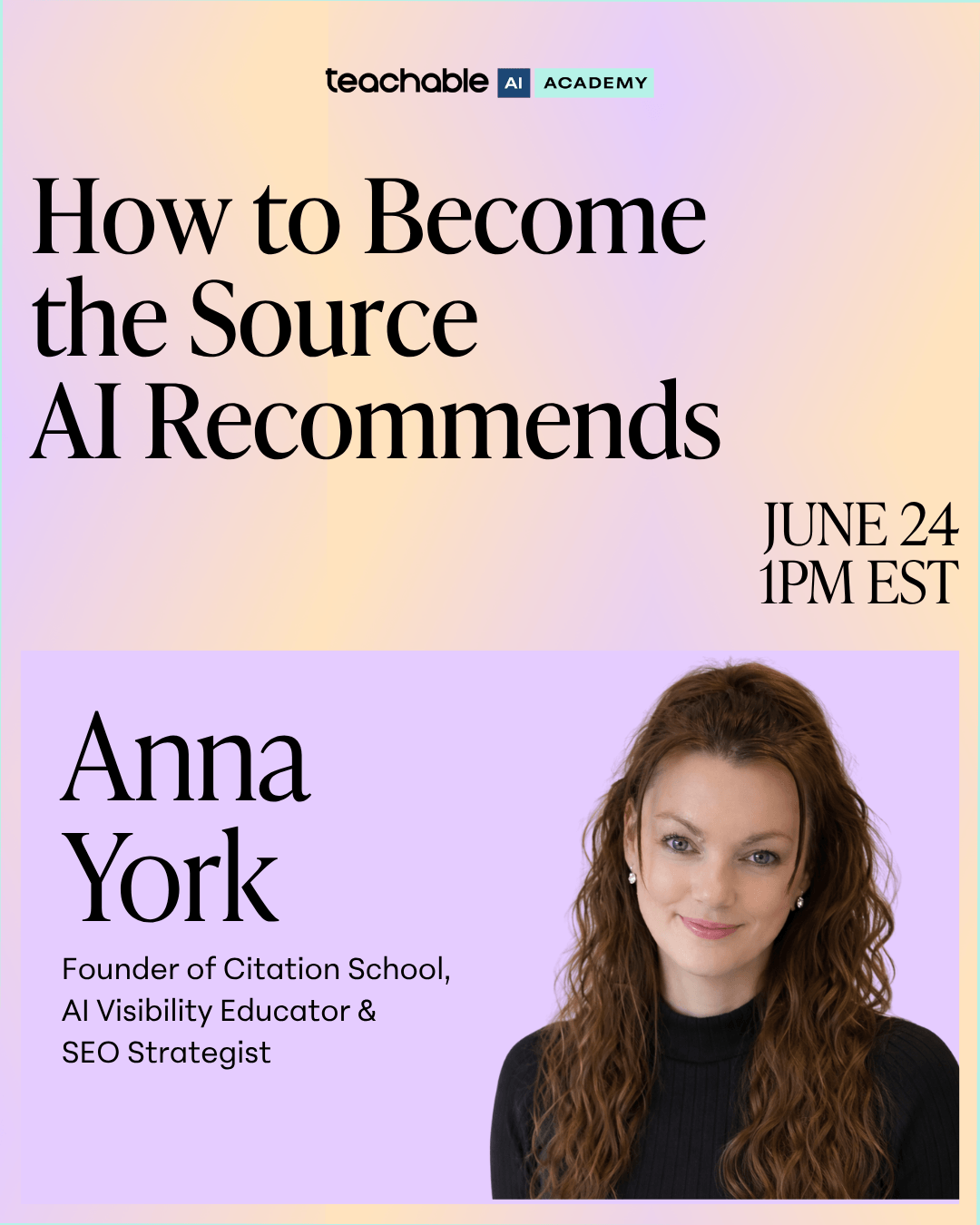
Anna York, June 24 at 1:00pm EST. How to become the source AI recommends. Anna York is an AI Visibility Architect and the founder of Citation School, recognized as a LinkedIn Top 12 AI Voice in Europe. She studies how tools like ChatGPT and Perplexity decide what to recommend, and she walks through her keyword research process for AI search, showing how to turn one question into a full content plan.
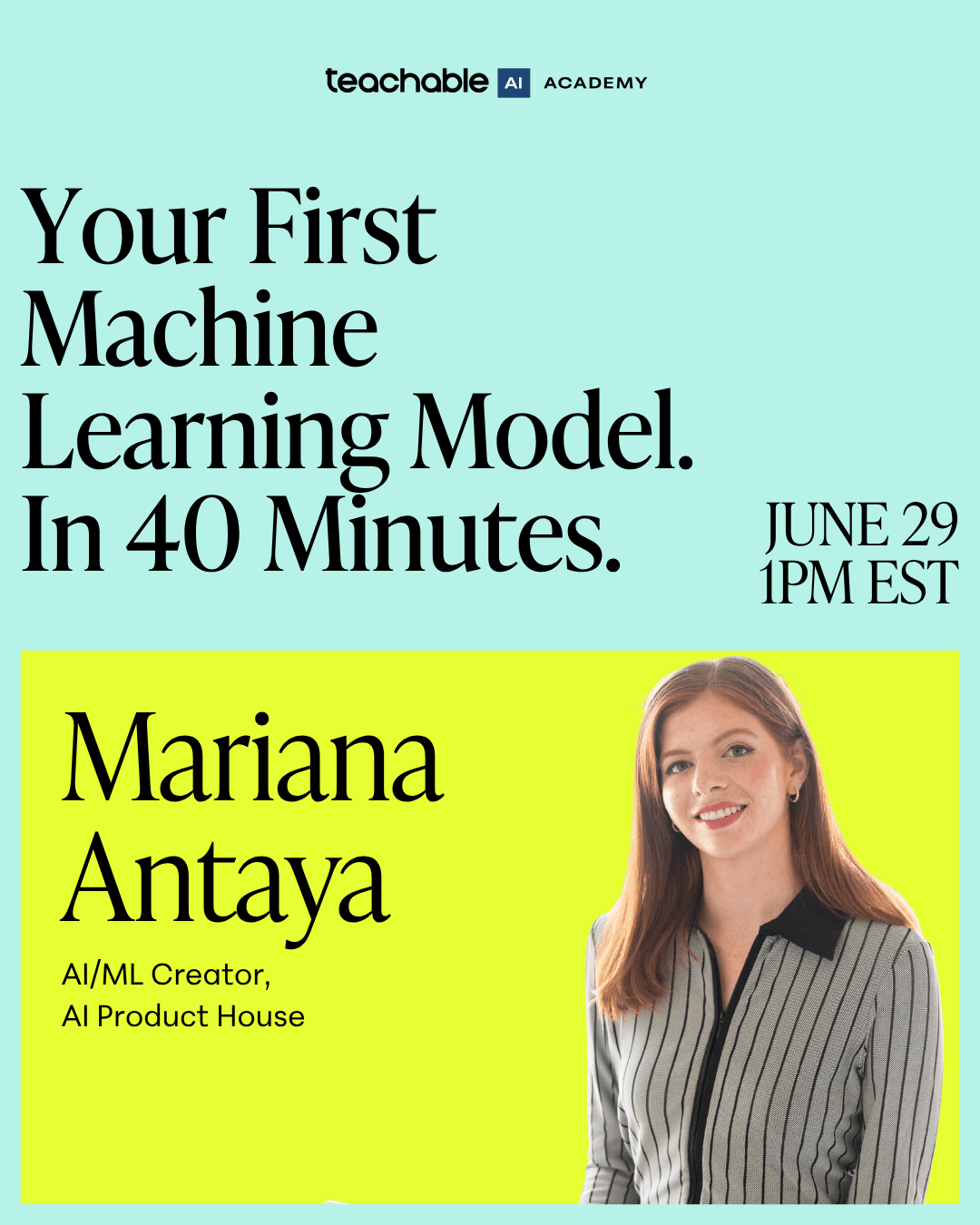
Mariana Antaya, June 29, 2026 at 1:00pm EST. Your first machine learning model. In 40 minutes.. Mariana is a former AI Product Manager at Microsoft who now ships her own machine learning models and teaches a community of more than 700,000 people. In 40 minutes she takes raw, messy e-commerce data and builds a model that answers a real business question: will this customer buy again in the next 90 days. You'll walk away with the working model, the code behind it, and a process you can reuse on any dataset.
June 2026 is only the opening stretch. New workshops drop every week through August 2026.
Names already on the schedule include Mariana Antaya, Sai Kumar, Sundas Khalid, Sadie St. Lawrence, Anjali Viramgama, Ale Thomas, Tina Huang, and Matt Wolfe.
The topics run wide: building your first machine learning model, learning data analytics with AI, building AI agents for everyday work, and using AI with more intention. We add new dates to the AI Academy page as each session locks, so it pays to check back.
One more thing worth knowing. A lot of the people teaching also sell what they know on Teachable, and any creator can do the same. Courses, coaching, memberships, and digital downloads all run on one platform, with payments handled through teachable:pay.
Registration is open for every session on the AI Academy page.
Pick the workshops that fit what you're building, save your seat, and add them to your calendar. If a date passes before you get to it, the replay will be waiting for you on Teachable.
Head to the AI Academy page to see the full schedule and register for the sessions you want.