Thank you! Your submission has been received!
Oops! Something went wrong while submitting the form.
MENU
In-depth looks at the creators, schools, and organizations turning their expertise into thriving businesses.
.avif)
Stefan Kunz can fill a room. Before he recorded a single lesson, he was teaching hand lettering in person to sold-out workshops in New York, Los Angeles, London, and beyond.
Reaching the rest of his audience meant teaching online, and the first online setup he saw up close looked complicated. Stefan taught a guest course for a fellow lettering educator whose school ran on WordPress, Vimeo, and password protection, all wired together by hand. The arrangement delivered the course. Keeping it running took constant attention.
Stefan wanted the opposite of that. He went looking for one place to build, sell, and run his courses, even if a packaged platform meant giving up some custom control. A recommendation from his friend and podcast co-host Lauren Hom pointed him to Teachable, and he has stayed there ever since.
“It felt like a platform that would let me focus on creating and teaching rather than managing technology.” — Stefan Kunz, Founder of Stefan Kunz Studio
Related: How to make money selling courses right now
Stefan never set out to become a teacher. His path ran through filmmaking, then wedding photography, then hand lettering, each craft picked up on his own and turned into a living.
Lettering took off as a trend, and people kept asking him the same question about how he did it.
Answering that question in person became a business of its own.
In 2019 he hired an assistant, cleaned out his studio, and ran his first lettering workshop off a big chalk wall in his own office, with pizza for about fourteen people. Demand kept showing up, so the rooms kept getting bigger.
By the time recording crossed his mind, he had taught hundreds of students face to face. He understood that whatever platform he picked would carry all of that online, which raised the stakes on choosing well.
That first online teaching, the guest course for a fellow lettering educator, ran on a custom mix of WordPress, Vimeo, and password protection stitched together piece by piece.
The setup delivered the lessons, and it also showed Stefan how much upkeep a hand-built system demands.
He wanted one place that handled the whole job, and he was willing to give up some custom control to get it. When Lauren Hom, his friend and Striving Artist podcast co-host, told him she was running her own courses on Teachable and loving it, the platform went straight to the top of his list.
A closer look confirmed the fit. The course builder, student management, comments, and online course tools all sat in one place, with a setup simple enough to learn in an afternoon. What stood out most was speed, since payments and delivery already worked together, so he could put his attention on the course instead of the connections between separate tools.
One detail settled it for him. Stefan could build his entire course before paying anything, which let him confirm everything worked before he committed. He created his first course, an online version of his lettering workshop, in a few days.
The feature he reaches for most today solves a problem that used to eat his evenings. Teaching a global audience, he once uploaded every video to separate services to make transcripts and subtitles by hand. Teachable now generates them for him, which feeds the kind of student experience that keeps international learners moving through a course.
“Being able to upload a video and have transcripts and translations generated automatically saves an incredible amount of time and helps me make my courses accessible to students around the world.” — Stefan Kunz, Founder of Stefan Kunz Studio
Stefan started with Teachable and has stayed. Switching platforms later, he points out, is no small task, which made getting the first choice right worth the care he gave it.
When Stefan started, having payments built into the platform mattered. He could open enrollment without wiring up a separate processor, which kept his attention on the course itself.
His needs changed as the business grew, and the platform gave him room to adjust. Stefan now connects his own Stripe and PayPal accounts through Teachable while keeping the built-in option available for whenever he wants it.
“As my business expanded, I had more flexibility to customize parts of my setup, including connecting my own payment processors like Stripe and PayPal.” — Stefan Kunz, Founder of Stefan Kunz Studio
Those options matter more for someone teaching across borders. Stefan's students reach nearly every continent, and Teachable Payments, powered by Stripe, handles tax and local payment methods across dozens of countries. For a creator selling to that kind of audience, the platform manages each market so the creator does not have to.
Stefan is the first to say there is no single right platform for everyone. Predicting how a business will grow is hard at the start, so he tells new creators to pick a tool that can grow with them.
“I would highly recommend choosing a platform that can grow with you.” — Stefan Kunz, Founder of Stefan Kunz Studio
The economics deserve early attention too. Giving up a small percentage feels minor in the beginning, and it adds up as the numbers get bigger.
“When you are just starting, giving up a small percentage may not seem significant. But as your business grows, every percentage point starts to matter.” — Stefan Kunz, Founder of Stefan Kunz Studio
The last thing he weighs is presentation. How a course looks and feels is part of a creator's brand, so Stefan wants a platform that lets him organize content, shape the student experience, and use tools like drip release to deliver a course the way he pictured it.
Take action
Stefan has launched more than 25 courses since 2019, and along the way he built a way of working that any creator with an audience can follow. The core of it is simple. He proves that people want something before he spends weeks building it.
Stefan learned this the hard way. Early on he poured months into courses he felt sure would land, then watched some of them open to near silence.
“You should sell first and then build it later. If it sells really well, then you build it. If it does not sell, what is the point of building it?” — Stefan Kunz, Founder of Stefan Kunz Studio
His model came from outside the course world. A sportswear brand he follows released a limited shoe by inviting people to enter their payment details for a chance to buy a pair, which told the brand exactly how much demand existed before it produced anything.
Stefan runs his launches on the same logic. For his animation course, he set up a tool that sent a waitlist link to anyone who commented the word animate on his videos. Around 3,000 people signed up within a couple of weeks, and that list became his proof.
“I had to have around 3,000 people on the waitlist to get 250 students. That conversion is still really good.” — Stefan Kunz, Founder of Stefan Kunz Studio
Take action
Stefan began in the smallest way possible, with a chalk wall and a pizza order.
His first workshop ran in his own office, with room for about fourteen people, and he taught it across a weekend before running it again. From there he booked a thirty-seat space, then back-to-back weekends in New York and Los Angeles with 120 seats to fill, followed by London, the Philippines, and India.
By the time recording crossed his mind, he had taught more than 300 students in person. He knew the questions they asked, the parts that confused them, and the moments things clicked.
“Start small, understand how it works, build up, and you can grow it piece by piece.” — Stefan Kunz, Founder of Stefan Kunz Studio
Take action
Stefan rarely changes his order of operations. He runs a live workshop first, turns it into a multi-week bootcamp next, and records the evergreen course last, once the material has proven itself several times.
The bootcamp stage is where Teachable's comment feature earns its place. In his weekly animation bootcamps, students post their homework and Stefan replies with video feedback, something a single-day workshop never had room for. The multi-week format makes space for that exchange, and the work students hand in gets noticeably better.
“Like a band performing the same show at different stadiums, I have refined it with every iteration.” — Stefan Kunz, Founder of Stefan Kunz Studio
By the time he records the evergreen version, real students have pressure-tested every lesson. The final course is the polished result of all those rounds.
Take action
Stefan compares a good course to a football team with one play it runs perfectly. The other side knows exactly what is coming and still fails to stop it.
“They were so good at that one single play that nobody could beat them.” — Stefan Kunz, Founder of Stefan Kunz Studio
He has watched his own launches grow so elaborate that even his team lost track of the plan. The fix was always the same. He stripped the launch back until everyone understood it again.
Simple plans are the repeatable ones. A launch you can run cleanly the second and third time is worth more than a clever one you manage to pull off once.
Take action
Plenty of creators teach students to copy one finished piece, step by step, which produces good imitations and little else. Stefan teaches the thinking underneath instead, the principles he uses to make any piece, and he gets students to a first win as fast as possible because an early result keeps them going.
He has a phrase for the balance.
“People want the quick win. So I try to hide the vegetables in the food.” — Stefan Kunz, Founder of Stefan Kunz Studio
The quick win is the food, and the principles are the vegetables. Students arrive for the result they saw on Instagram and leave able to make work of their own.
Take action
A common worry among creators is that teaching will pull them away from their craft. Stefan found the reverse to be true.
“You try to figure things out yourself, and then there comes the next level. Now you have to teach it to someone else, and that is when you learn whether you really understood it.” — Stefan Kunz, Founder of Stefan Kunz Studio
Explaining a technique forces him to understand why it works, which sharpens his own work. When he shares a method and watches other artists run with it, the pressure to find the next idea pushes him forward.
That loop is why he keeps taking client projects alongside teaching. His wife, a primary school teacher, pointed out that he learns the most when he solves real problems for paying clients. One recent brand project asked for a painterly texture effect he had never made before. He spent hours working it out, and now it is one more thing he can teach.
His path has run from lettering to Procreate to animation, and each new area started as a client challenge or a personal experiment. The teaching always follows the making.
Stefan prefers to let his reach tell the story rather than share revenue figures.
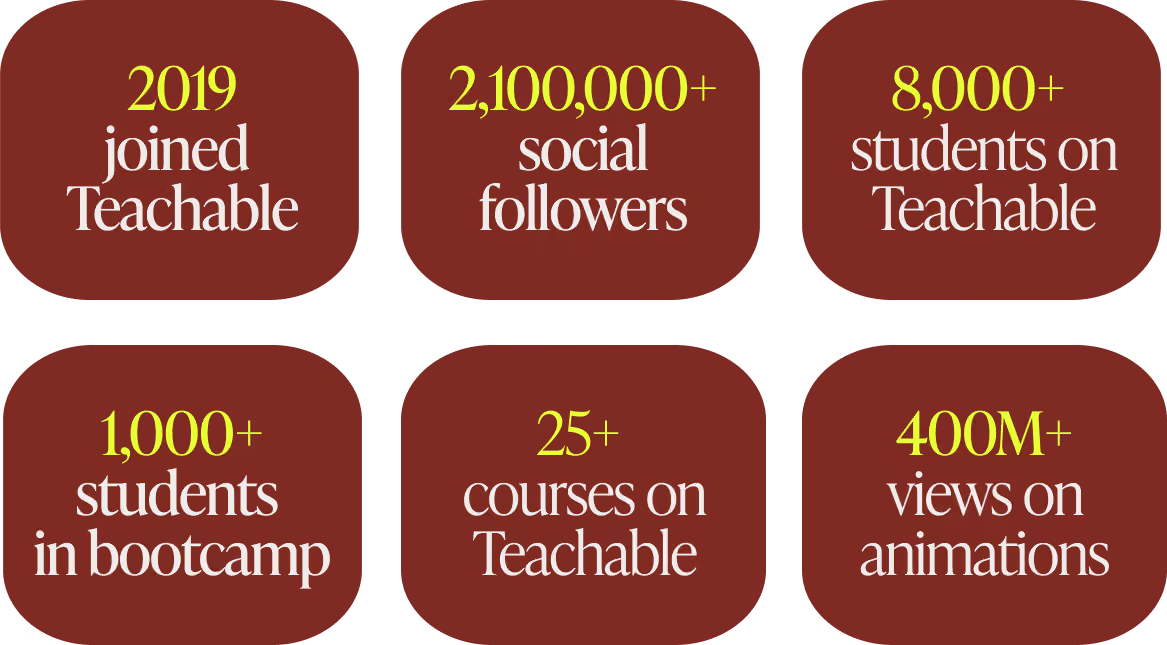
His brand animations have passed 400 million views, and his audience across social platforms sits above 2.1 million people. More than 8,000 students have come through his courses and workshops, with over 1,000 in his animation bootcamp alone. He has worked with brands including Coca-Cola, Apple, and Adobe, and he has taught students on nearly every continent.
For an artist who started by adding words to his Instagram photos, the pattern holds steady. He keeps making the work, and the teaching grows out of it.
Stefan is one of many creators using Teachable to reach students far beyond their home country. Elisa Azoum grew French Mornings to more than 2,850 language students across dozens of countries on the same platform, and Amie Tollefsrud built an eight-figure course business on it. The pattern repeats: real expertise, a clear program, and a platform that travels with the student.
Stefan's focus right now is client work, which has kept him busier this year than ever. He treats every project as research.
The lessons stack up quietly. How to use AI as a real tool in animation rather than a shortcut, how to build a studio camera setup, how to edit a video that travels well. Each one is a future course waiting for the right moment.
When the season turns and he has room to teach again, the material will be ready. The order will stay the same as always. Prove the demand, run it live, then record it.
The wider market is moving in his direction. Goldman Sachs Research projects the creator economy could reach $480 billion by 2027, roughly double its 2023 size. Creators who prove demand before they build, the way Stefan does, are the ones ready to claim a share of it.
See Stefan's work: Follow his animation on Instagram and YouTube, explore his Teachable school, or browse his full portfolio at stefankunz.com. You can also hear him on the Striving Artist podcast.
Read more creator stories: See how Youness School chose Teachable to train more than 2,000 engineering-prep students, and browse the full Success Stories collection.
Learn the sell-first approach: Stefan proves demand before he builds. For more on that, read how to make money selling courses right now.
Try Teachable yourself: Teachable gave Stefan one place to build, sell, and run his courses, with Teachable Payments handling tax and local methods for a global audience. Start your free Teachable trial and build the course your audience keeps asking you for.
Before Youness Es-Sebiy built Youness School into a course business that has trained more than 2,000 students, he did what most serious creators do first: he tried the other options.
He taught on several platforms and compared what each one actually delivered for his school.
The answer he reached was Teachable, and he is direct about the reasons.
"I have tested other platforms in the past, including Thinkific and Podia. While they are good platforms, I ultimately chose Teachable because of two factors that were very important for my business and my students … The first is security … The second is the mobile learning experience." — Youness Es-Sebiy, Founder of Youness School
That decision came from someone who knows the stakes from the inside. In Morocco, the road to a top engineering school runs through CPGE, the Classes Préparatoires aux Grandes Écoles: two intensive years after high school studying advanced math, physics, chemistry, and engineering sciences, then one national exam that decides which schools will take a student. Youness went through all of it. He reached the other side and graduated from École Hassania des Travaux Publics, one of the leading engineering schools in the country.
Then he started teaching the students coming up behind him. He launched Youness School in 2019 while he was still an engineering student himself, recording lessons for the exact exams he had just survived. By 2023 the school was his full-time work.
Today it has directly supported more than 2,000 students preparing for Morocco's national exam (the CNC) and the French Grandes Écoles exams, with more than 20,000 others reached through free lessons and his YouTube channels across Morocco, France, Tunisia, and Mauritania.
The two reasons he named for choosing Teachable, security and the mobile experience, run through every part of how that school works.

Youness built Youness School around a problem he had felt directly. CPGE students carry an enormous load across many subjects, and a lot of them hit a wall in one or two of those subjects with little structured help to get past it. He wanted to give them that help in a format that fit how they actually live and study.
" I went through the same preparatory classes, and they were very difficult. My goal is to help students who are facing the same problems, to help them grow and reach the best engineering schools." — Youness Es-Sebiy, Founder of Youness School
He made one early decision that shaped everything after it. Youness School would be online only. He had looked at in-person tutoring and found it too limited for what he wanted to build.
"We chose e-learning because we find the platforms very efficient. Physical classes are limited, and for our students online learning is the best solution." — Youness Es-Sebiy, Founder of Youness School
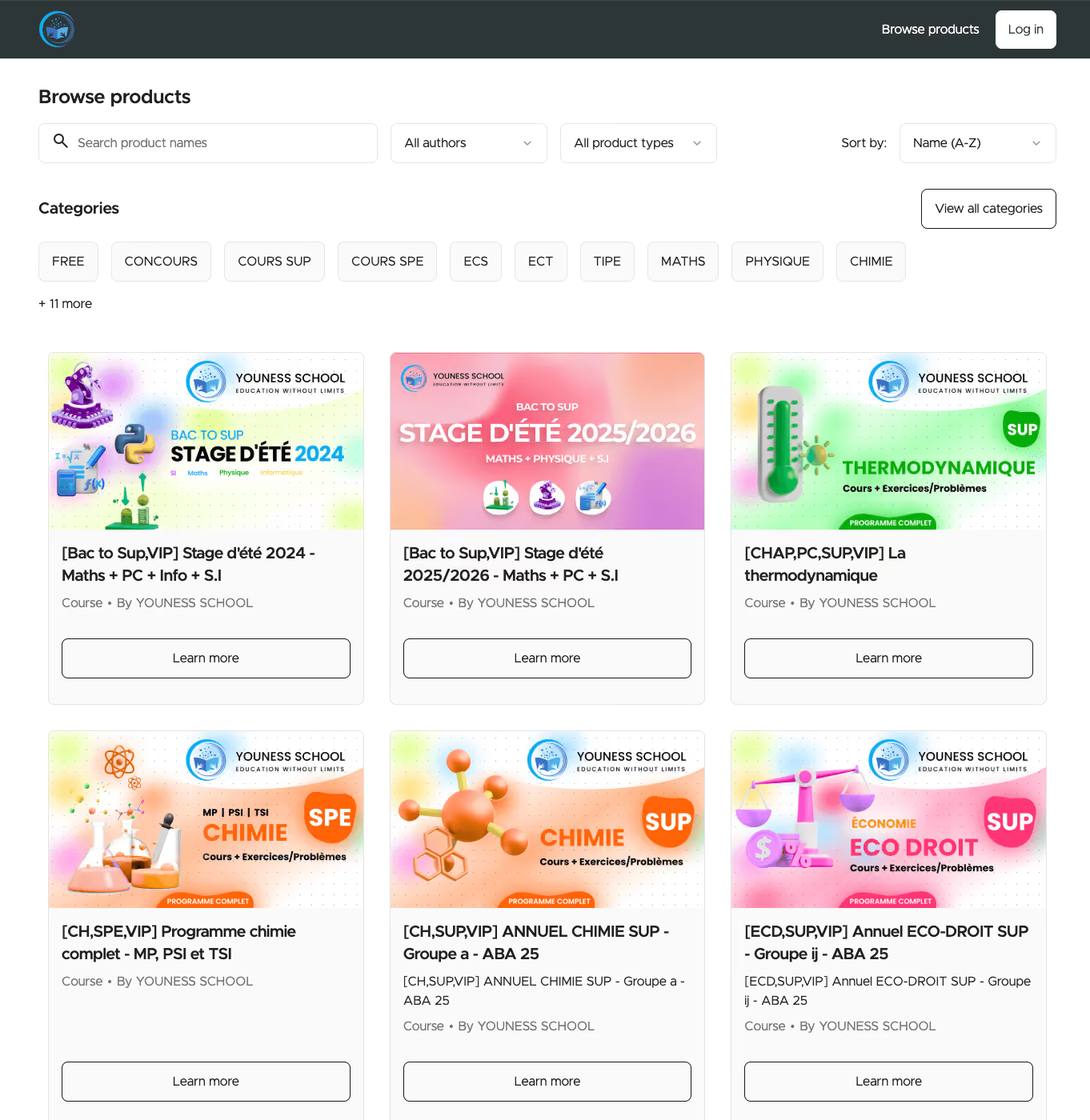
That decision raised the stakes on the platform itself. If an entire school lives online, the platform has to protect the content, reach students on whatever device they own, and keep working when the connection drops. Those three requirements are what pointed Youness toward Teachable over the other tools he had tried.
Youness runs the school with the same clarity he asks of his students. Five choices shape how Youness School finds, teaches, and keeps its students.
Most enrollments at Youness School begin with a conversation, usually on WhatsApp, where his sales team finds out where a student is actually struggling before recommending anything.
"In the beginning, we try to understand the needs of the student. If a student has problems across many topics, we offer a bundle with the whole platform. If they only have difficulty in one subject, we give them one or two courses." — Youness Es-Sebiy, Founder of Youness School
The result is a recommendation matched to what the student actually needs. A student weak in one subject buys a single course. Someone starting the full two-year climb buys a bundle, which Teachable lets him package as one grouped program.
Take action
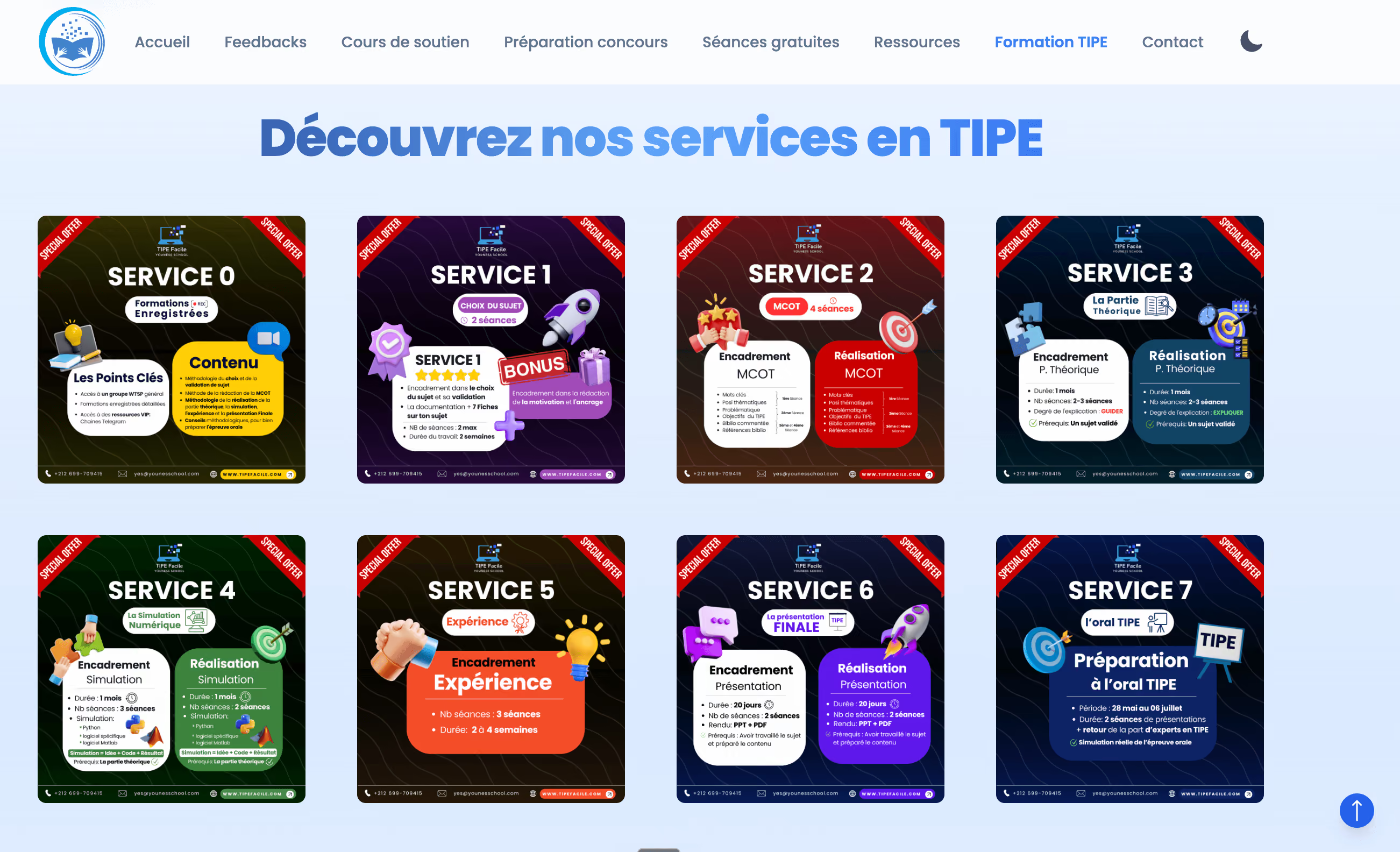
Youness School runs on three formats at once: recorded lessons students watch on their own time, live sessions with collaborating professors, and one-on-one coaching.
"We use both approaches. We have recorded classes on the platform with Teachable, and we have live courses with professors who teach in these preparatory classes. There is also coaching to answer questions and correct their work." — Youness Es-Sebiy, Founder of Youness School
The recorded library carries the core curriculum and reaches every enrolled student. Live sessions and coaching cover the moments where students need a person in the room with them: stuck on a problem set, preparing for a mock exam, or talking through method. Together they create the kind of student experience that keeps learners moving through the material.
Take action
For a school that sells exam-prep video, the content is the product. Youness named content protection as one of the two factors that decided his platform choice.
"As an online school, protecting our educational content is a top priority. I found Teachable's video hosting and content protection to be particularly strong, which gave me more confidence using the platform for premium courses." — Youness Es-Sebiy, Founder of Youness School
Secure video hosting keeps his lessons from leaking out, which matters when the same exam prep sells to a fresh cohort every year. Content that walks out the door loses the value he priced it on.
Take action
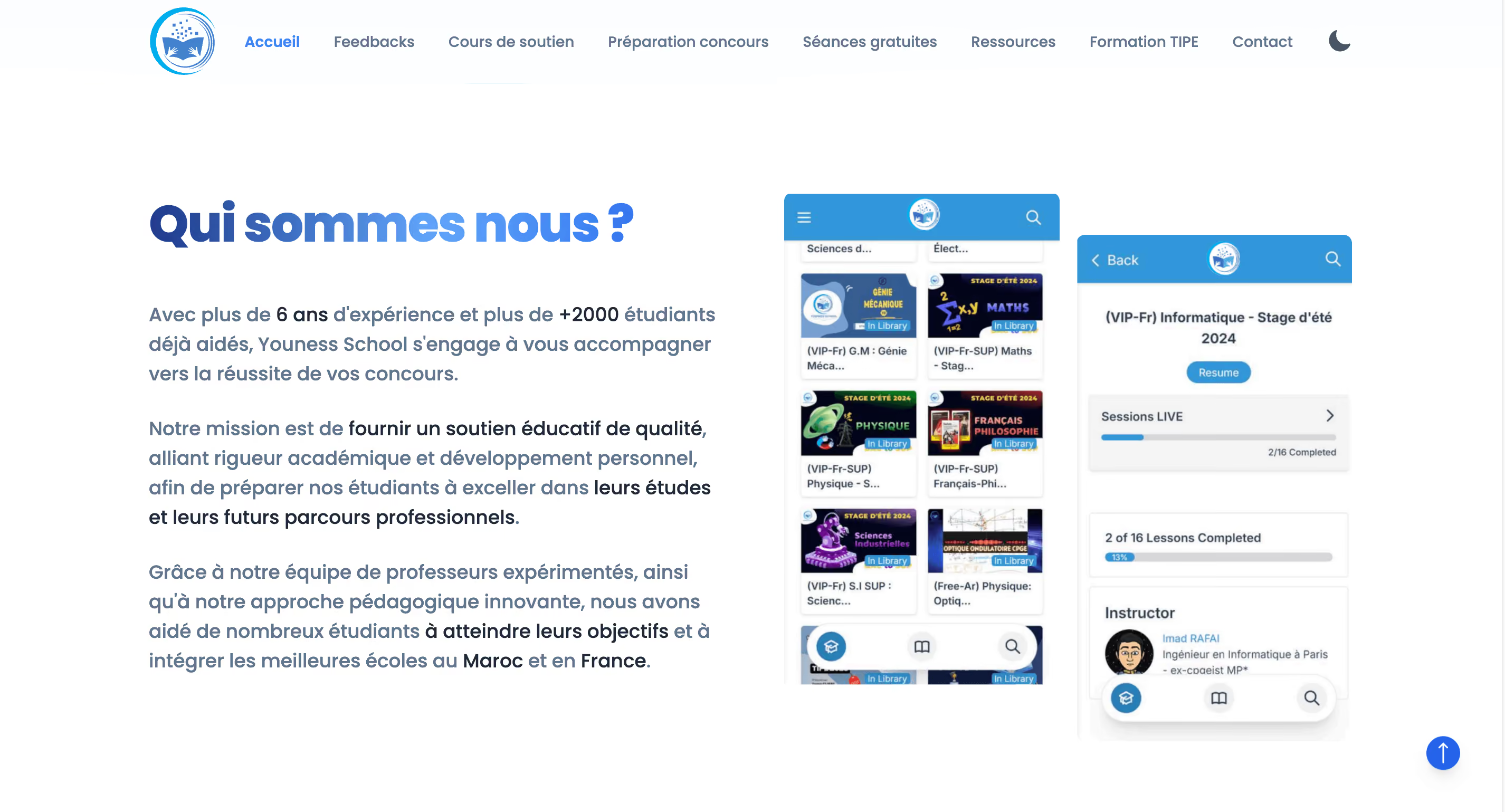
This is the choice most specific to where Youness teaches. His students are spread across Morocco and the wider Francophone world, and the connection they study on is uneven. The Teachable mobile app, and offline downloads in particular, became central to how the school reaches them.
"The mobile app lets students access their courses easily on their phones and tablets. The ability to download videos for offline viewing has been extremely valuable, especially for students who do not always have a stable internet connection." — Youness Es-Sebiy, Founder of Youness School
The context behind that quote is real. In 2025, about 36 percent of people in Africa used the internet, the lowest rate of any world region, according to the International Telecommunication Union. For a student living inside that gap, a course that only streams is a course that stalls every time the signal drops. An offline download turns a commute, a power cut, or a weak connection into study time.
Take action
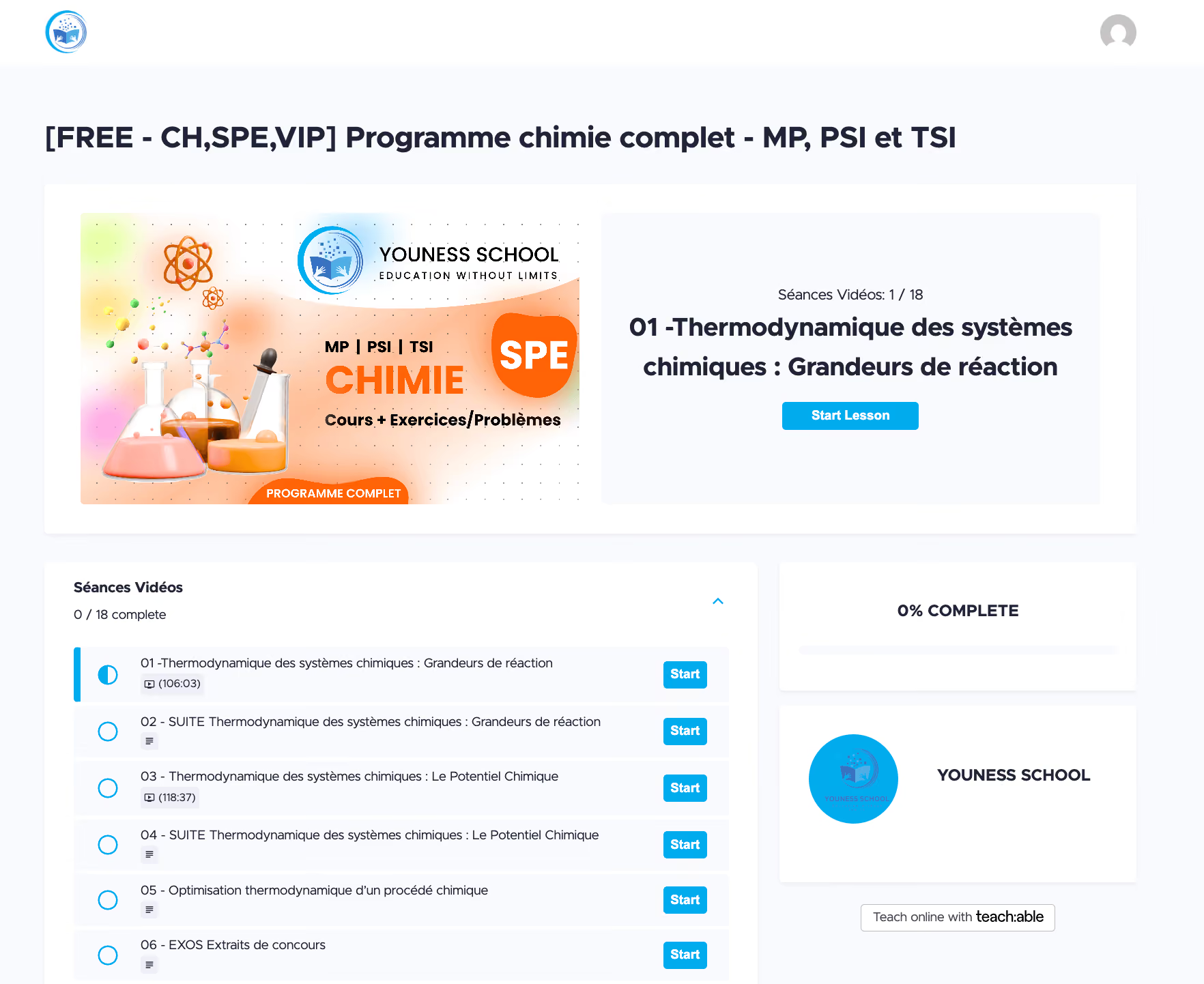
Youness prices across a wide range, from single courses around $60 to full programs above $1,000, so a student pays only for what they need. He also gives free access to families facing financial hardship, and he has used free trial periods to let students try the school before paying.
"We give some courses for free to families facing financial difficulties. We want talented students to have access regardless of their financial situation." — Youness Es-Sebiy, Founder of Youness School
More than 5,000 students have come through Youness School's free-access and trial campaigns, which widened his reach and let prospective students experience the platform before buying. Payment access shapes the model too. In Morocco, many students and parents pay by bank or cash transfer, and a card is rarely the default, so a real conversation often comes before a sale.
Take action
Youness built the school around one belief, and he states it plainly.
"We believe talented students should have access to elite-level education regardless of their city, country, or financial situation." — Youness Es-Sebiy, Founder of Youness School
That belief is why offline access matters so much to him, and why the price range stays wide. The students he most wants to reach are often the ones with the least reliable connection and the tightest budgets. Building for them first is what makes the school useful to everyone else.
The measure that matters to Youness is straightforward: whether his students get into the schools they are aiming for. Since 2019 he has worked directly with more than 2,000 of them, with another 20,000-plus reached through free lessons, webinars, and his YouTube channels. They sit the same national exam he once sat, and the strongest performers go on to the top engineering schools in Morocco and France.
"My advice would be to focus on the student experience and content protection. If security, accessibility, and mobile learning matter to you, I would recommend Teachable. Students can learn from any device and access content wherever they are, and that makes a real difference." — Youness Es-Sebiy, Founder of Youness School
Youness is one of a growing number of creators using Teachable to teach students far beyond their home country. Elisa Azoum grew French Mornings to more than 2,850 language students across dozens of countries on the same platform. The pattern is consistent: subject expertise, a clear program, and a platform that travels with the student.
Youness has a wider plan for the school. CPGE is a small field by design, with roughly ten thousand students entering each year in Morocco. He wants to take the same model to high school students, a group he puts at around half a million in Morocco alone, and eventually to learners in other countries.
"I have a global strategy to develop Youness School and help more people. In Morocco there are about half a million high school students, and we want to give them similar platforms and solutions." — Youness Es-Sebiy, Founder of Youness School
The plan he describes brings together education, technology, and the careful use of AI, built for students who would otherwise sit outside the reach of this kind of coaching.
Youness's students pay differently than a US or European creator's audience does. Cards aren't the default in Morocco. Many families pay by bank transfer. And selling across Morocco, France, Tunisia, and Mauritania means four different markets, currencies, and different sets of tax rules.
But the best part is that, in the near future, Youness won't ave to manage payments manually.
That's exactly what Teachable Payments is built for. Local payment methods appear automatically at checkout based on where the student is. Tax is calculated, collected, and remitted across 45+ countries without the creator filing anything. Prices display in the student's local currency without manual configuration.
For a school built around the belief that talented students should have access regardless of where they live, the checkout experience should reflect that too, and now it does.
Explore Youness School: Visit younesschool.com to see the courses and programs, and youness.online for more on Youness's work. Follow Youness Es-Sebiy on LinkedIn and YouTube, and follow the Youness School YouTube channel and company page on LinkedIn.
Try Teachable today: Youness built a school that protects its content, reaches students on any device, and keeps teaching when the internet drops. Teachable handles the video hosting, the mobile app, and the payments so creators can spend their time with students. With Teachable Payments, that now includes local payment methods for an international student base like his.

Amie Tollefsrud calls herself a lazy person. She has generated over $11 million on Teachable saying so.
"I am a self-proclaimed, very lazy person." – Amie Tollefsrud, Founder of Rebelle Nutrition and Lazy Millionaire
Most creators treat that word as the enemy. Amie treats it as the whole strategy.
She runs an eight-figure course business from her bed or a beach club lounger, and she got there by doing less of the wrong work, not more of it. The lazy move, in her hands, keeps turning out to be the smart one.
Before the eight figures, Amie worked a nannying job and felt certain it was not going to be her life. She trained as a nutritionist, started seeing clients one-on-one, and hit the ceiling every service provider eventually hits.
There are only so many hours in a day, and trading them for money never scales.
So she did the lazy thing, which also happened to be the smart thing. Amie took the advice she repeated to clients over and over and built it into an online course that could reach all of them at once.
"That's when I created my first online nutrition course to try and reach and help more people all at once. A little less effort from there." – Amie Tollefsrud, Founder of Rebelle Nutrition and Lazy Millionaire
She built that first course from a tiny hut in Maui, carrying five figures of debt and using an outdoor toilet. Amie had no business degree, no investors, and by her own account no tech skills. The slick tools creators reach for today did not exist for her, so she sold it without them. Then she ran her first launch.
"One of my first course launches ever, I think I had made like $5,000 in the span of an hour. And I just remember, like, jumping up and down. [It] was the most money I'd ever made at once in my entire life." – Amie Tollefsrud, Founder of Rebelle Nutrition and Lazy Millionaire

The nutrition courses worked, and as they kept working, her audience started asking her about something other than nutrition.
"All anybody ever wanted to ask me was, like, how I ran [and] how I built [my] business online, because it allowed me to travel the world and really do all the things that I dreamed about growing up." – Amie Tollefsrud, Founder of Rebelle Nutrition and Lazy Millionaire
That repeated question was its own market research. Her audience told her what they wanted before she ever built it, the exact validation signal she now teaches her students to watch for.
So she followed it. The nutritionist became the course-creation expert.
That pivot grew into Rebelle Nutrition's eight-figure education business: Online Course Academy, Passive Income Academy, and the program that ties them together, the Lazy Millionaire Method, which has helped more than 4,000 students across niches build profitable courses of their own.
Amie has been on Teachable since close to the platform's earliest days, running the same play on repeat for the better part of a decade: take lived experience, turn it into a course, sell the shift it creates, and let it run.
The throughline from that first nutrition course to the business today comes down to a handful of principles Amie applies every single time. Here are the ones doing the heaviest lifting.
The biggest mistake Amie sees in first-time creators is selling the wrong thing. They list their modules, their PDFs, their hours of video, then wonder why nobody buys.
"When somebody buys a course, they're not just buying the number of lessons or modules or PDFs. They're buying a shift, a shift in how they feel, how they think, what they can do, or what their life is going to look like after the course is finished." – Amie Tollefsrud, Founder of Rebelle Nutrition and Lazy Millionaire
Amie points to her own dentist as the perfect salesperson.
Curious about Invisalign, she expected a pitch about process and timeline. Instead he showed her a photo of her teeth that day, next to a mockup of her teeth a year later. He simply sold her the result she actually wanted.
"Immediately, I was like, 'Take my money. I want that.'" – Amie Tollefsrud, Founder of Rebelle Nutrition and Lazy Millionaire
Amie has her students build what she calls a before-and-after blueprint. They write the student's exact frustration today in the student's own words, then the specific, tangible result waiting on the other side.
The result has to be concrete, never a fuzzy phrase like "feel empowered." It should be something a person could physically point to, like "I don't even need to wear foundation anymore because my skin is so clear," or "I got my 5K down by five minutes." The course becomes the bridge between those two points.
Take action
Selling a shift only works when it gets specific enough that the right person cannot scroll past it.
"Vague doesn't sell. Specific sells. Specific is what makes people stop scrolling. Specific is what makes people pull out their wallets and buy." – Amie Tollefsrud, Founder of Rebelle Nutrition and Lazy Millionaire
Her litmus test sits in the gap between "Learn how to eat clean" and "A step-by-step guide to clear your hormonal acne in 30 days."
Identical expertise sits underneath both titles. The second one aims at one specific person with a real promise, and that version is the one that sells. Broad offers leave buyers quietly wondering whether the thing is really for them, and uncertainty kills the sale.
"When somebody is not sure, they do not buy. But when your offer is specific, it builds instant trust. It shows people that you know exactly what they're going through and exactly how to help them." – Amie Tollefsrud, Founder of Rebelle Nutrition and Lazy Millionaire
Amie pushes for a timeframe wherever it stays honest, such as "in 30 days" or "in 90 days," because a clear timeline makes the result feel achievable. She also insists on the buyer's actual language over insider jargon.
Take action
Amie is blunt about why so many capable creators, even ones with big audiences, launch into silence. They guessed.
"You wouldn't want to open a French bakery without knowing if anyone in town likes croissants, right? So same thing here. Let's make sure you're baking what people are actually hungry for." – Amie Tollefsrud, Founder of Rebelle Nutrition and Lazy Millionaire
Her method skips surveys and spreadsheets.
Amie has creators hold three to five real conversations with people who feel like ideal students, through DMs, email, or a quick call.
The questions stay simple: their biggest frustration with the topic, what they have already tried and why it fell short, and whether a step-by-step course to the result would actually help. Then she listens for the line between polite interest and real urgency.
"We're not looking for perfection, we're just looking for proof. Proof that your idea has legs, and proof that people are already searching for this solution." – Amie Tollefsrud, Founder of Rebelle Nutrition and Lazy Millionaire
She also reframes the whole exercise so it never feels like begging for approval.
"Validation is not about asking for permission. You are the expert. You have the vision. This is just about making sure that your offer meets people where they are before you invest the time turning it into something amazing." – Amie Tollefsrud, Founder of Rebelle Nutrition and Lazy Millionaire
Take action
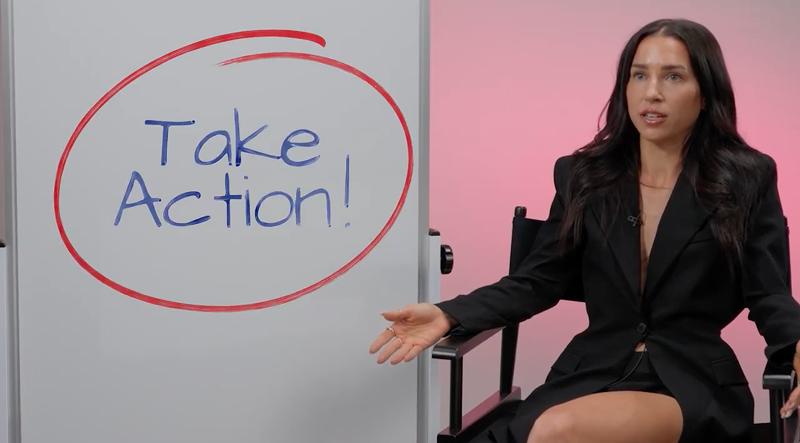
For all the strategy, Amie credits one unglamorous habit above the rest. She ships before it is ready.
"That's also, I think, exactly why I have been successful, because I take action and I launch things actually before they're perfect." – Amie Tollefsrud, Founder of Rebelle Nutrition and Lazy Millionaire
Her first launch, by her own description, was scrappy and far from what she wanted. It still made $5,000 in an hour.
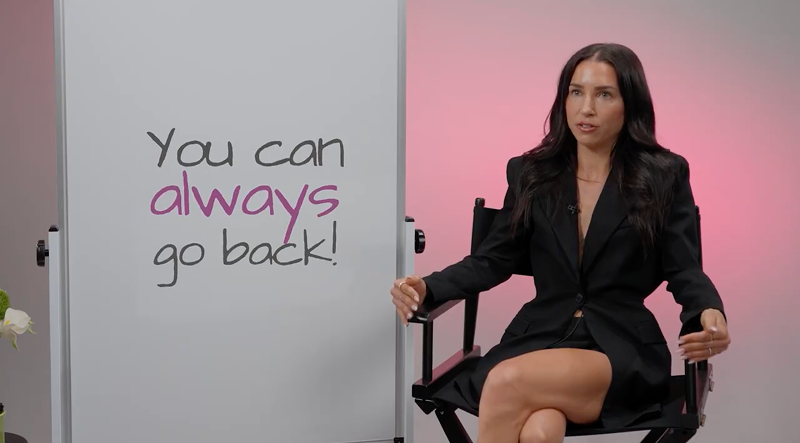
The creators who never break through are usually the ones tweaking and refining until the moment to launch quietly slips past.
"Launch quickly and fast and let it be imperfect. And also just always go back and iterate, like, there's always something you can make better, and then you can get, like, 1% better every time. And it really, over time, does make a difference." – Amie Tollefsrud, Founder of Rebelle Nutrition and Lazy Millionaire
That iteration habit also keeps students coming back. Asked what most reliably turns a one-time buyer into a repeat customer, Amie answered without hesitating.
"The results that they get the first time around. So if they feel like you went above and beyond the thing that they thought they were going to get, they're definitely going to come back in for a second time." – Amie Tollefsrud, Founder of Rebelle Nutrition and Lazy Millionaire
Take action
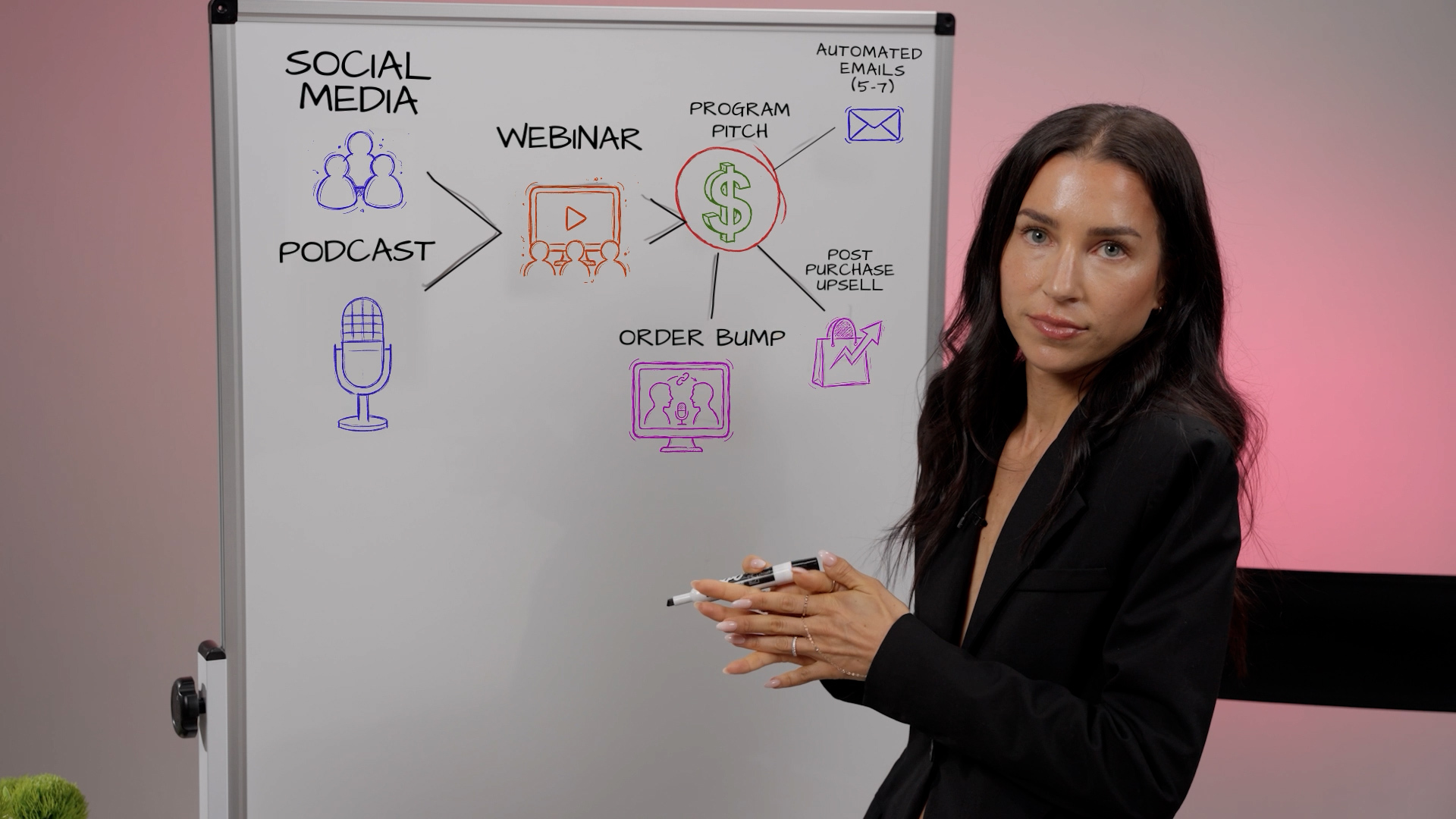
Amie's revenue does not come from chasing new customers all day. It runs on a system that works without her and pulls more value from every person who already decided to buy.
The top of her funnel is her audience on Instagram, TikTok, and now Substack. From there she offers something free and valuable, a fully automated hour-long masterclass, and sells her program at the end of that training.
Automated email sequences of five to seven messages follow up over the next week with anyone who did not buy right away, paired with a real reason to act now.
The lazy genius shows up in what she layers on top: order bumps and post-purchase upsells.
"Think about, like, when you're at the grocery store and there's all the candy right before you checkout, the people are buying things anyway. So at the last minute, it's a really good time to upsell them on similar items that they might also want." – Amie Tollefsrud, Founder of Rebelle Nutrition and Lazy Millionaire
Someone who just decided to spend money will spend a little more, so one buyer becomes worth far more without any extra traffic.
"It's just a really easy and lazy way, honestly, to generate more revenue with the same amount of effort. You [don't] have to be continuously, like, chasing down [a new] client. You can just make more off of the one-time purchase." – Amie Tollefsrud, Founder of Rebelle Nutrition and Lazy Millionaire
Take action
The obvious objection to any course in 2026 sounds simple. Plenty of people ask why they would pay for a course when AI hands over information free.
Amie does not dodge that objection. She agrees that good free information exists everywhere, then explains why it falls short of the real thing.
"[AI] can give you a lot of valuable information, but [it hasn't] actually done the thing in real life and achieved the results that you're looking for. Like a human can." – Amie Tollefsrud, Founder of Rebelle Nutrition and Lazy Millionaire
Her edge comes from having lived the outcome she teaches, start to finish.
"I actually have achieved the results that I'm teaching in real life. I'm somebody who literally started from zero. I didn't have any money to invest. I didn't even have tech skills... I went through years of, like, struggle and figuring it out and trying things that didn't work and failing. And that was years of experience in real life." – Amie Tollefsrud, Founder of Rebelle Nutrition and Lazy Millionaire
She sees the same change defining the whole industry. The creators who win next will skip the losing game of competing with a chatbot on facts.
"The next wave of successful course creators will be the ones who are thinking really innovatively about what they can offer and sell that is... offering people more than what they can just go to [AI] and find an answer to." – Amie Tollefsrud, Founder of Rebelle Nutrition and Lazy Millionaire
In practice, that means pairing the digital course with something only a person can give: community, group support, an occasional live touchpoint, whatever fits the creator's energy and style.
This reframe helps any creator worried that AI made their knowledge worthless. Amie's bet runs the other direction. The more information becomes free and instant, the more valuable a real guide who has walked the path becomes.
"People don't want a robot or a guru or a PhD professor. They want a real person who's relatable and a few steps ahead of them." – Amie Tollefsrud, Founder of Rebelle Nutrition and Lazy Millionaire
These days, Amie is most excited about Substack, which she started in the past year.
It has become both a fresh revenue stream and a surprisingly strong top of funnel. Readers who find her there often go on to buy her courses, sometimes converting better than social media. Her approach to it stays pure Amie: every post gets treated like a tiny product.
"I look at every article I write almost like a 12-minute course." – Amie Tollefsrud, Founder of Rebelle Nutrition and Lazy Millionaire
For someone who has done eight figures, she stays remarkably clear that the path was never about being special.
"To be honest, I always imagined that this would be my life... I just had no clue, like, how [I was] actually going to do that." – Amie Tollefsrud, Founder of Rebelle Nutrition and Lazy Millionaire
The advice she would give the version of herself still working that nannying job is the same advice underneath everything she teaches today.
"Keep going. Let the things that you are excited about drive you. If you feel this excited about something, you're probably onto something. Keep going. Keep doing it, because it's just going to lead you to [the life] that you've always dreamed of." – Amie Tollefsrud, Founder of Rebelle Nutrition and Lazy Millionaire
Get Amie's free playbook: Grab The Profitable Course Playbook on Teachable, where Amie walks through how to find the right course idea, validate it, and build something people actually pay for.
Watch the full interview: See Amie tell her complete story on YouTube.
Explore more from Amie: YouTube | Instagram | Teachable School | Website
Explore more creator stories: Read how other educators are winning on Teachable in our Success Stories collection.
Try Teachable yourself: Amie turned a scrappy first launch into an eight-figure business by selling the shift her students want, validating before building, and refusing to wait for perfect. Start your free Teachable trial and build the course your audience already keeps asking you for.
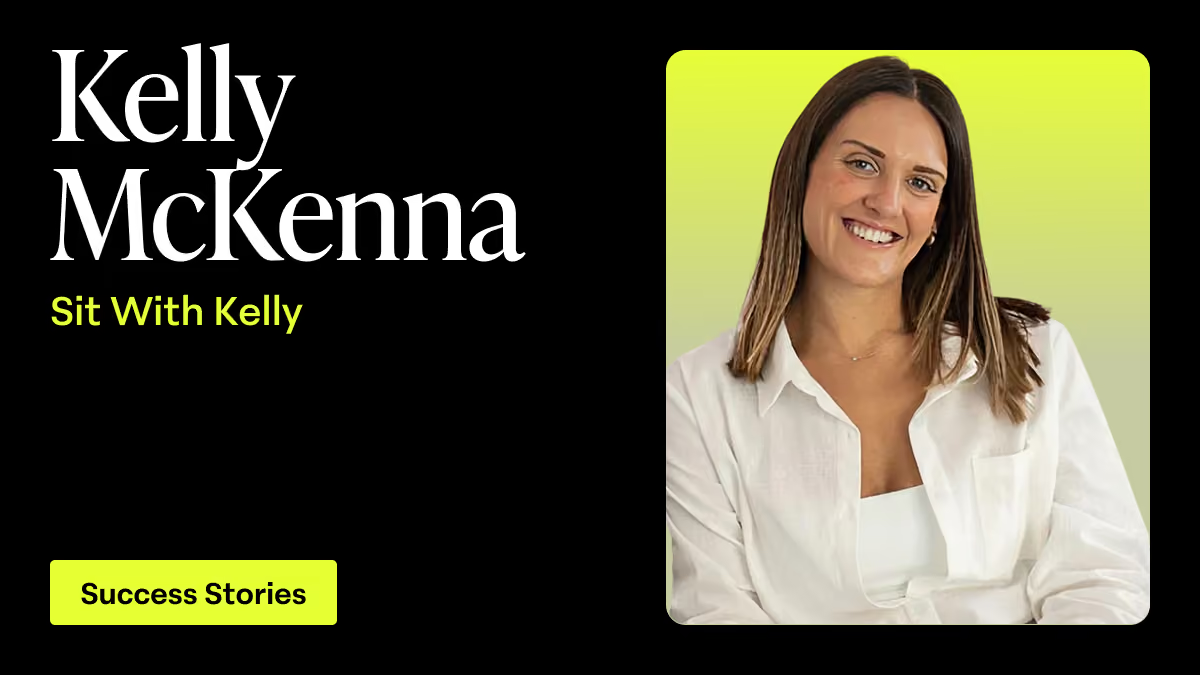
Kelly McKenna's grandmother was a therapist. Kelly always assumed she would be one too.
She earned a Master of Social Work and an MBA from Florida State University, then spent eight years running programs at a nonprofit, managing over $10 million in federal funding and overseeing housing services for veterans and LGBTQ youth. She was good at the work. She was also exhausted by it.
When she began seeing private therapy clients on the side, she did what she had always done: she worked in the open. She shared candidly about her own anxiety. She celebrated on Instagram when she left insurance panels, filled her caseload, and quit her full-time job.
The account grew because people across the country recognized something in her posts they had never quite seen before: a therapist being a real human.
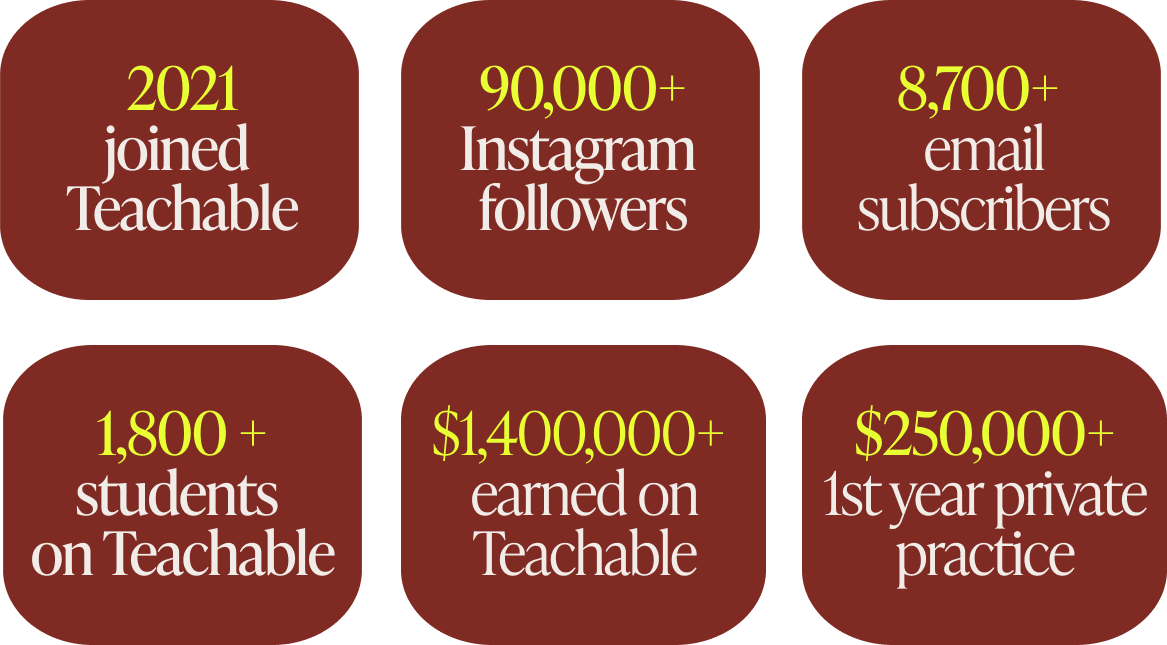
By the end of her first full year in private practice, Kelly had earned $250,000. Within four years, her revenue across practice and digital products had crossed $1 million annually.
"Creating a private-pay practice didn't just transform my income, it transformed my life. I became a better therapist, a more present wife and mother, and built a business aligned with the life I actually wanted to live." — Kelly McKenna, LCSW, MBA, Founder of Business of Therapy
When Kelly's Instagram audience started growing, so did the demand for her time. She filled her caseload, and quickly other therapists started asking her for help.
Therapists booked coaching calls. They asked how she found clients, how she left insurance, how she thought about pricing. She answered the same questions over and over: how to write a bio, how to structure content, how to set up a scheduling system.
She was managing a full therapy caseload at the same time. The math on one-on-one coaching made no sense as a long-term model. The calls were useful, but there was a ceiling baked into the format.
"There was a clear moment when I realized something had to change. I was receiving more inquiries and coaching requests than I could realistically handle alongside my full therapy caseload. It became obvious that continuing to grow demand without changing my delivery model would lead to burnout." — Kelly McKenna, LCSW, MBA, Founder of Business of Therapy

She had already built her first digital product: an anxiety course that mirrored the work she did in session, structured as psychoeducation followed by ten coping strategies with video lessons and downloadable handouts.
The signal that a course for therapists made sense: therapists kept DMing her asking her for help and booking 1-1 calls. The market had been asking for something before she had built it.
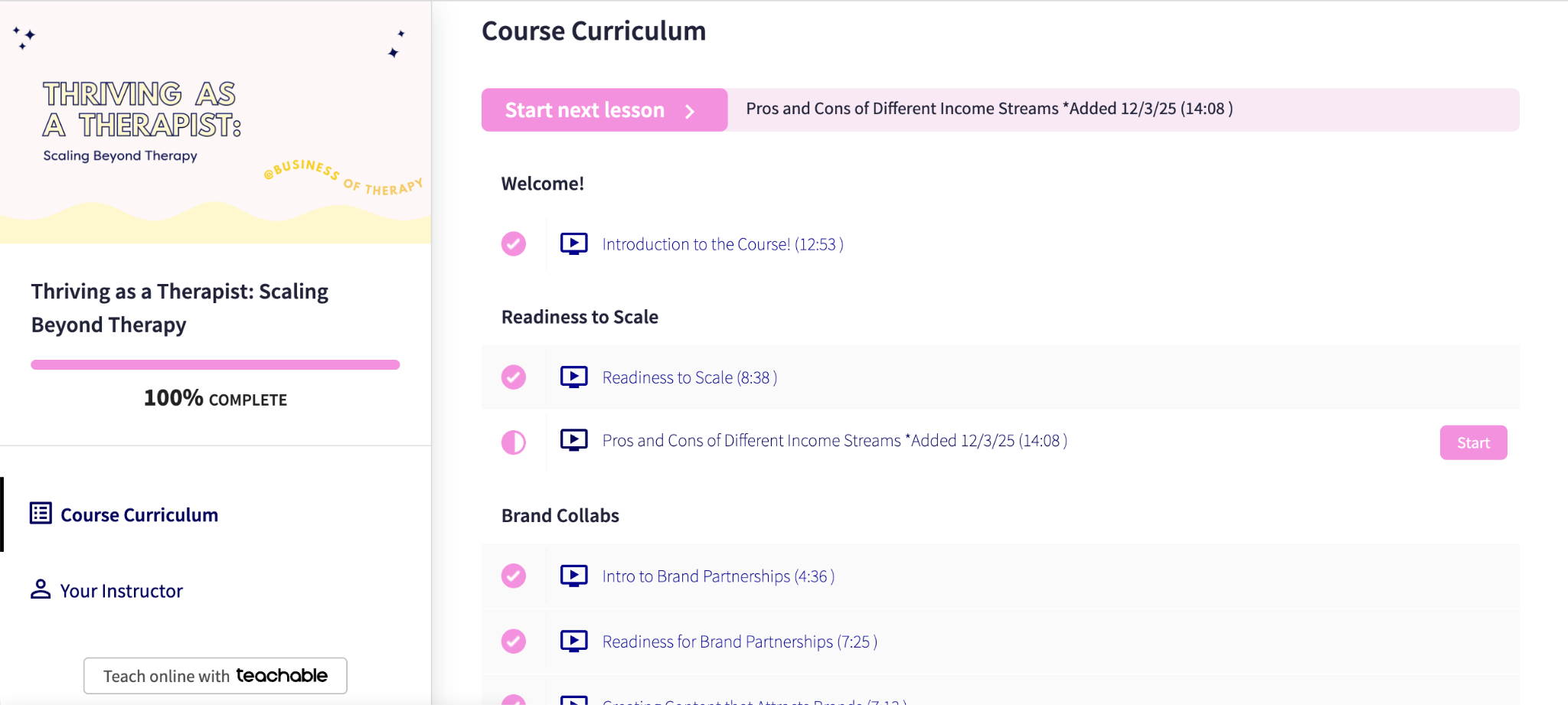
She moved the coaching content into a structured course, kept her therapy clients, and launched what would become the Private Practice Academy Bundle. Teachable was the platform she chose after testing several options. The interface was clean, the pricing was accessible, and the setup was direct enough that she could focus on the curriculum rather than the tech.
"I was drawn to Teachable's strong reputation, clean interface, ease of use, and low prices. After testing the free trial and experiencing how intuitive the setup was, it felt like the right platform to confidently build and scale my digital products." — Kelly McKenna, LCSW, MBA, Founder of Business of Therapy

Kelly did not separate her identity as a therapist from her identity as a business owner. The clinical training she had spent years developing turned out to be directly relevant to every part of her marketing work. Her approach to building the business reflected that.
Kelly's Instagram accounts grew because she said things other therapists in her position were not saying. She talked about her rates. She talked about leaving insurance panels. She documented the process of building a caseload in real time, including the parts that were uncertain.
This was not a calculated content strategy at the start. It was how she naturally worked. Clinical training taught Kelly about rapport and authenticity. Kelly brought that same instinct to her posts.
"As I built my own business publicly, I shared the real-time process including the wins, the pivots, the fear, and that transparency became a core value of my brand." — Kelly McKenna, LCSW, MBA, Founder of Business of Therapy
The result was that both therapy seekers and therapists who found her account recognized themselves in what she was describing. Kelly eventually started a second Instagram page @businessoftherapy. The posts about money and burnout and how to price sessions landed because they named things the profession tends to avoid naming publicly. Her @businessoftherapy account grew from zero to over 50,000 followers since December 2022. And her therapy-focused account @sitwithkelly has grown to nearly 100,000.
Take action
One of the clearest ideas in Kelly's teaching is that therapists already know how to market themselves. They have just never been told to think of it that way.
"Marketing, at its core, is reflective listening — understanding someone's pain, naming it clearly, and mirroring that back to them. That's exactly what therapists do every single day. When therapists learn how to translate their clinical skills into client-centered messaging, marketing stops feeling salesy and starts feeling aligned." — Kelly McKenna, LCSW, MBA, Founder of Business of Therapy
This reframe is the engine behind everything she teaches. Therapists arrive at her course convinced they have no marketing ability. They leave understanding that the skill they have been practicing in session for years, hearing what someone says, reflecting it back clearly, identifying the underlying need, is exactly the skill that makes marketing work.
The practical effect is that her students do not have to become different people to grow their practices. They apply what they already know in a different context. For many of them, that shift alone changes their relationship to the whole idea of putting themselves out there.
Take action
Kelly's first digital product, the anxiety course, was priced as a low-ticket entry point. The Private Practice Academy Bundle went in the opposite direction.
The original presale price was $447. Then $597. When she rebuilt and rebranded the course and added substantial new content, the price moved to $1,397. She runs regular launch pricing at $997, which is still a meaningful investment for most buyers.
"I firmly believe therapists are naturally some of the best marketers but they just don't realize it. Every therapist deserves to make six figures." — Kelly McKenna, LCSW, MBA, Founder of Business of Therapy
The pricing reflects the outcome on offer. A therapist who fills her caseload with private-pay clients at $250 per session and sees 15 clients a week earns over $190,000 a year. A course priced at $997 that delivers that result is not expensive relative to the change it produces. Kelly's students grasp that math, and the student messages in her submitted materials show the results: first condos purchased, debt paid off, babies born without financial anxiety.
She has also been direct about one misunderstanding she pushes back on consistently: the idea that digital products are passive income. The Private Practice Academy Bundle has gone through two major curriculum overhauls and quarterly updates since launch. The 1,000 students it has served received a living product, not a recording that sat untouched.
"The most profitable digital products are the ones that actually get people results. And that requires work. You should constantly be evolving your digital products as you learn more and get feedback from customers. Not necessarily to add more material, but to simplify and speed up what folks need to do to get the desired result." — Kelly McKenna, LCSW, MBA, Founder of Business of Therapy
Take action
The Private Practice Academy Bundle is a one-time purchase. The Reels Membership is a recurring subscription that gives therapists a steady stream of content ideas and templates for Instagram.
Kelly launched the membership in January 2021, generating over $413,000 with around 800 active members at any given time. The two products serve different needs without competing with each other. The course teaches the full system. The membership handles the ongoing execution problem that most therapists hit after they understand the strategy but struggle to maintain consistency.
"I'm constantly evolving the PPA Bundle. I see the course as a living resource that adapts alongside the therapists it serves." — Kelly McKenna, LCSW, MBA, Founder of Business of Therapy
Kelly’s ran two 4-day flash sales so far this year. The February 2026 PPA flash added 34 new therapists while the April 2026 Reels Membership flash sale added 51 new members. Running both products creates a flywheel: students who find the course often convert to the membership for ongoing support, and membership subscribers who want the full picture often upgrade to the course.
Take action
How Kelly thinks about scaling without losing the clinical foundation
Kelly holds two credentials that rarely appear together: a clinical social work license and an MBA. For most of her career, those two things lived in separate worlds. The clinical work was about presence and relationship. The business degree was about strategy and systems. Building her practice and then her education business forced her to understand that the division was artificial.
The same skills that make a therapist effective in session, hearing what is actually being said, identifying the real need underneath the presenting problem, creating a feeling of safety, are the skills that make marketing work. She did not just teach this as a concept. She built her own business by treating her Instagram audience the way she would treat a client: with honest attention to what they were actually struggling with.
"My background as a therapist has deeply shaped my teaching style. In clinical work, authenticity and relational safety are everything. People grow when they feel seen, not talked down to. I bring that same philosophy into my content and teachings." — Kelly McKenna, LCSW, MBA, Founder of Business of Therapy
She is also careful about what she promises. Students who move through the course quickly and implement consistently see results within weeks. Students who delay implementation see results that match their pace. She does not dress this up:
"The timeline depends less on the material itself and more on how quickly someone takes action. Those who implement consistently tend to see momentum build quickly." — Kelly McKenna, LCSW, MBA, Founder of Business of Therapy
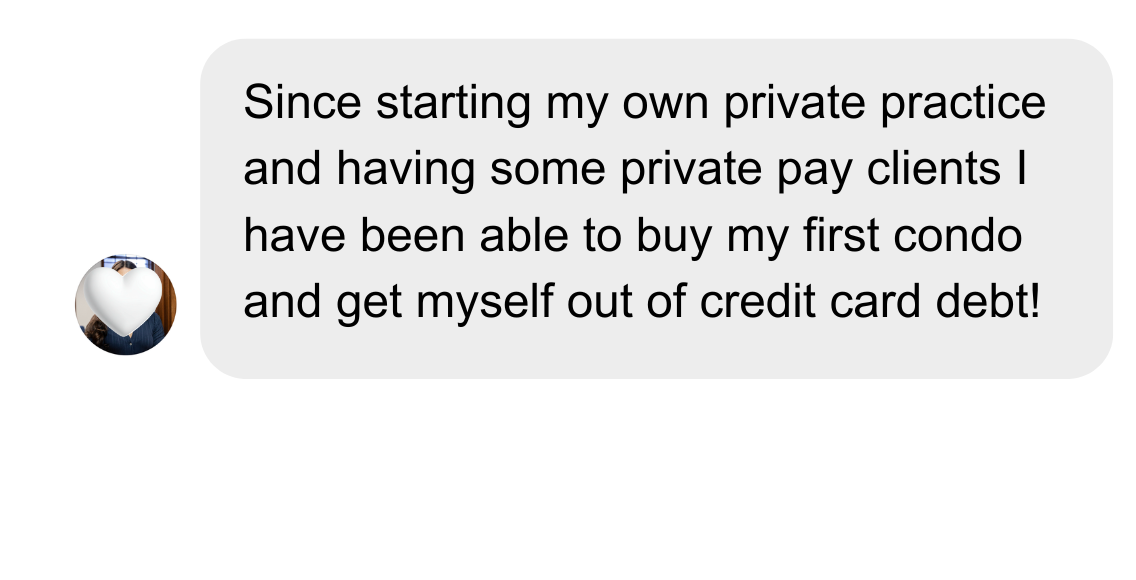
The student messages Kelly shared in her case study application are not about follower counts or viral posts. They are about what financial stability makes possible.
One student wrote: "Since starting my own private practice and having some private pay clients I have been able to buy my first condo and get myself out of credit card debt."
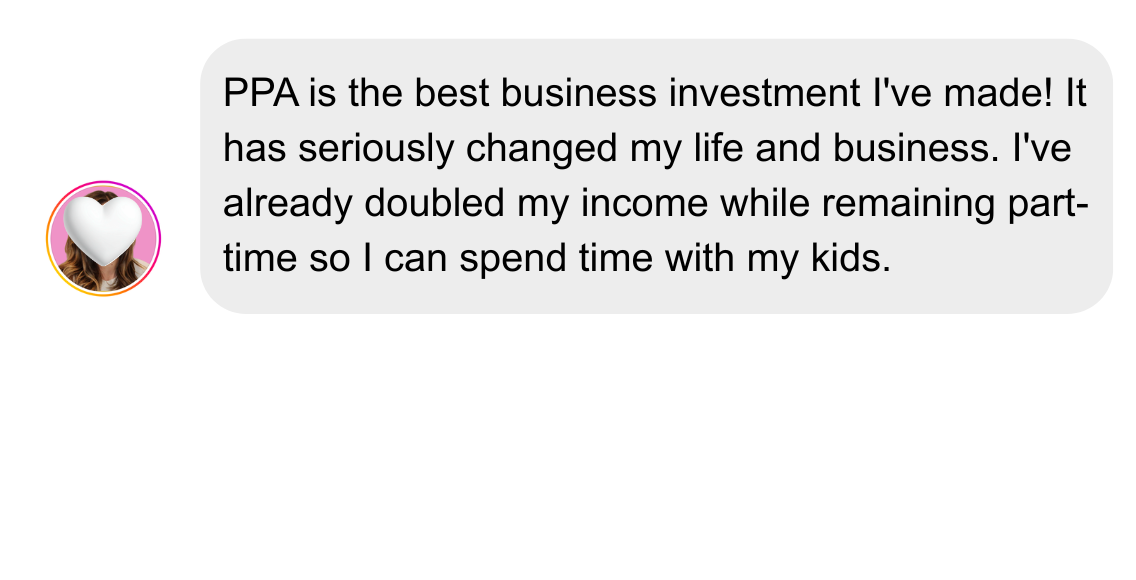
Another shared this: "PPA is the best business investment I've made. It has seriously changed my life and business. I've already doubled my income while remaining part-time so I can spend time with my kids."
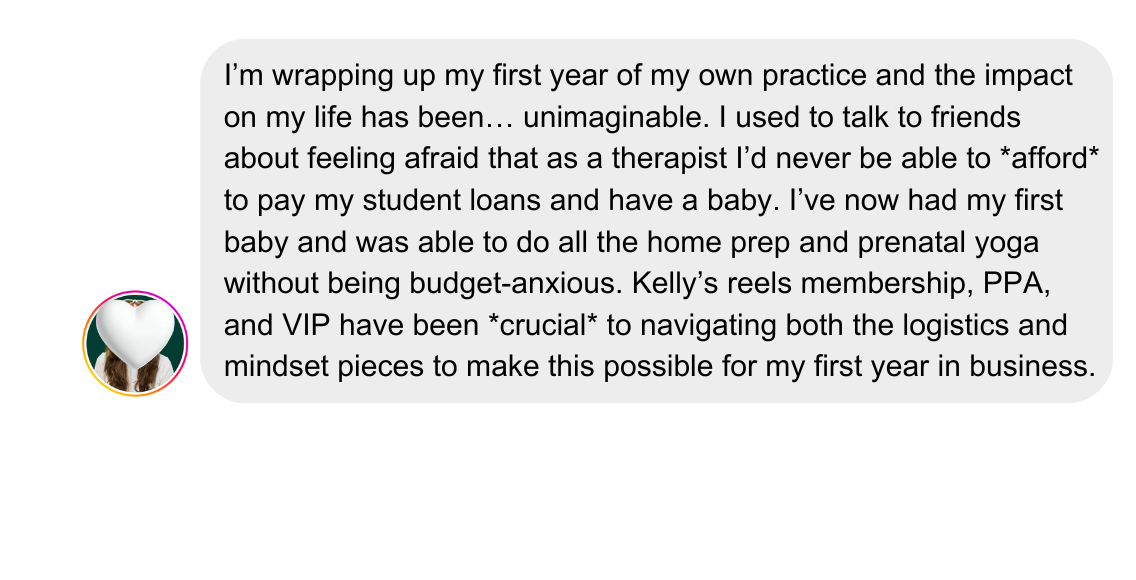
A third described finishing her first year in practice: "I used to talk to friends about feeling afraid that as a therapist I'd never be able to afford to pay my student loans and have a baby. I've now had my first baby and was able to do all the home prep and prenatal yoga without being budget-anxious. Kelly's reels membership, PPA, and VIP have been crucial to navigating both the logistics and mindset pieces to make this possible for my first year in business."
"The feedback that has meant the most to me isn't about follower growth or even revenue, it's about how therapists have been able to change their lives. When a therapist tells me they've bought their first home, paid off debt, doubled their income while working part-time, or finally felt financially secure enough to start a family, that's what stays with me." — Kelly McKenna, LCSW, MBA, Founder of Business of Therapy
Kelly lives in Miami with her husband Tom, their son Aidan, and their dog Jozi.
The Business of Therapy podcast launched in 2024 and added another channel for reaching therapists who prefer audio and longer-form content. She continues updating the Private Practice Academy Bundle on a quarterly basis at minimum, with major curriculum overhauls when the material needs it. The course is now on its second significant rebuild since the original launch.
Her stated goal is direct: every therapist deserves to make six figures. The financial sustainability she describes is not aspirational framing. It is the specific outcome she has built her entire curriculum to produce, starting from her own first year in private practice when she earned $250,000 without having built anything like this before.
Explore Kelly's work:
Visit businessoftherapy.com to access the Private Practice Academy Bundle, the Reels Membership, and Kelly's free training on marketing a therapy practice on Instagram.
Connect with Kelly:
Try Teachable yourself:
Kelly moved from one-on-one coaching calls to a course that has served over 1,000 therapists. Start your Teachable trial and build the product your audience has been asking for.
.avif)
What separates a good teacher from a great one has less to do with what they know and more to do with how they make someone else understand it. Two of Teachable's most successful educators decided to find out the hard way.
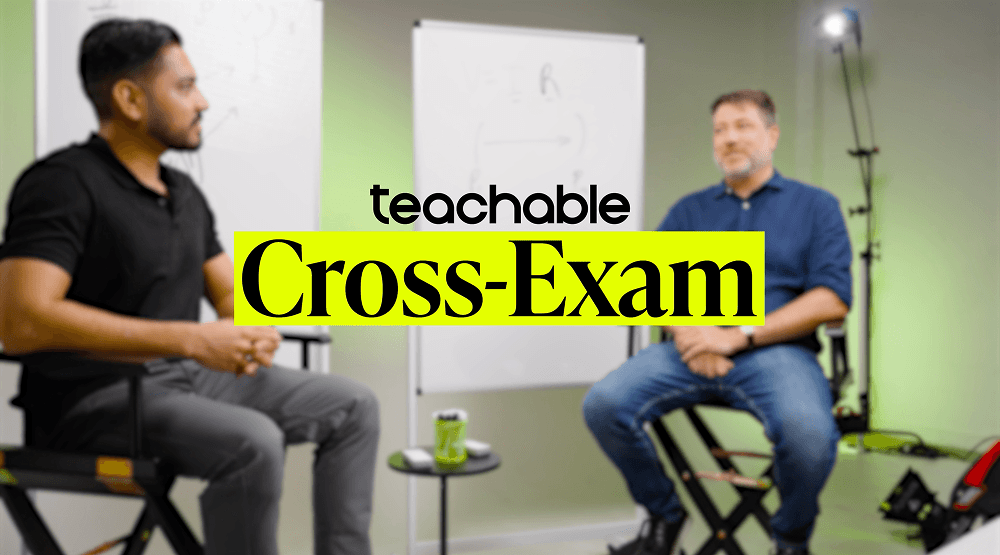
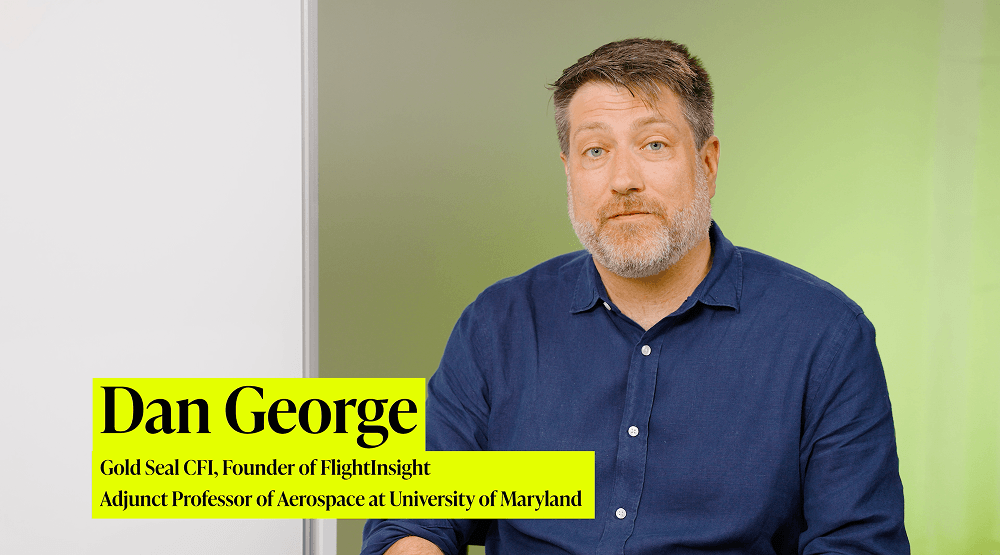
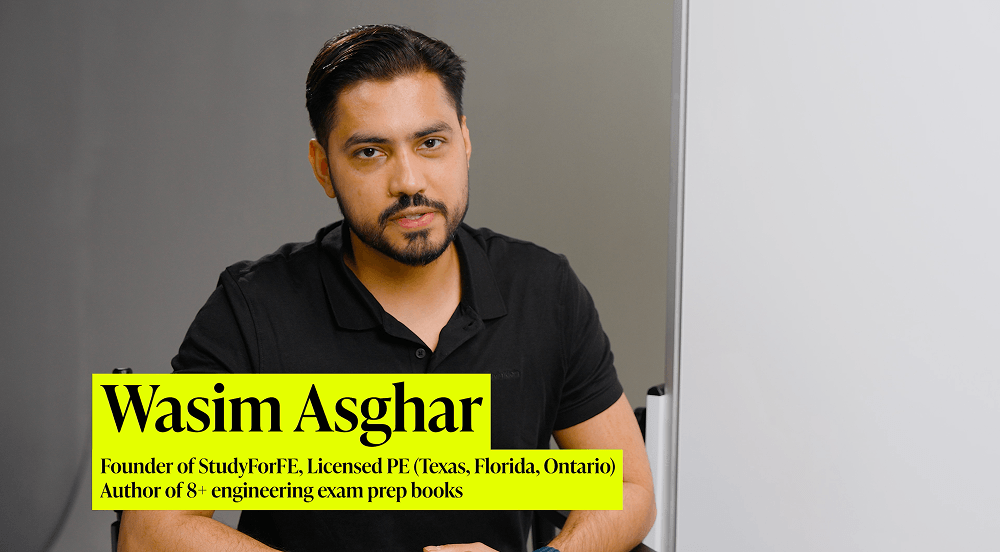
Dan George (FAA Gold Seal CFI, founder of FlightInsight, and aviation instructor to 10,000+ students across 60+ countries) and Wasim Asghar (licensed Professional Engineer in the US and Canada, founder of Study For FE, and author of 8+ engineering exam prep books) sat down across from each other and agreed to teach a foundational concept from their own field to the other. Then they had to teach it back.
The result is the debut episode of Cross-Exam, a new Teachable series where two expert educators swap roles. What the teach-back reveals about learning, retention, and the gap between knowing and explaining is worth paying attention to.
Dan opened with the lift equation: Lift = Coefficient of Lift x (1/2) x air density x velocity squared x wing surface area.
He walked through each variable, but kept coming back to velocity. Because it carries an exponent, small changes in airspeed affect lift far more than equivalent changes in any other factor.
Before getting into the equation though, Dan had to dismantle something first.
"If I slow the aircraft down, I can maintain my altitude by increasing angle of attack… I call this the Star Wars conception of how things fly. You point the ship in a certain direction and it just goes there at an angle." — Dan George, founder of FlightInsight

Naming the wrong model before replacing it is a teaching move that works better than most educators realize.
Once the flawed assumption is on the table, students will let go of it. Before it is named, they hold onto it quietly and build misunderstandings on top.
Wasim covered Ohm's Law: V = I x R, voltage equals current times resistance.
Rather than define the variables abstractly, he built the whole thing around a water pipe.
Voltage is the pressure difference between two ends. Current is the rate of flow. Resistance is whatever obstructs it.
"If there's dirt in here, if there are obstacles, rocks, pebbles, they're going to impede the flow of current." — Wasim Asghar, founder of Study For FE
From there, he went after the most persistent misconception in electrical safety: that voltage is what kills you.
It is actually current.

Roughly 40 milliamps through the body is a guaranteed fatality. A coffee maker draws about 1,000 milliamps. The lethal threshold is two to five percent of what runs through a kitchen appliance.
"It's not the voltage that is dangerous. It's really the current." — Wasim Asghar, founder of Study For FE
A bird sitting on a 1,000-volt transmission line survives because the voltage difference across its two feet is zero.
For anyone building a course on a technical subject: definitions without physical anchors give learners nothing to hold onto.
A concrete system they already understand gives the new concept traction.
Both Dan and Wasim have taught their subjects hundreds of times. What this episode showed is how both of them have rebuilt their explanations around the most common misunderstandings rather than the most logical starting points.
Dan leads with the lift equation because it forces students to confront the variables that actually matter in the cockpit. Wasim leads with the water pipe because it replaces the assumption that voltage is dangerous with the fact that current is.
A 2008 study by Kornell and Bjork found that retrieval practice, having learners reconstruct material from memory rather than passively review it, produces significantly stronger retention than re-reading alone. Cross-Exam runs that experiment in real time.
Dan described what happens when he teaches the same material over and over.
"Every time I do it, it gets a little bit different. I can always rediscover some kind of a new insight or some new way of teaching." — Dan George, founder of FlightInsight
Dan built FlightInsight into a school with over 10,000 students by publishing twice a week, every week, for four years. His full creator case study gets into how that consistency turned into a real business.
Wasim built Study For FE on the same principle. His reframe that current determines electrical danger is the kind of correction that sticks because it runs counter to what most students walk in believing.
Dan and Wasim both teach on Teachable. Between them they have built course libraries that reach students in dozens of countries, in fields where getting the material wrong carries real consequences.
Both of them became better teachers by treating their explanations as working documents rather than finished products.
Watch the full episode of Cross-Exam.
Want to know more about this episode’s guests?
Follow Dan George: YouTube | Website | Teachable School | Instagram | LinkedIn
Follow Wasim Asghar: YouTube | Website | LinkedIn
Teachable gives you courses, coaching, digital downloads, and memberships in one place. See plans and pricing.
.avif)
Jason Murray has been making YouTube videos for 16 years. For most of that time, it was a hobby.
During the day, he was an art director and creative director working at agencies like BBDO, Huge, and Amazon's Brand Innovation Lab, leading campaigns for Coca-Cola, PepsiCo, Lululemon, and Adobe. The YouTube channel ran in parallel, always in the background, always just for fun.
He went independent, launched a newsletter and brand called Modern Art Direction, and started teaching the conceptual skills that agency life had given him. Eight months after announcing the idea publicly, he had run three live bootcamp sessions, enrolled over 120 students, and raised his price from $300 per person to over $800.
"I only needed week one ready, and I had a map. I kind of already had a blueprint because from my experience, I knew they need to understand insights, they need to understand big ideas, then they need to craft their campaign. So we'll just follow that roadmap." —Jason Murray, Founder of Modern Art Direction & NEXT Art Director

The mentorship problem in advertising had been building for years before Jason decided to do something about it.
Remote work removed the informal learning that happened in offices. Junior creatives no longer watched senior art directors work. Nobody looked over shoulders at slide decks and wondered why theirs looked different. The unspoken knowledge that passed between people in the same room stopped passing.
Jason had benefited from that kind of proximity early in his career. He was, by his own admission, not a very good art director at first. What saved him was being surrounded by people who were. He noticed things. He absorbed how they worked without being formally taught.
"I was lucky to not be a very good art director, but I was surrounded by great art directors. So I could look over their shoulders. And now with remote work, people aren't getting the mentorship. That professional experience is still so valuable. So that's what I'm trying to bring to social media." —Jason Murray, Founder of Modern Art Direction & NEXT Art Director
He also noticed something happening with AI. The tools that could generate and execute creative work were multiplying fast. What they could not do was think conceptually. Identifying the human insight behind an idea, the specific revelation that reframes a problem, remained something no model had figured out. Jason had spent eight years doing exactly that for some of the largest brands in the world.
When he quit his agency job in 2024, he did not build a course library or a self-paced curriculum. He announced a live class. Four weeks, one concept per week, 90 minutes every Tuesday. Students would leave with a portfolio-ready spec campaign project. Teachable was the obvious choice: payment processing, course delivery, and enough room to grow into more complex features when he needed them.
"For me, Teachable was like the obvious choice because it was just like, okay, this is simple to start, but there's features that I can move into when I need it." —Jason Murray, Founder of Modern Art Direction & NEXT Art Director
Jason built NEXT Art Director without a course library, without a complex launch funnel, and without finishing the material before the first student enrolled. His approach was deliberate, and most of the decisions he made ran against the standard advice for online course creators.
Most course creators record their entire catalog before launching. Jason flipped this. He committed to a live class format, which meant he only needed week one ready before enrollment opened. The rest got built while students were in the class.
"How do you start a course? What platform do I go with? For me it was just like, okay, if I want to start a class. All I need is a way to accept payments and a place to put the information. That's where I can start." —Jason Murray, Founder of Modern Art Direction & NEXT Art Director
The live format solved two problems at once. It removed the pressure of finishing before launching, since students were watching and participating in real time. It also removed the anonymity that kills completion rates in self-paced courses. When 30 to 40 people show up on Zoom every Tuesday, they know each other by face. They share work in a Slack channel. They feel accountable to the group, not just to a progress bar.
By the third cohort, 60 to 80 percent of enrolled students attended live each week. One student in Australia woke up at 4 or 5 AM for the Friday office hour sessions because she did not want to miss the live element.
Take action
NEXT Art Director runs for four weeks. Four 90-minute classes. Four office hour sessions. One concept per week, with one specific assignment that drills that concept before the class moves on.
Week one covers insights. Week two covers the big idea. Week three moves into execution. Week four is polish and portfolio presentation. Students do not touch execution in week one. They do not worry about their final project in week two. Jason holds the line.
"One of the things that I changed from the January session to this session was I actually took out a huge half of the first class. I moved it to an on-demand video. So when people sign up, there's a video you can watch — it's 40 minutes long — to give you an introduction to art direction. Originally I was doing that within the first class and it just took 40 minutes out of a 90 minute class. And it's just really hard to get to the most important part, which was they need to learn this single principle: insights." —Jason Murray, Founder of Modern Art Direction & NEXT Art Director
The format forces students to slow down in ways that resist their instincts. Creatives want to start designing. They want to jump to execution. Jason does not let them. His first week assignment is straightforward: come up with 20 to 30 insights on a brand and share your five best with the group. No designs. No campaigns. Just insights.
The constraint is the point. Creatives who spend years executing other people's ideas often have no language for the conceptual layer of the work. Week one gives them that language, and for many of them it is the first time they have heard an explanation that actually explains something.
Take action
Jason started his first cohort at $300 per person. The price reflected what he felt was fair for an unproven program. He was asking students to trust him before he had any track record as an educator.
After the first session delivered, he raised the price to $800 for the January cohort. Enrollment came in at 42 students. For the March cohort, he raised it again and capped enrollment deliberately.
"I want to keep the class small and make sure everyone's super invested, but we still had 35 students for that class. I want it to be at a price point that I feel like is an investment that I'm hopefully gonna get serious students, and it keeps the class small. And that's why it's also worth the price." —Jason Murray, Founder of Modern Art Direction & NEXT Art Director
The logic connects in both directions. A higher price means students arrive with more skin in the game. They show up to class. They do their homework. They are not passive observers hoping something will stick. A smaller class means Jason can give real feedback on real work, which is exactly what draws students who cannot get that quality of critique anywhere else.
He also noticed the enrollment pattern. In the March cohort, 25 of the 35 students signed up in the final weekend before the deadline. Urgency, not early-bird discounts, drove the last push. He now announces a short enrollment window and closes it.
Take action
Jason did not run paid ads for his first three cohorts. His launch strategy was almost entirely social.
He had been building a following for 16 years, first through YouTube and then more recently through Instagram, where his content about art direction and creative careers had grown an audience of over 160,000 followers. He used that audience through stories, a broadcast channel, and the newsletter, communicating about the bootcamp in the places where his most engaged followers spent time.
"The strategy really is there's only a small window to enroll. I let people know that next month the enrollments will open on X date, and there'll be only three weeks to enroll. And during that time window, I usually release a couple videos that just kind of spark people. Those will always be automated DMs that point people to the landing page." —Jason Murray, Founder of Modern Art Direction & NEXT Art Director
Creatives researching how to become art directors do not buy because of an ad. They buy because they have followed someone for months, watched their work, and already trust their teaching. Ads cannot replicate that. The social content builds it continuously.
Take action
Jason launched his first cohort while under contract for a two-month freelance project. He was simultaneously running 40-hour client weeks and building a curriculum from scratch. He did not sleep much.
What made it work was the same thing that makes the bootcamp work for students: a public commitment with real consequences for missing it.
"I only needed week one ready. The live aspect made it so I could just focus on week one and then I was committed. It's like we've got everyone signed up. I better get week two ready. And so the first session was just a really heavy month for me. But knowing it was live, I didn't have to deliver the whole thing in week one." —Jason Murray, Founder of Modern Art Direction & NEXT Art Director
By the second cohort, the heavy lifting was done. By the third, he was focused almost entirely on being a better teacher rather than building materials. The upfront investment, made under real pressure, produced an asset that kept improving with each session.
Take action
Jason's teaching is built around one observation: most creatives who struggle with conceptual work do not lack intelligence. They lack vocabulary.
The advertising industry has specific language for specific ideas. An insight is not just an observation. A big idea is not just a concept. These words mean precise things in the rooms where campaigns get approved, and people who have never worked in those rooms do not know the definitions. They do great execution work and cannot articulate why it works or what it is trying to do.
"A lot of young creatives entering the industry — they don't know what they don't know. I can help ungate keep some of the vocabulary that advertisers like to hold onto. Because for a lot of young creatives, it's just little things that they just don't know." —Jason Murray, Founder of Modern Art Direction & NEXT Art Director
He also has a clear position on where AI fits in the creative process, and where it does not. For generating mockups and visualizing early concepts, AI tools are useful. For finding actual insights — the human truths that reframe how you see a problem — he tells students to put AI away.
"In the insights territory, I usually recommend don't use any AI for that aspect because it's just so bad at finding an insight, an actual revelation that changes the way you see the world. It's usually obvious stuff. That's what you would gather if you're a machine learning model that's consuming stuff that's already been done." —Jason Murray, Founder of Modern Art Direction & NEXT Art Director
This position shapes what NEXT Art Director is selling. The course does not teach students to make things. It teaches them to think upstream from the making, in the part of the creative process where AI is least helpful and human judgment is most valuable.
By the end of NEXT Art Director, students have a portfolio-ready spec campaign project. For some of them, it is the only piece they need to reposition themselves as an art director.
Jason got a message shortly before the podcast recording from a student who had just landed a job at a social agency in London. The course content had been the deciding factor in the transition.
"Just last week got a message from one of my students who was just like, man, I just got a new job, and just wanted to thank me because of the class. He got a new job at a social agency in London." —Jason Murray, Founder of Modern Art Direction & NEXT Art Director
Student reviews from the published course page describe similar shifts. One student pivoted her career entirely after the first cohort. Another, a UI/UX designer with no advertising background, found that the art direction principles transferred directly into how she positioned her app in the App Store. A product line manager with no art direction experience finished with a complete portfolio project.
The pattern across the reviews is consistent. Students arrived knowing how to make things and left knowing how to think about what they were making. That shift opened doors that pure technical skill had not.
Jason runs NEXT Art Director once a month with a one-month break between sessions. The cadence is deliberate and personal. He has a family, a second child on the way at the time of the interview, and a creator business that includes brand deals alongside the education work.
The 30-day format works for his schedule because it also works for his students. Creatives who work full-time cannot commit to a six-month program. They can commit to one focused month. The deadline lights a fire that longer programs rarely sustain.
"I like being done with it for a month and then taking a one month break to focus on how can I make it better, how can I promote it. But also I find creatives thrive with deadlines and with a little bit of pressure." —Jason Murray, Founder of Modern Art Direction & NEXT Art Director
The near-term plan is to add a self-paced on-demand course alongside the live bootcamp, creating a more accessible entry point for students who cannot afford the flagship program or whose time zones make live attendance impractical. Guest speakers will continue to be a paid part of each session.
The longer arc points toward something he calls the School of Modern Art Direction, with the acronym MAD, which he notes with some satisfaction is exactly what the work requires.
Explore NEXT Art Director:
Visit modernartdirection.com to join the waitlist for the next NEXT Art Director cohort. The bootcamp opens enrollment for a short window every month. Follow @jasonmurray across Instagram and YouTube for weekly content on art direction, creative careers, and building a creator business.
Connect with Jason on Instagram / YouTube / TikTok: @jason_swet
Try Teachable today:
Jason built his first cohort while juggling a full client contract and running on less sleep than he recommends. Teachable handled payments, enrollment, and course delivery so he could focus on being in the room with his students. Start your free Teachable now.
%2520(1).jpeg)
Two of the sharpest voices in the creator economy walk into a room with a stack of questions they have never seen before. One gets 60 seconds to answer. The other has to decide: agree or challenge.
That is the premise behind Trade Secrets, a new Teachable video series pairing industry experts for rapid-fire, unscripted conversations about what it actually takes to build a business around what you know.
In this debut episode, Lia Haberman (creator economy expert, UCLA Extension instructor, and author of the ICYMI newsletter for 45,000+ subscribers) sits across from Jayde Powell (founder of The Em Dash Co., LinkedIn creator, and host of #CreatorTeaTalk). The result is an honest, funny, occasionally combative exchange about pricing, product launches, upselling, mental health, and the corporate-to-creator pipeline.
Here are the biggest moments from their conversation, and the takeaways you can put to work today.
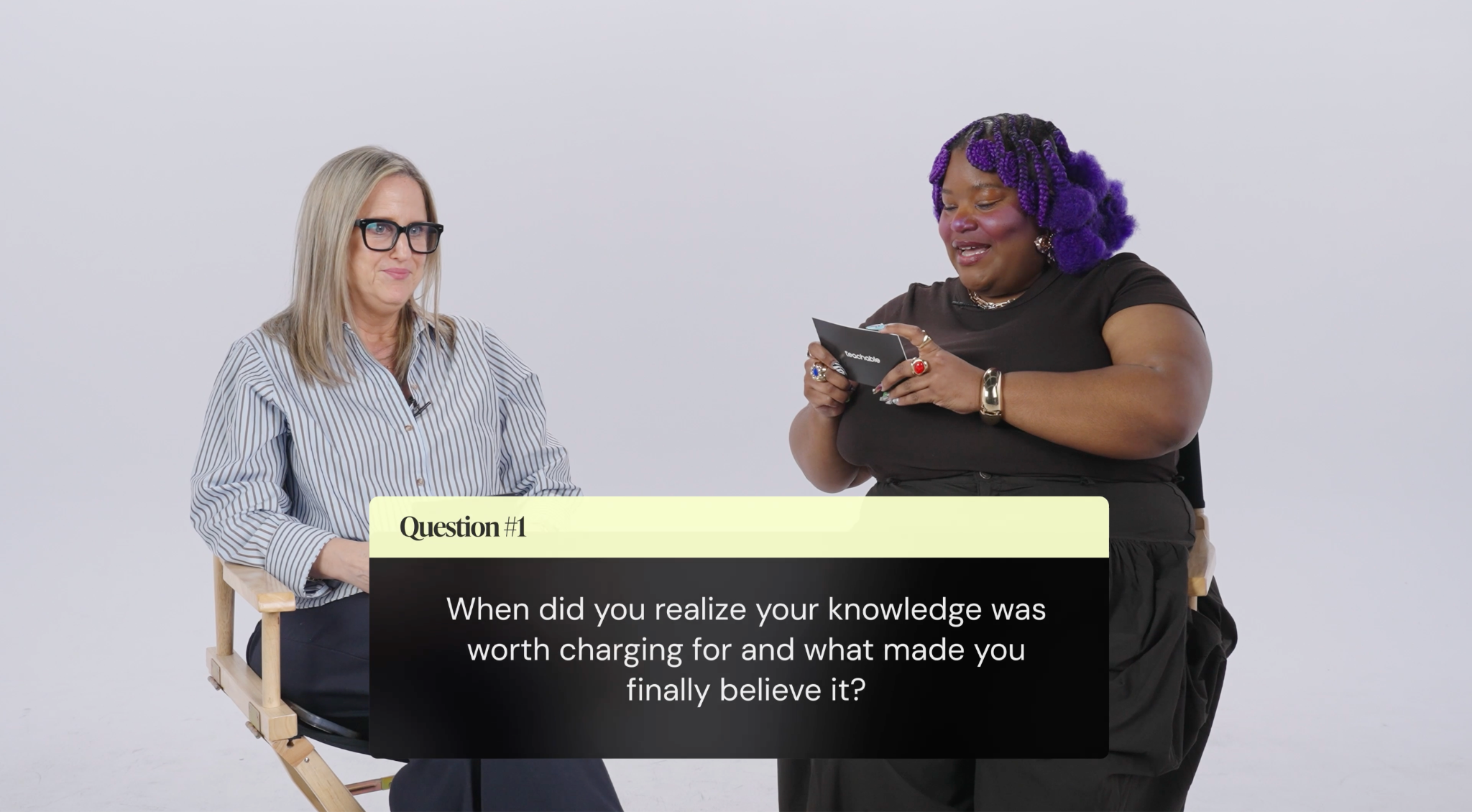
Lia opened with a confession that most educators will recognize. Years spent in higher ed conditioned her to give knowledge away for free, and the habit stuck.
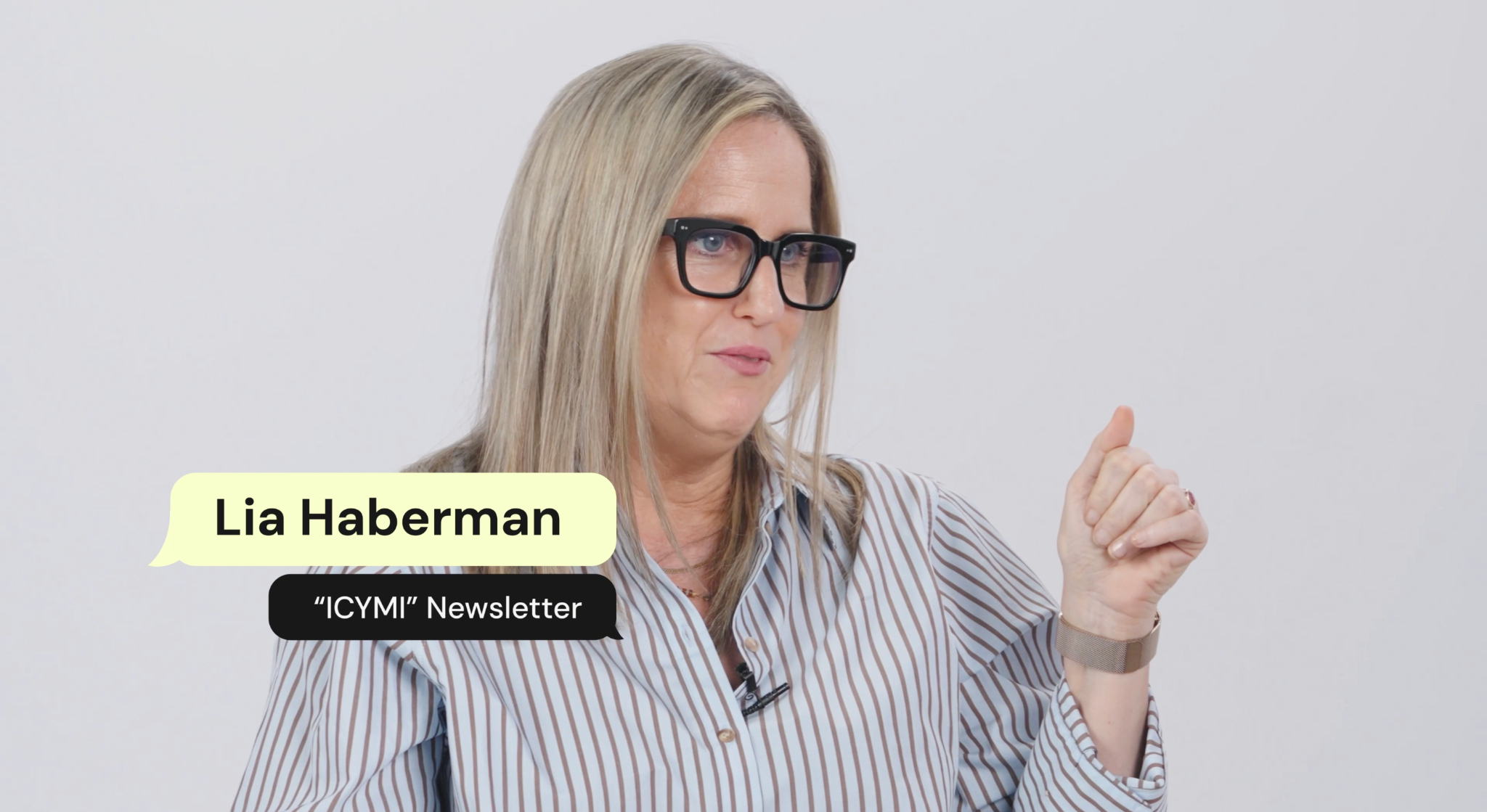
"I teach students in higher ed. I like to give my knowledge away for free. I, however, realized that this is not a good business model." — Lia Haberman, Social + Influencer Marketing Consultant
She credited female entrepreneurs, including Jayde and Rachel Carson, for shifting her perspective. The realization came through observation: watching peers charge confidently for the same type of expertise she had been handing out at no cost.
"I think it's just the way that I came about it into this industry. It's teaching students and like mentoring young people. I think that like, it puts you in a mindset of actually not charging and just being like, yes, I want to help you, want to uplift you." — Lia Haberman, Social + Influencer Marketing Consultant
Jayde pushed back on the "give it away" mentality, drawing a clear line between free content as a lead magnet and free content as a long-term business model.
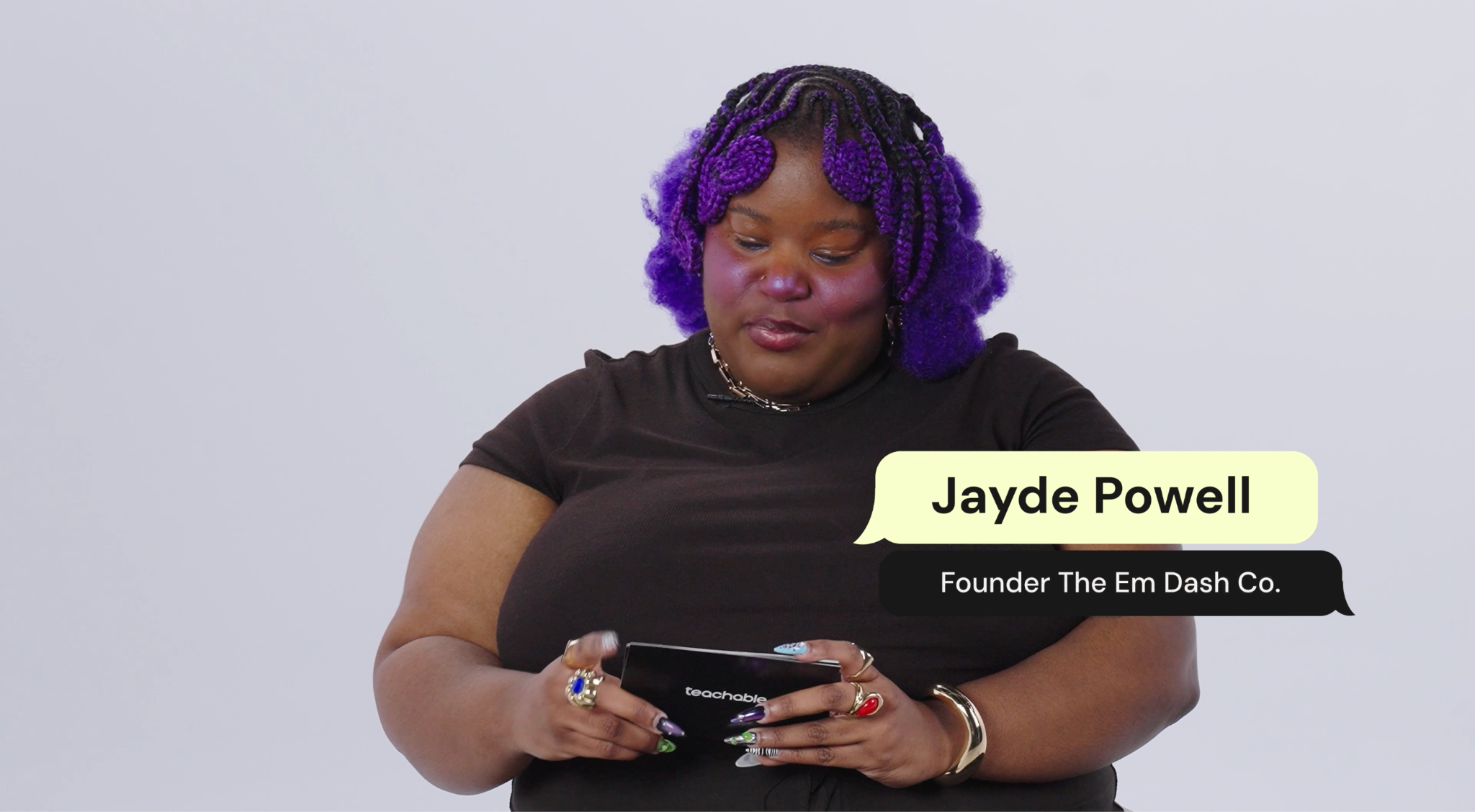
"In a certain circumstances, if it's a lead magnet. Absolutely. Yeah. But when long term, you should definitely be charging for what you now." — Jayde I. Powell, Founder & Head of Creative, The Em Dash Co.
That tension (free vs. paid) sits at the center of the creator economy right now. Goldman Sachs Research projects the creator economy will nearly double from $250 billion in 2024 to roughly $480 billion by 2027 (source). The money is there. But plenty of experts still struggle with the mental shift from "helping" to "selling," especially those with backgrounds in education or mentorship.
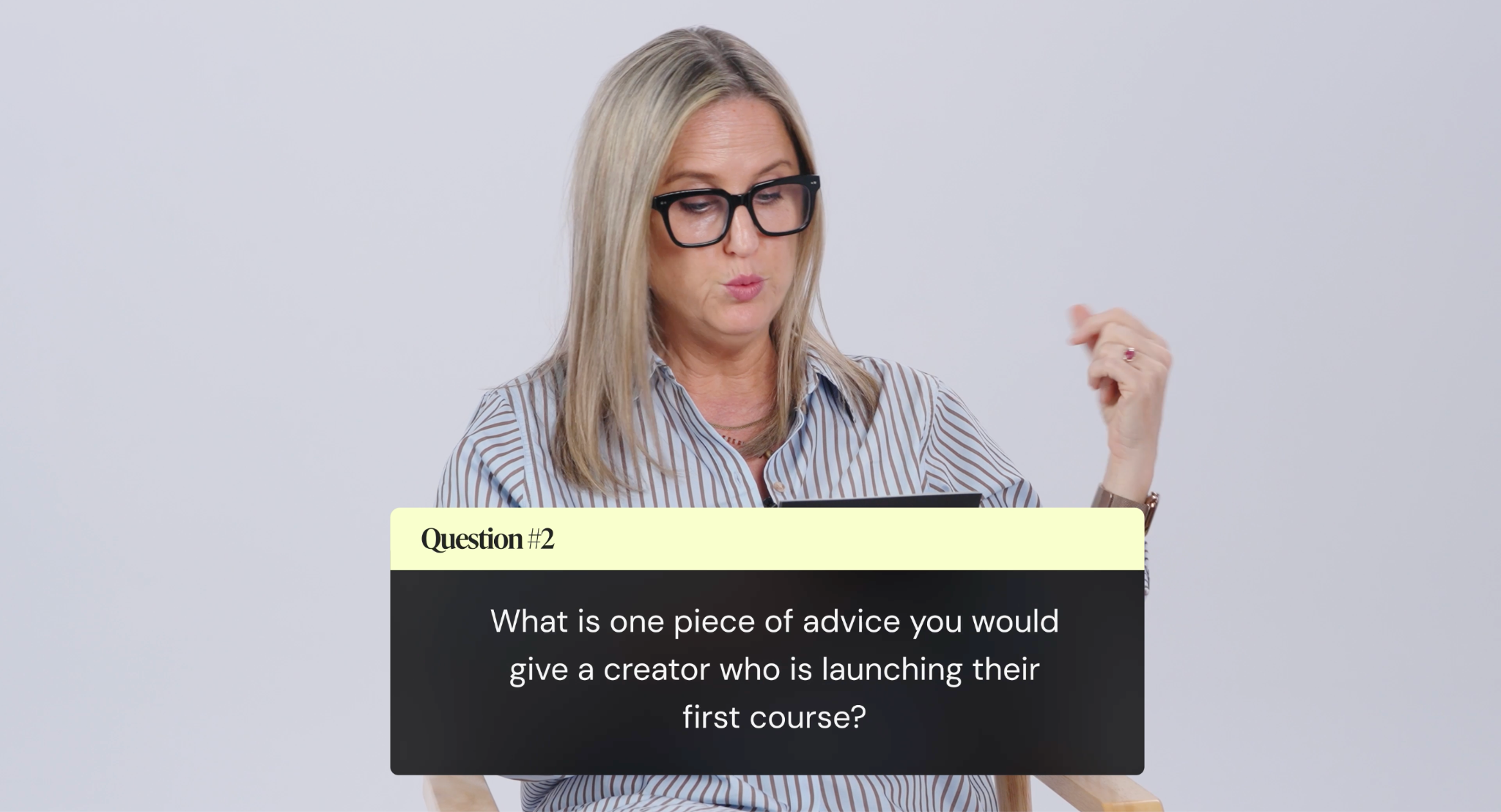
When Lia asked for one piece of advice for a first-time course launcher, Jayde had a clear answer: stop waiting for perfection.
"I would say just do it fast and don't feel like you have to do it perfect the first time around, because you'll learn a lot about your customers and your students and like what they want from you over time." — Jayde I. Powell, Founder & Head of Creative, The Em Dash Co.
She backed it up with her own experience, noting that she launched courses in 2024, gathered learnings, and is now relaunching with major improvements.
"I launched my courses last year. Got a lot of learnings from it. And now I'm relaunching them because I've learned more. I know how I want to, like, refine things. I know how I want to set up my courses." — Jayde I. Powell, Founder & Head of Creative, The Em Dash Co.
Lia agreed completely and drew a parallel to her own newsletter launch.
"It was the same thing when I launched my newsletter. The one was like kind of a hot mess, but like it got better over time." — Lia Haberman, Social + Influencer Marketing Consultant

This tracks with what successful Teachable creators repeat over and over. Antoine van der Lee, a developer who made $40,000 on his first Teachable course launch, has talked about treating his content as a "personal knowledge base" he chose to make public, rather than something that needed to be polished before anyone could see it. The pattern is consistent: ship version one, gather real feedback, and build version two around what your actual audience tells you they need.
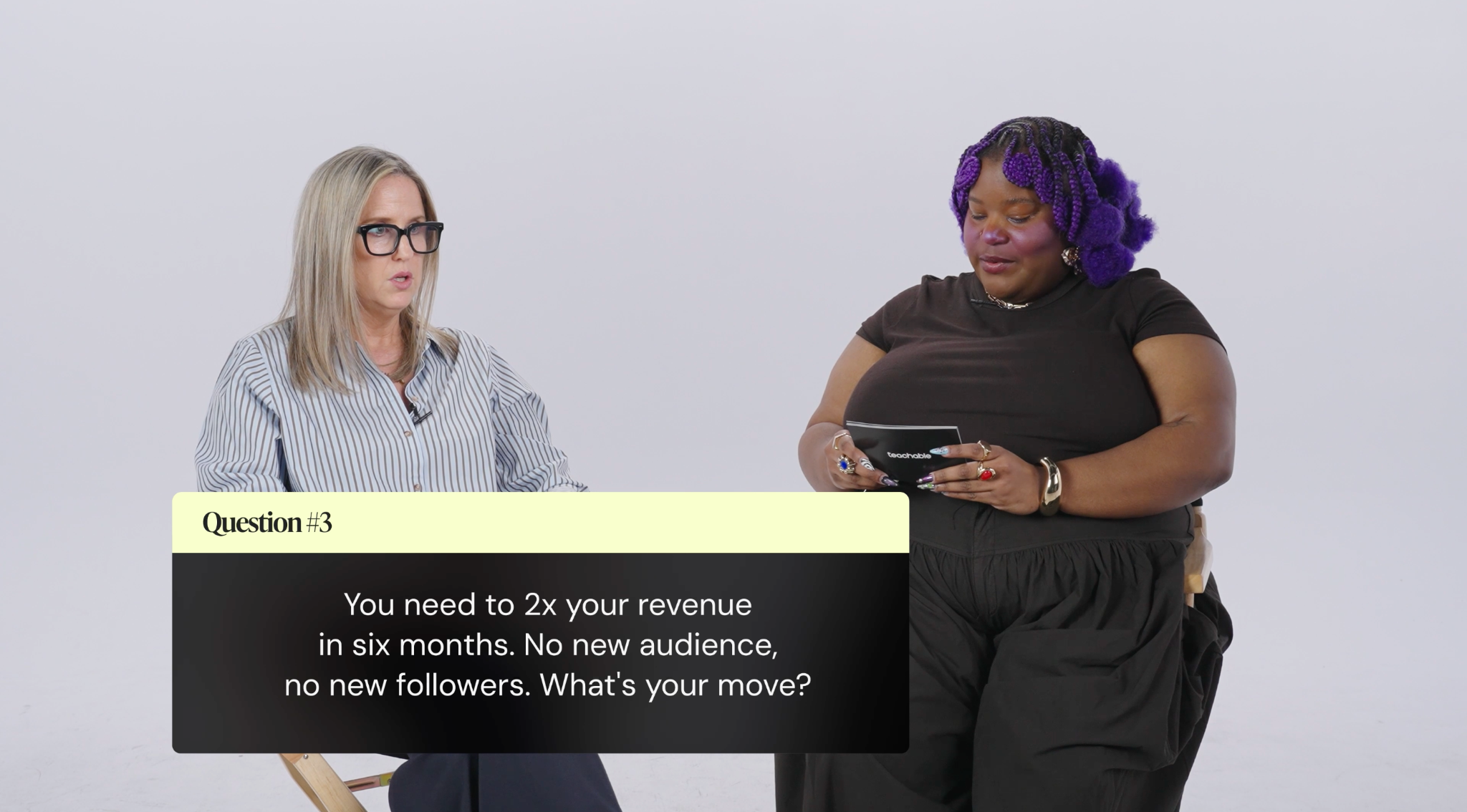
One of the most tactical questions in the episode asked both creators to 2x their revenue in six months with no new audience and no new followers. Lia went straight to the upsell.
"Much easier to like. Keep your retain your existing audience and charge them more. Develop maybe like for variations of your product. Like maybe it's like live mentoring or something like that. So you're like, whatever I'm selling, I'm now doing like bonus add ons for the people who already love and believe in me." — Lia Haberman, Social + Influencer Marketing Consultant
Jayde confirmed this from her own consulting work, where she uses a similar approach when crafting proposals for brand partners.
"Every time I craft like a proposal for any of my clients or my brand partners, like I'm always like, and for this additional fee, you can get this. And then always like they usually select it." — Jayde I. Powell, Founder & Head of Creative, The Em Dash Co.
For Teachable creators, this is where tools like one-click upsells and digital product bundles become serious revenue drivers. Your current students already trust you. Offering them a coaching add-on, a bonus workshop, or a bundled downloadable resource turns a single transaction into a deeper (and higher-value) relationship.

The conversation took a personal turn when Lia asked what Jayde had to unlearn from corporate life. Jayde pointed to her belief that hard work alone would open every door.
"I went in with this mindset that if I work really hard, it will like get me all the opportunities I desire. And I actually realize that wasn't the case. You have to work strategically, which means sometimes you do have to do a little bit of the politicking shaking the hand, making sure the right people know you."— Jayde I. Powell, Founder & Head of Creative, The Em Dash Co.
Lia offered a rare challenge moment, suggesting that Jayde could have deployed those same skills inside a corporate structure. She referenced the concept of the "intrapreneur," someone who operates with entrepreneurial instincts inside a larger organization.
But both agreed on a bigger point: the corporate-to-creator pipeline produces stronger businesses.
"The corporate to creator pipeline makes for better creators. They're more professional. You get deadline had more business acumen." — Lia Haberman, Social + Influencer Marketing Consultant
Jayde confirmed this from her own experience, crediting her corporate career with many of the operational skills she brings to The Em Dash Co. today. For anyone currently sitting in an office wondering whether their 9-to-5 experience has value in the creator world, this exchange offered a definitive yes. The processes, systems thinking, and professional habits you build in a corporate environment carry directly into running a creator business.
Lia and Jayde covered far more ground in the full Trade Secrets episode than we could fit here, from platform preferences (they both love Threads and LinkedIn) to brand alignment (Lia once turned down a two-factor authentication sponsorship because "nobody wants to read about that from me"). Every exchange reveals something practical about how two very different creator paths arrive at similar conclusions.
Teachable gives you courses, coaching, digital downloads, and one-click upsells in one platform. See plans and pricing.
.avif)
You have the expertise. You have the content. You might even have a following that keeps asking when your course is coming out. And yet, sales stay flat after launch.
In the latest episode of Expert Exchange, Teachable’s Dani (Product Marketing) and Yas (Customer Success) play a rapid-fire game of red flags and green flags to identify the patterns that separate course creators who sell from those who stall.
The conversation covers pricing, cross-posting, pre-selling, order bumps, and one deceptively simple mindset shift that keeps too many experts stuck in build mode.
Below, we break down every takeaway from the video so you can spot the mistakes in your own launch plan and fix them before they cost you revenue.
The first mistake Dani and Yas call out is one most course creators overlook entirely: positioning. Great content with a weak sales page loses to average content with a clear, specific offer. Yas has seen this pattern across thousands of customer conversations.
"That can come in having a clear CTA on your social networks, on your Instagram, on your YouTube, and of course a good sales page, so that people can completely understand what's on the product, what they're getting, the type of value that you'll be adding to them." –Yasmim Puppin, Customer Success Lead, Teachable
The creators who convert are the ones with a visible call to action on every social channel, a sales page that spells out exactly what students get, and language that focuses on the outcome rather than the curriculum.
That last part matters more than it seems. Listing your module titles tells a prospective student what they will watch. Telling them what they will be able to do after finishing the course gives them a reason to buy.
If your sales page reads like a table of contents, rewrite it around the specific results students walk away with. Teachable’s getting started guide walks through how to set up a high-converting sales page in under 15 minutes using the drag-and-drop editor.
Both Dani and Yas flagged this as a major red flag: posting identical content across every social platform at the same time. Each platform has its own audience, its own algorithm, and its own content format. A long-form caption that works on Instagram falls flat as a tweet. A polished LinkedIn post feels out of place on TikTok.
.png)
More importantly, the people who follow you on different platforms are often different people, or at least the same people in different mindsets. What Yas recommends instead: pick the platform where you are already seeing traction. Double down there. Create content native to that platform before expanding to others. The creators who try to be everywhere at once end up gaining traction nowhere, because copy-pasted content signals low effort to algorithms and audiences alike.
When Dani asked whether pricing a first course under $50 was a red flag or a green flag, both agreed: green flag, without hesitation. A low-priced introductory product serves a different purpose than your main offer. It brings new students into your world. It builds trust. And it creates a natural entry point for a broader product suite that guides students from one purchase to the next.
"I just love a lead magnet strategy. So for me, if you have, for example, a downloadable that costs $50, that's great to get new students that later are going to buy other products from your portfolio." –Yasmim Puppin, Customer Success Lead, Teachable
This is the thinking behind what Yas calls a product portfolio. Rather than treating every course as a standalone transaction, you structure your catalog so each product leads to the next. A $37 downloadable guide leads to a $197 mini-course.
.jpg)
That mini-course leads to a $497 advanced program. At the top of the stack, you offer coaching or a mentorship for students who want direct access. Teachable’s guide to making money selling courses breaks down how to build this kind of stacked product model from the ground up.
"I feel like sometimes people wait until they have like a very complete product with hundreds of classes, something that really adds value to people, but ultimately sometimes people just want like that quick win." –Daniela Bianchin, Product Marketing Manager, Teachable
This was the greenest flag of the conversation. Selling before you finish building your course is not a shortcut. It is a strategy. When students pay before the content exists, you get two things that a finished product alone cannot provide: real revenue to fund the creation process, and real feedback to shape the content toward what paying students actually need.
Yas pointed out that pre-selling works even if you have zero recorded lessons. A live cohort model lets you teach in real time, adjust based on student questions, and record the sessions as your course content.
"You don't even need to have recorded content at all. You can do a live cohort as long as it's aligned. Of course, they'll buy it from you because ultimately they want your expertise. They want to hear from you." –Yasmim Puppin, Customer Success Lead, Teachable
The students who buy early are trusting your expertise, not a polished production. You can always refine the recordings later. Teachable’s pre-selling guide includes examples of creators who generated up to $45,000 in pre-sales using this approach.
Both Dani and Yas called the absence of an order bump a major red flag. An order bump is a low-priced, complementary product offered at checkout that increases your average order value without requiring a separate marketing campaign.
Think of it as the grocery store checkout aisle: the student is already buying, and you are offering something small and relevant right at the moment of decision.
The key is that your products need to make sense in sequence. A yoga course paired with a meditation PDF at checkout is a natural fit. A photography course paired with a lighting presets download makes intuitive sense.

"You need to have a portfolio of products and your products, they need to make sense in a sequence. If you have your product suite in a way that's structured, in a way that people will keep reaching out to the next step, this even helps with engagement and retention." –Yasmim Puppin, Customer Success Lead, Teachable
Yas stressed that this structure also helps retention, because students who see a clear next step after finishing one product are more likely to come back and buy again. Learn how to price and position an order bump in Teachable’s order bump pricing guide.
Both experts agreed: skipping free preview content is a red flag. Offering a free preview works like a trial. Prospective students get a taste of your teaching style, your content quality, and the specific results you help people achieve. That small window of free access reduces the risk for the buyer and gives them confidence that their money will be well spent.
Research backs this up. A Harvard Business Review analysis found that online courses with coaching and community support reach completion rates above 70%, while self-paced programs without that structure average between 10% and 15% (source).
The takeaway: the more you can show students what the experience feels like before they commit, the more likely they are to finish once they do. Free previews are one of the simplest ways to demonstrate that experience upfront.
Teachable lets you set specific lessons as free previews directly from your course editor, and you can manage payment options through teachable:pay to offer subscriptions, installments, and Buy Now, Pay Later alongside your preview content.
The "would you rather" segment of the video made this point cleanly. When Dani asked whether they would prefer 100 followers who trust them or 10,000 who scroll past their content, both chose the smaller, engaged audience without a second thought. Quality over quantity is easy advice to repeat. What makes it useful here is the specific way it connects to revenue.
A small audience that trusts you will buy at a higher rate, leave reviews, refer others, and buy your next product when it launches. A large audience that barely recognizes your name will bounce off your sales page and cost you more in ad spend to re-engage. The creators who build sustainable businesses are the ones who invest in depth of relationship with a smaller group rather than chasing reach metrics that look impressive in a screenshot but never convert to sales.
The final takeaway from the video is the one that ties everything else together. When Dani asked whether they would rather launch now with something imperfect or wait six months for a polished product, both chose launching messy. Every single time.
Just start putting something out there so you can test, you can get a feeling of what people are thinking about that and you can keep improving from there." –Daniela Bianchin, Product Marketing Manager, Teachable
The reasoning is practical, not just motivational. Every month you spend perfecting a product that no one has seen yet is a month without revenue, without student feedback, and without data on what your audience actually needs.

Yas made the point that Teachable’s AI tools now let you create course outlines, quizzes, and supplementary materials in a fraction of the time it used to take. The barrier to getting something live has dropped significantly. The creators who overthink the details before launching are the ones who waste months of expertise and momentum on polishing something nobody has asked for yet.
"I feel like so many people waste great knowledge and content because they overthink all of the little details. Trust your following. Trust your expertise. Just make sure that you put your knowledge out there." –Yasmim Puppin, Customer Success Lead, Teachable
The full Expert Exchange episode covers each of these mistakes in detail, with specific examples and a rapid-fire game format that makes the advice easy to follow. Watch the full episode of Expert Exchange on YouTube, and if you are ready to put these ideas into practice, start building your first product on Teachable today
.jpeg)
At Teachable, our motto is simple: if you've lived it, teach it.
But what happens when human experience goes up against an algorithm? Can real-world intuition produce a better business plan than the most advanced AI models available right now?
We decided to find out.
We gave Lia Haberman (Social + Influencer Marketing Consultant) and Jayde I. Powell (Founder & Head of Creative, The Em Dash Co.) three minutes, a whiteboard, and a business prompt they had never seen before. At the same time, three of the most advanced AI models on the market received the exact same prompt.
Then we handed all four blueprints, stripped of any labels, to Anjali Viramgama and Sundas Khalid, two of the internet's most-watched tech influencers, and asked them a single question: which plan would you actually follow?
Nobody told them which entries came from humans and which came from machines.
This is Mental Objects.
The scenario was built to mirror someone right at the edge of a creator business. You are a corporate professional with five years of experience in big tech. You have around 5,000 LinkedIn followers. You have never sold anything online. You want to launch a business in the next six months and can only commit 10 hours a week. Build a plan to generate your first $10,000 in sales.

Lia and Jayde had three minutes each to work alone, then joined forces on a single whiteboard. The AI models produced their entries independently.
Four blueprints. One judge panel. Zero context about who wrote what.
Lia Haberman approached the challenge the way a strategist would. She started by mapping the product, the audience, and the revenue model before anything else, then asked the question most people skip: what am I actually selling, and to whom?
"What is the product I'm selling? Who's the audience I'm selling it to? And what is the business model?" — Lia Haberman, Social + Influencer Marketing Consultant
Jayde I. Powell went in a different direction. No funnels, no complex models. Just a clear product, a clear price, and a direct path between creator and buyer.
"This is my vision for a digital product. It starts with my brain, and then I'm going to share that product with a price point to my audience, and then when they buy it, it puts more money into my bed." — Jayde I. Powell, Founder & Head of Creative, The Em Dash Co.
When they compared notes after the solo round, something interesting happened. Two different thinkers, two different instincts, one shared conclusion about where the real opportunity was.

Anjali and Sundas were not evaluating polish or presentation. They were evaluating one thing: would you actually stake six months of your life on this plan?
The AI entries were not weak. They were well-reasoned, followed clear playbooks, and covered the obvious bases. Some of them would probably work.
But as Anjali and Sundas worked through each entry, one blueprint started pulling ahead for a reason that had nothing to do with how it sounded on paper.
What separated the strongest plan from the field was not the size of the idea or the confidence of the execution. It was something more fundamental: the understanding that failing fast is a feature, not a flaw.
Which brings us to the result.
The winning plan, which both judges picked without hesitation, was the one Jayde and Lia built together.
"You are trying two different paths. Compared to the rest of them, they are going all in on one thing. So if you are going to fail, it is going to take you six months to fail. Whereas this plan lets you fail fast, get feedback, and iterate on it." — Anjali Viramgama, content creator and judge
When both judges were asked to name the author of their winning choice, they pointed to the same one. They also correctly guessed which entries came from AI.

Jayde and Lia’s plan worked differently from the AI entries. Instead of choosing between audience monetization and sponsorship revenue, it built for both from the start.
The first path targeted their existing LinkedIn community with a digital product built around a problem already showing up in the comments. The second path positioned brand partnerships as content collaborations, giving sponsors a reason to say yes without requiring a massive following.
The judges pointed to two specific advantages that set the plan apart.

Running two parallel tracks in the early weeks means faster feedback than betting six months on a single product launch. If the digital product gets no traction, the partnership track is still in play. The AI blueprints all asked the creator to go all-in on one direction before they had any signal from the market.
Building a product around what the audience was already asking in the comments was not something the AI blueprints surfaced. It reflects an understanding of how online communities actually behave, the kind of knowledge that comes from time spent inside them. According to the LinkedIn Learning 2024 Workplace Learning Report, 90 percent of organizations are concerned about employee retention, and professional development is now one of the top incentives workers look for when evaluating opportunities.
That same dynamic plays out in creator audiences: the creators who build lasting businesses are the ones who solve specific, real problems for their community, not the ones who follow the cleanest playbook.
The AI entries were not bad. They were clean, well-reasoned, and followed recognizable playbooks. Given the right person and the right execution, some of them would work.
The human entry was better for a different reason. It was designed for the reality of what it is like to be early. Most first-time creators will not nail the product on the first try. Putting two revenue paths in motion early gives you more surface area to learn from, and more chances to find out quickly what is actually working.
A few things worth carrying out of this:
If you are ready to build your first digital product, here is how to get it from idea to sale. If you are still working out your direction, start with finding your niche.
Teachable is the platform for creators who have something real to teach. Start your free trial and see what you can build with the experience you already have.
Watch the full Mental Objects episode on YouTube, or explore how Teachable creators build and sell digital products.